
Will books make a comeback like vinyl?
The digital divide used to be social. It is changing now: the digital divide will become a cognitive divide.

The surprising resilience of the book
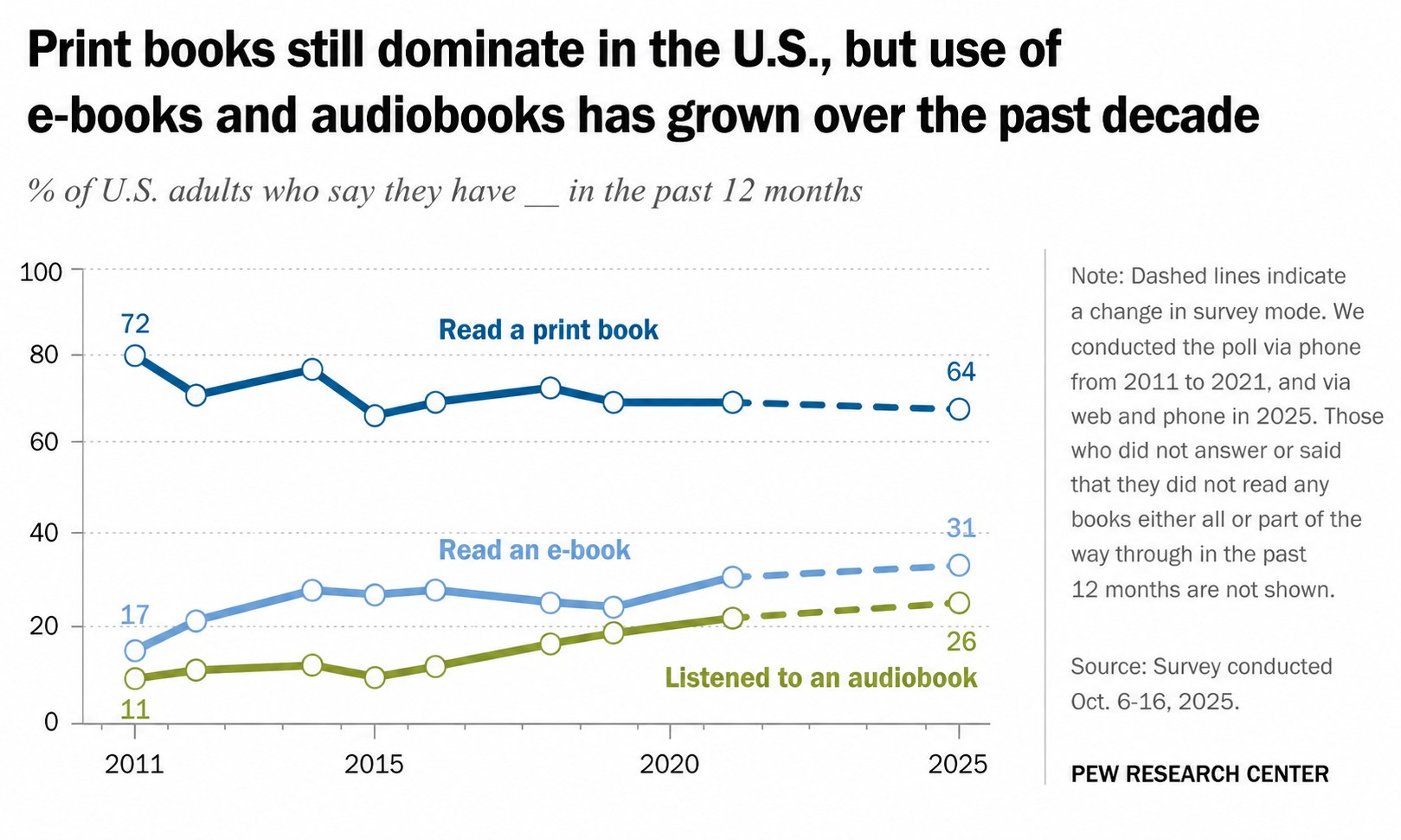
The data show that print books remain surprisingly resilient. Despite the incredible growth of reels and video consumption, despite the galloping digitalization, the number of people who say they still read print books remains relatively stable. Or, one could say, the decline has not been as dramatic as might have been expected: from 72% in 2011 to 64% in 2026, as a recent Pew Research study revealed.
Maybe people will stick with books? Maybe, burned out on digital life and exhausted by screens and newsfeeds, they’ll drift back to the long, deep, slow reading that only books can offer? Maybe books will even stage a comeback?
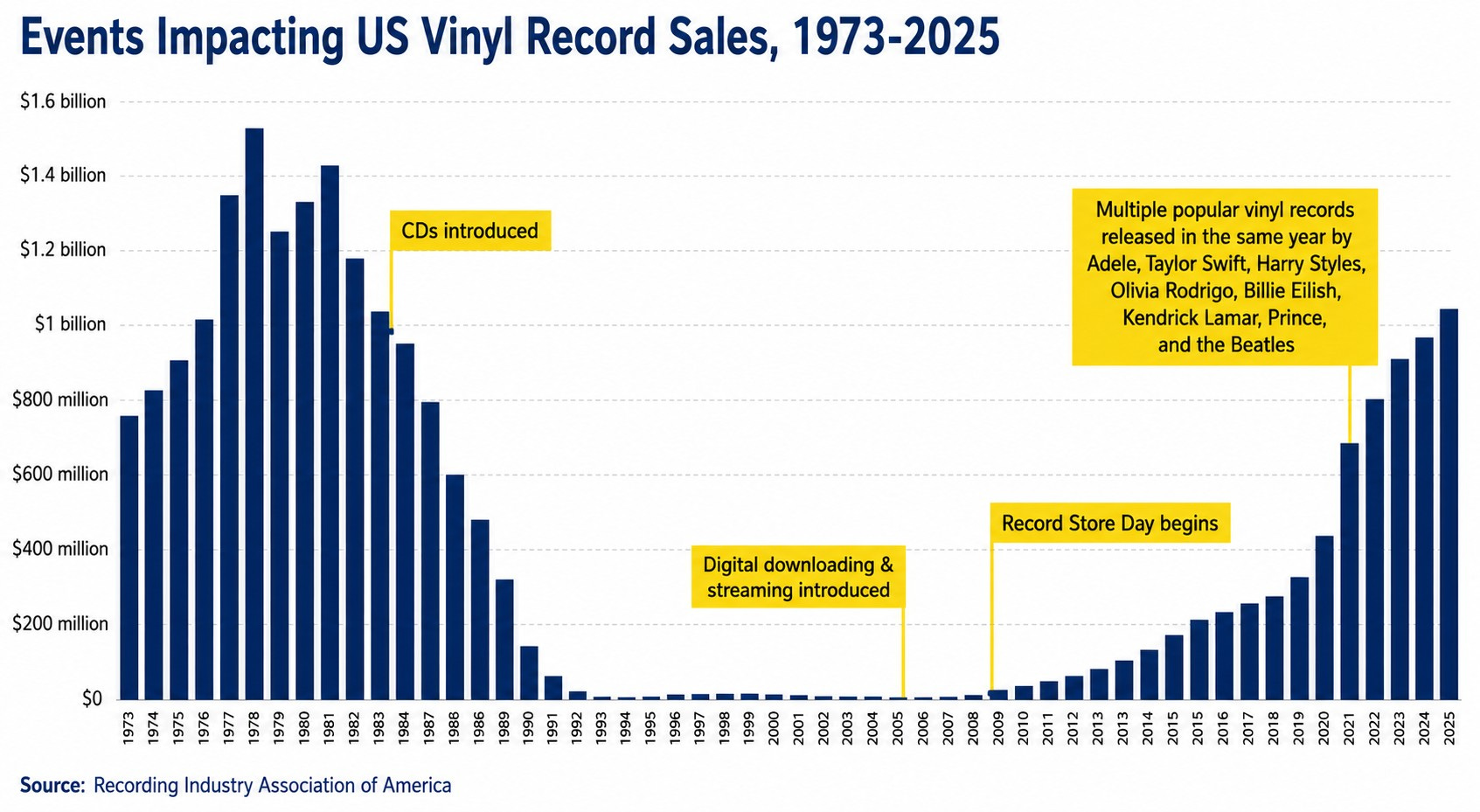
Optimists often point to vinyl as proof that obsolete media can rise again. After being crushed by the CD boom of the 1990s and early 2000s, vinyl has indeed made a remarkable comeback. For almost twenty years, vinyl listening and collecting have climbed steadily, with sales and revenue rising—and, quite surprisingly, with Gen Z fueling much of that growth.
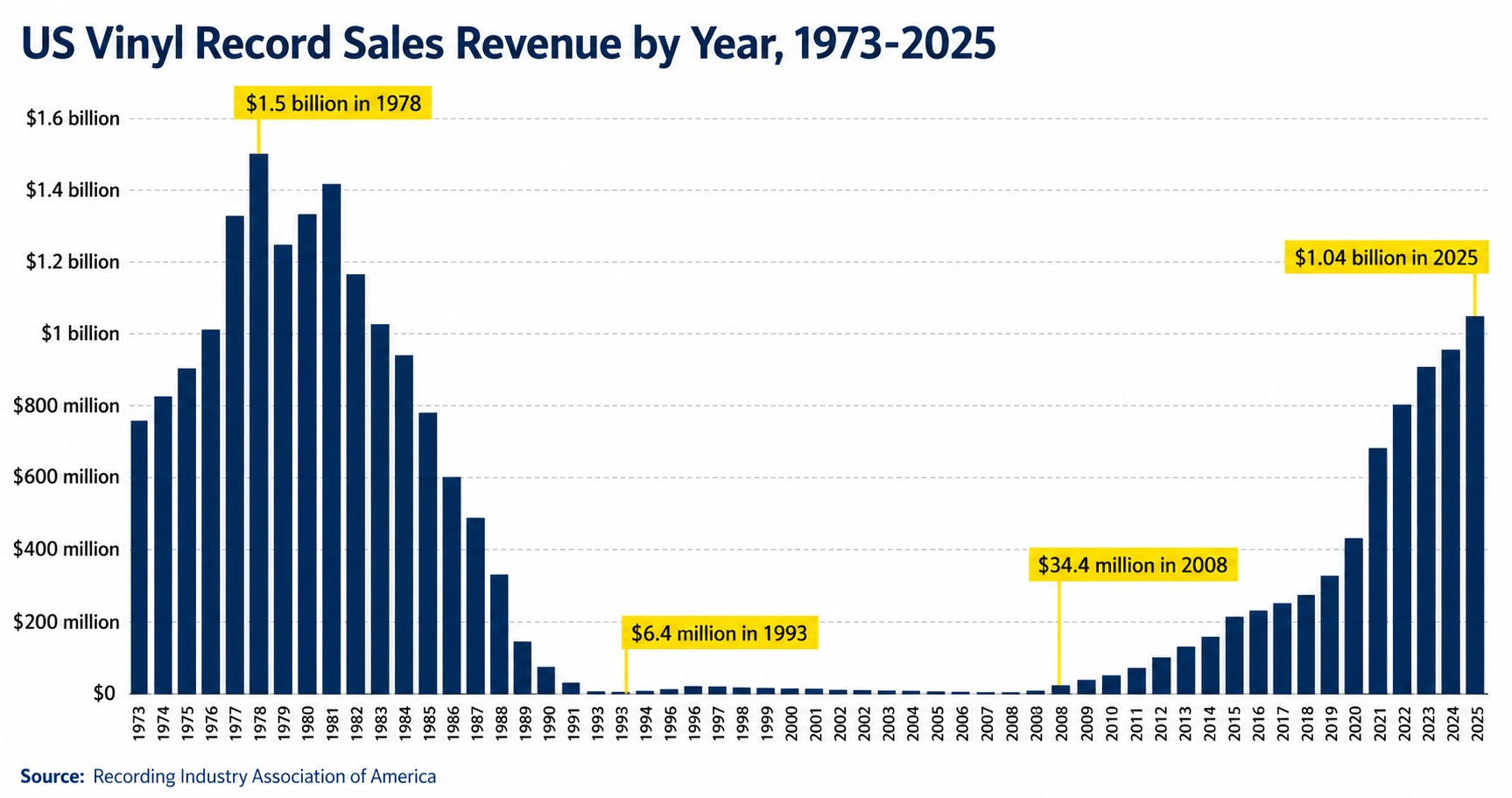
In 2025, total vinyl record sales revenue surpassed $1 billion for the first time since 1983, representing 76% of all non-digital recorded music sales in the US that year. Source: Jordan, Jilayne. (June 5, 2026). The Surprising Resurrection of the Vinyl Records Industry in the Digital Age.
The factors of book decline
The “comeback” of vinyl does look like a “reversal of reversal,” as a friend of mine suggested. What if a process driven by a digital reversal, such as the reversal of book literacy, reaches its limits or full extent (the conditions of reversal, according to McLuhan) and then reverses into its opposite, back to its previous condition? Can the decline of book reading hit rock bottom and bounce into its own reversal, just as vinyl listening did?
No. Unfortunately, there are several factors that do not allow for the “reversal of reversal” of literacy—the comeback of the book.
1. Industrial decline. The book industry was an ecosystem in which production, distribution, and consumption sustained profitability, which, in turn, maintained the infrastructure. A decline in one component affects the entire ecosystem. Amid shrinking markets, especially in non-fiction and academic publishing, many publishers have shifted to small print runs and very high prices, relying on bulk sales to a limited number of institutional buyers such as libraries. Such a publishing strategy does the opposite of what publishing is supposed to do: it effectively isolates authors from readers forever.
Luckily, digital media provide incredible post-industrial opportunities of emancipated authorship. With the right skills and determination, an author can become an indie publisher with global reach and depend less on the old industrial infrastructure. Look no further for an example: my books are sold from Argentina to Denmark and New Zealand because 1) I have a new industrial-scale ecosystem at my disposal (Amazon), and 2) previous work in print media equipped me with all the required skills—a nice severance package we journalists received from the dying profession.

A revelation of the secrets from “behind the scenes.” The rearview-mirror photo for the cover of Digital Future in the Rearview Mirror was taken in my car. The photo of the “dead trees” for the cover of Postjournalism and the Death of Newspapers was taken next to my apartment in Kingston (the trees are not dead—it was just winter). Professional photography and design might have added some surplus value, but actually not much, and certainly not enough to make a crucial, threshold-level difference.
Post-industrial infrastructure for creativity, along with technologically emancipated authorship, gives a versatile author with some media expertise all the necessary tools. That is a great gain. Alas, there is a trade-off: the emancipation of authorship empowers not only indie professionals but also amateurs and virtually everyone else. Consumers gain more choice in how they shape their media diet. As a result, the forces driving book reading down are not on the production side but on the consumption side.
2. The decline of long reading. The habit of long reading has been brutally undermined by the newsfeed. As text reversed into texting, writing and reading have turned from a cognitive exercise into a behavioral activity. Literacy has reversed into orality, but now it is digital orality: instant, impulsive, and conversational.

This oral-like way of receiving information about the world through digital devices rewires the brain. Long reading becomes too slow and even burdensome at the level of neurophysiology. But even that is not the harshest blow dealt to long reading.
3. Media competition. Slow media with weaker sensorial triggers cannot compete for human time with fast media rich in sensorial triggers. The fastest and most seductive media formats compete for human attention: online surfing, videogames, newsfeed scrolling, and reel swiping compete with each other, and they are all incredibly addictive. Slow, deep reading has no chance of even entering that competition. Time scarcity is crucial, and there is no plausible development leading to more favorable conditions for deep and long reading. That train left the station long ago.
But what about vinyl?
Why, then, has vinyl returned? As a format of media consumption, vinyl is slow and fairly demanding. In digital media, persuasive design strives to eliminate friction. Vinyl goes against the grain. It requires special equipment and arrangements for listening, as well as a significant chunk of time devoted to that particular activity. In this respect, vinyl is remarkably similar to books. This is, in fact, a very interesting and seemingly promising comparison.
What does vinyl do that books cannot? There are two things.
1) Vinyl allows you to do something else at the same time, such as partying, spending time with friends or loved ones, or doing chores. Books do not allow this. Reading is highly exclusive—it demands your full attention, leaving no space for multitasking.
2) Vinyl massages (McLuhan: The Medium Is the Massage) the sensorium with powerful sensations. Some insist that the sensation—the quality of sound—is even exquisite. Books cannot do that.
Most importantly, vinyl has not actually returned. It has merely regained some ground after its archenemy, the CD, died. The same study of vinyl (the brilliant one, I recommend) testifies: “While this growth is impressive, it should be noted that it represents only 9% of US recorded music sales revenue across all formats. Digital downloading and streaming remain the primary ways people listen to music.”
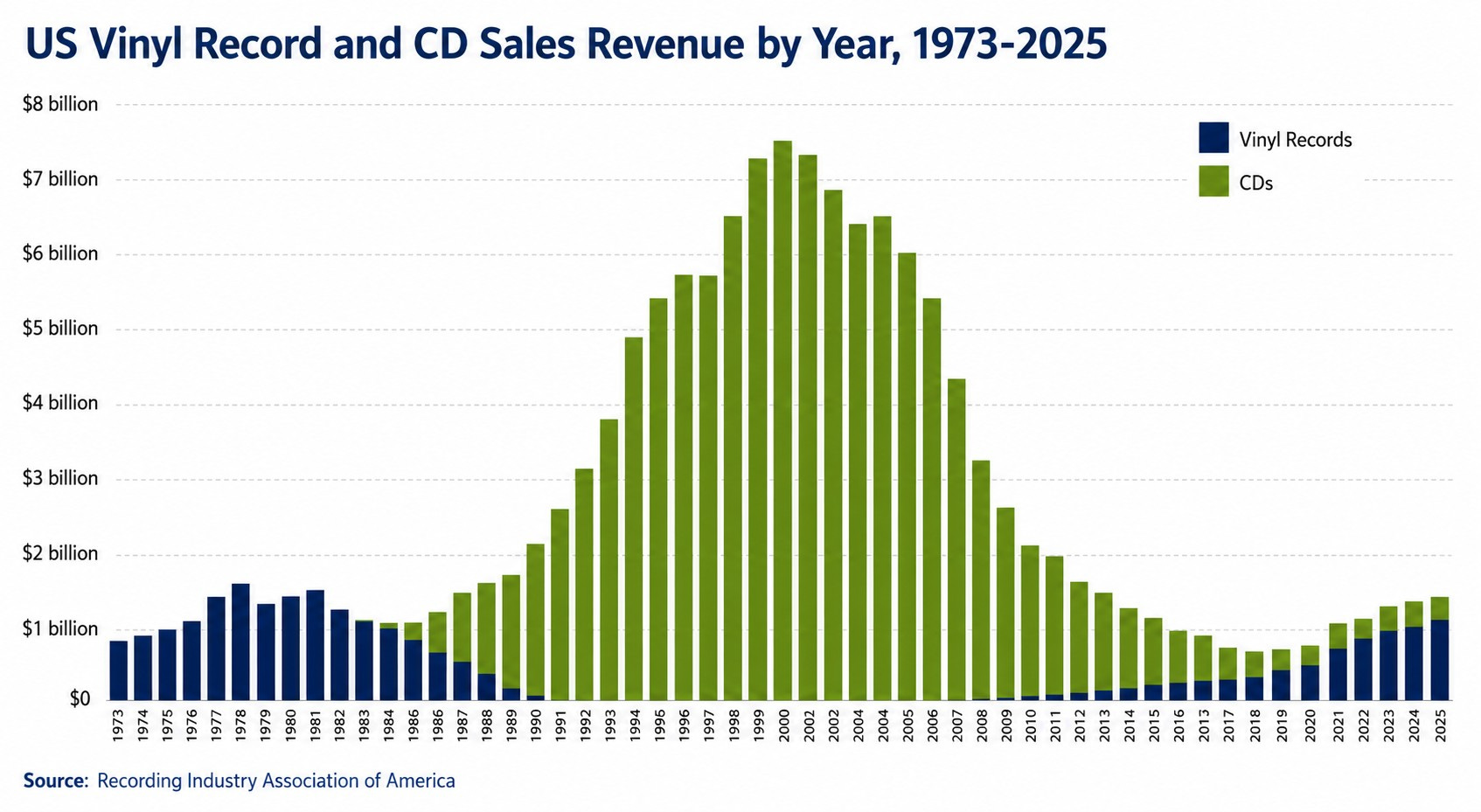
So, by the return of vinyl, we mean a noticeable increase within what remains a very small share of the market. Is it possible for books? Maybe, why not?
Another interesting factor contributing to vinyl’s “comeback” was the marketing strategy of leading pop stars. They found that releasing music in album format suited their touring strategy: a vinyl album provides a coherent body of material around which a concert tour can be organized. Concerts remain a major—if not the major—source of revenue for many musicians.
Alas, writers generally cannot tour with book-sized products of their art. Public events such as book readings and signings cannot become “concerts” matching the scale of the product. Yet, there may be a lesson here. Proactive promotion of the format may revive public interest in it. If you are the Taylor Swift of book literacy, advocating for book reading may increase the public appetite for it.

By the way, vintage consumption—and, in the case of books, performative reading for Instagram selfies or public display—is a form of status consumption. For books, that is not a bad thing; it's even good when reading, or even just holding a book, carries status. But the conversion of performative reading into deep reading is likely very, very low…
In the meantime, another game changer is arriving: AI. AI emancipates music production even further. It makes music creation available to more people not only technologically but, so to speak, creatively as well. Now even the lack of a musical ear or musical education is no longer an obstacle: AI can compensate for almost any lack of skill or talent. As with AI-assisted book production, the skill that matters most is no longer book literacy, music literacy, or talent, but prompt literacy.
How will AI affect the recording industry in general and vinyl in particular? There is a premonition that nothing good will come of it—not even for those musical “creators” who use AI. Their overproduction may corrupt the art, undermine the industry, and contribute to the broader inflation of publicly traded creativity.
What about the “reversal of the reversal”?
In conditions of accelerated time, any reversal escalates and reaches its extreme, its limits, or its full potential, and thus quickly creates the conditions for the next reversal. But the next reversal never leads back to the “before” condition. It always reverses some other qualities or features, escalating into a chain of reversals in which next reversals are always adjacent but never symmetrical. It is not a pendulum.
The clearest illustration is feminism. When patriarchy reached its full potential, it reversed into feminism. But when feminism reached its own extremes, it did not reverse back into patriarchy. Instead, it reversed into sex fluidity and trans activism. And even though some forms of trans activism may resemble patriarchy (men in women’s spaces), it is not the patriarchy it used to be. (See Feminism as a media effect and the chain of gender reversals, a chapter in The Digital Reversal.)

All subsequent reversals reverse something new. In fact, one of the two essential features of reversal is not reversal itself but the reaching of limits and extreme forms. This is what dominates the chain of reversals in accelerated time: a sequence of extremes perpetually reversing some previous functions or features. From this point of view, not only is the previous stage impossible after a reversal, but no stage is sustainable or even lasting; everything escalates into “a McLuhanian apocalypse,” to use Carlos Scolari’s metaphor.

So the logical exercise of a “reversal of reversal” does not lead to the possibility of a book comeback—or a comeback of anything that was previously reversed.
What remains of the book?
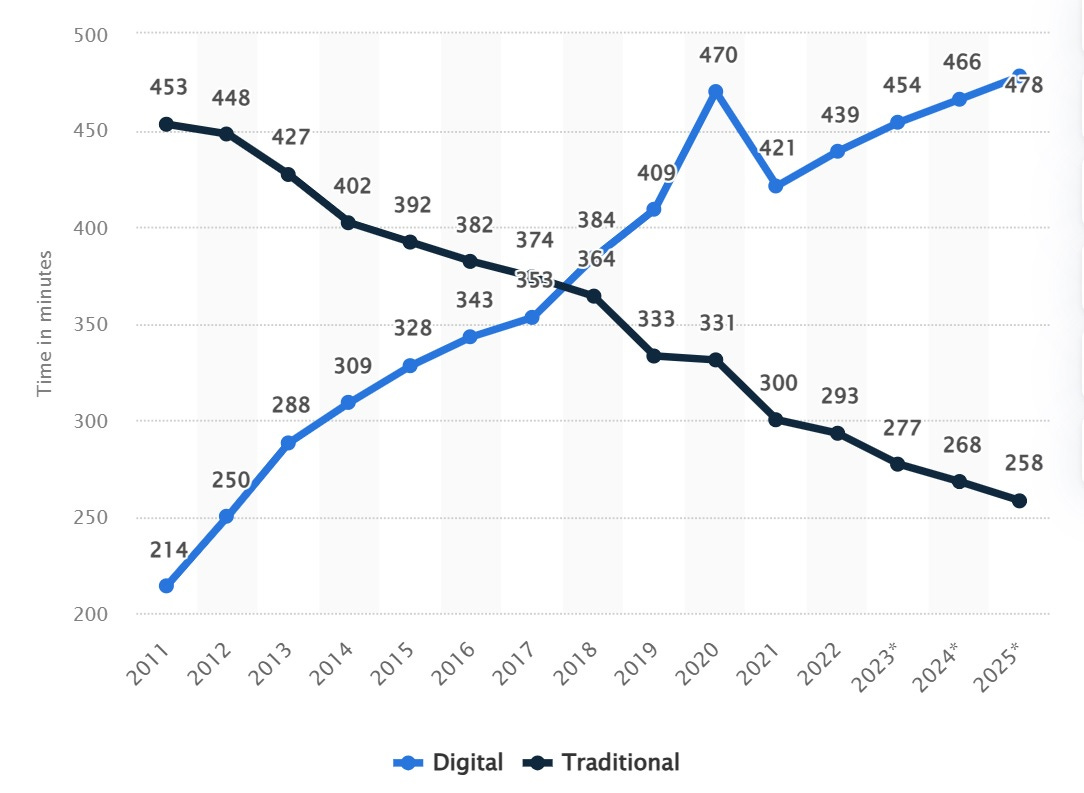
The remnants of book reading will survive in the sanctuaries of those who value long reading and are determined to make the necessary effort. Print books seem resilient—in studies that ask people whether they read books. Surprisingly, there are no studies measuring the actual time spent with books as a share of the daily media diet. But there are many studies tracking the dynamics of media consumption. They all show the dramatically shrinking share of traditional media. Book reading is likely simply invisible in the average media diet today, despite people saying that they still read.
Time spent per day with digital versus traditional media
in the United States from 2011 to 2025 (in minutes)
In The Glass Bead Game, Hermann Hesse fantasized about Castalia—an isolated province of intellectuals pursuing knowledge as an aesthetic synthesis of the arts, sciences, and meaning. But a better reference may be the historical Respublica Literaria, an invisible college of intellectuals that emerged in the late Middle Ages and ushered in the Enlightenment. Literacy was on the rise, but it was “semi-literacy” (Havelock)—not yet mass literacy, but literacy limited to educated circles, when the number of writers roughly equaled the number of readers.
Now we are approaching the same conditions, but from the other end—from the end of full literacy—rewinding history backward toward semi-literacy. In a sense, Substack is already a parody of the Respublica Literaria: an enclosed space where the number of readers roughly coincides with the number of writers.

There are factors that can boost book reading to some degree: digital burnout, vintage or status consumption (as McLuhan suggested, old media may sometimes return as art objects), educational efforts or vigorous advocacy for books.
There are also factors that drive book reading into further decline, and the greatest of them is generational change. New generations are arriving that have never read a single book. There is no reason for them to suddenly start, and no advocacy for books can change that on a statistically significant scale.
There will be, perhaps, a tiny fraction of the new generations that picks up book reading in affluent and educated families. Compared to total annihilation, the preservation of book reading in some demographics seems benevolent—at least to those demographics. They preserve a longer attention span and greater capacities for deep concentration, self-reflection, and long-term planning. At the same time, the isolation of such capacities in certain demographics will signify a new digital divide.
The term “digital divide” once meant social inequality: affluent demographics had better digital access. But that, too, has reversed. Statistics now clearly show that “vulnerable” demographics have much “better” digital access—they spend substantially more time on digital devices than affluent demographics. Conversely, affluent families have better access—often deliberately enforced access—to book reading. This is a new digital divide.
Orality and literacy shape different kinds of minds and cultures. So does digital orality: it rewires the brain and dismantles cognitive capacities cultivated by literacy—concentration, delayed gratification, self-discipline, rationality, long-term planning, and so on. Therefore, the new digital divide will also be a cognitive divide—a divide in cognitive capacities between demographics capable of deep reading and those that are not.
Perhaps this is the single most profound reason for advocating book literacy in schools and, especially, in families. (And this is also the essence of counter-digital media literacy—a work in progress).

See other books by Andrey Mir:
NEW! The Technological Imperative: Why We Develop Our Media. Essays on Human Agency and AI (2026)
The Viral Inquisitor and other essays on postjournalism and media ecology (2024)
Digital Future in the Rearview Mirror: Jaspers’ Axial Age and Logan’s Alphabet Effect (2024)

I think if there’s a future rebound in book sales, it can only mean one thing: that collecting books has become a status symbol
Look at the titles exposed in book shops…Publishers are selecting for success, not intellectual pretense and diversity - like they used to (and could afford to). Now that women dominate the fiction section we get clone after clone where a woman finds a box in the attic as she is cleaning up the house of her just expired mother or grandma and discovers a secret carried over 3 generations.
Or she inherits a house and finds a box and... you know…
A Dutch white male author sent his raw print to publisher after publisher and got friendly replies ‘very interesting but it’s not for us unfortunately’. Then he changed one thing: he replaced his name with a Moroccan one, turning himself into a young Moroccan woman of immigrant descent in the bio. The very next publisher offered him a contract. He then recruited a female Moroccan friend to draw out the trick a little further before making it public.