
Understanding the Law of Reversal (II): Towards a Critique of Total Reversal.
The analysis of McLuhan’s Laws of Media and the Law of Reversal by Carlos A. Scolari


This comes from Part One: Understanding the Law of Reversion (I): Humans as Extensions of the Media. Carlos A. Scolari continues to discuss the Laws of Media in the context of The Digital Reversal. The second part is reposted from his blog with his kind permission. — A.M.

Revisiting Media Laws
Let’s review the origin of the four principles that Marshall McLuhan and his son Eric developed to appease their critics, who demanded a less “speculative” and more “scientific” contribution. The laws emerged while they were working on a revised version of *Understanding Media* . Reviewing the criticism that volume had received—some said it was “impossible to read” or “incomprehensible”—their reflection led them further. Eric explains this in the Preface to *Laws of Media: The New Science.*
“Of course, there was rigor and science in it plenty, but not conventional science. How then could we reconcile the two: satisfy the one without subverting the other? There began the search that led to the present book. The style of UM had been deliberately chosen for its abrasive and discontinuous character, and was forged over many redraftings. It was designed deliberately to provoke the reader, to jar the sensibilities into a form of awareness that better complemented the subject-matter. This is poetic technique (science, if you will) of a high sort – satirizing the reader directly as a means of training him. Now we were faced with the question of how to make it ‘scientific.’ It took my father nearly two full years of constant inquiry to find out ‘what constitutes a scientific statement.’ He asked everyone he encountered – colleagues, students, friends, associates, Finally visitors, one evening, he found the answer in Sir Karl Popper’s – that it was something stated in such a manner that it could be disproved. That was it. The next day he began asking – What statements can we make about media that anyone can test – prove or disprove – for himself? What do all media have in common? What do they do?”
This is how the Laws of Media were born: as a response to a scientific community steeped in Cartesianism that, in the case of communication theories, demanded objective “statements” from McLuhan that even they themselves were unable to formulate after several decades of empirical research.
In this text I would like to continue the exchange with Andrey Mir ‘s book The Digital Reversal that I started in the first part of this text, but first I would like to draw attention to the way in which Media Laws have been applied.

Apply Media Laws
Let me be clear: when researchers apply McLuhan’s four laws, we almost always find examples that “fit” the model. I have the impression that we’ve applied the four laws only to obtain positive results. We’d have to review all the texts and authors who have worked with this analytical model over the last 40 years, but I’d be surprised to find a single negative case. This is related to what’s called confirmation bias. The researcher starts with a preconceived expectation: that every medium or technology will produce these four effects. From there, they tend to search for, select, and interpret cases in a way that confirms the tetrad.
For example, the mobile phone can be seen as a medium that extends interpersonal communication, renders certain forms of fixed or face-to-face communication obsolete, revives practices of orality and brief messaging, and leads to surveillance, dependence, or communication overload. So far, so good. The problem isn’t that these observations are false, but rather that the framework is so flexible that it almost always allows for finding something that serves as confirmation. If the researcher only looks for positive cases, they may ignore ambiguous situations, counterexamples, or effects that don’t fit neatly with any of the four laws. Even ambiguous evidence can be reinterpreted until it becomes favorable proof.
In short: McLuhan’s laws were born with a Popperian intention, but are often applied in an anti-Popperian way. According to Eric McLuhan’s Preface, his father sought to formulate statements about the means that could be “tested by anyone.” The reference to Popper is key: a scientific claim is not simply one that accumulates favorable examples, but also one that could be refuted.
(By the way, it would be wonderful to have the possibility of bringing Marshall McLuhan himself into the scene, as Wood Allen did in Annie Hall , and asking him what he thinks of these applications of the four laws.)

The paradox is interesting: McLuhan sought to escape accusations of unscientific rigor by appealing to Popper, but the metaphorical breadth of his laws can hinder effective refutation. Tetrads are very powerful as heuristic tools: they help uncover unexpected relationships between media, technologies, cultural practices, and social environments. But if their application is too flexible, then any result can be reinterpreted as confirmation.
The problem, to conclude this reflection, lies not in McLuhan’s original intention, but in how we apply the four laws. A rigorous application would have to include not only positive cases, but also negative, ambiguous, or resistant ones. If there is no real possibility of saying “this law does not apply here,” then the tetrad ceases to behave as a falsifiable hypothesis and functions more as a simple interpretive framework. There is nothing wrong with the latter, but if we want to advance our understanding of the media and technocultural ecosystem, we should aim to refine our analytical tools and processes.
Towards a critique of Total Reversal
The Laws of Media present a delicate balance. Where the Law of Extension initially amplifies a human capacity, the Law of Reversion curbs it at the end of its cycle; and if the Law of Obsolescence declares a practice or technology obsolete, the Law of Recovery makes it reappear in a new medium. These four principles work together. If we privilege one of them, we risk undermining the entire analytical framework. Eric McLuhan himself acknowledges this in the Preface:
«Gradually, as we searched for the fifth law, other discoveries and implications began to emerge. The single largest of these was that of an inner harmony among the four laws – that there are pairs of ratios among them – and of the relationship between that and metaphor. All the while, my father was exhorting colleagues, visitors, and students – especially those at his Monday-night meetings at the Center for Culture and Technology – to use the four laws to explore media, and to test the laws. Suddenly (I forget exactly when or with whom) we learned that they applied to more than what is conventionally called media: they were applicable to the products of all human endeavor, and also to the endeavor itself.
When the laws are applied individually and in isolation, that “harmony” begins to falter. If I had to offer a critique of Andrey’s inspiring book, it would be precisely this: applying the Law of Reversion to the Law of Reversion. In other words, taking reversion to its ultimate consequences and, in doing so, overshadowing the other three laws.
I must admit: the exercise is fascinating. Pushing the boundaries of a law and seeing where it takes us. In the case of this thorough application of the Law of Reversal, I believe my reflections can only be expressed through two metaphors, one philosophical and the other physical.
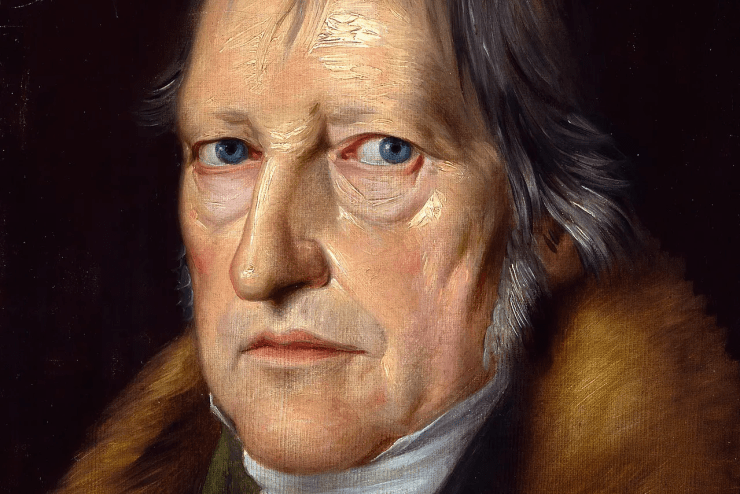
Welcome, Hegel. As you know, Hegelian dialectics—which we studied in the first year of the Bachelor’s Degree in Social Communication at the National University of Rosario in year 4 AM (before Messi)—can be summarized in three moments: thesis, antithesis, and synthesis . For the German philosopher, every initial assertion is met with its negation or conflict, and from this tension arises a transcendence that retains elements of both but transforms them at a more complex level. It is not a simple sum of the two previous moments, but rather a historical movement of thought and reality.
However, if the Law of Reversal is applied to its ultimate consequences, it’s as if the analysis stops at the point of antithesis. Pure negative thinking. A dialectic only halfway there. While McLuhan’s logic isn’t Hegelian (in this case, it doesn’t seek dialectical reconciliation, but rather to show how every medium taken to its limit turns against itself and the environment it produced), we could say that the inversion doesn’t clearly lead to a superior synthesis, but to an accelerated chain of reversals, implosions, and extremes . Instead of the thesis-antithesis-synthesis cycle , we would have an infinite cycle of thesis-antithesis-antithesis-antithesis-…
I admit it: this Hegelian reflection doesn’t completely convince me either. Let’s try the other one.

These days mark the 40th anniversary of the Chernobyl nuclear reactor explosion . Even a 3-year-old AI knows that a nuclear reactor contains graphite rods to slow down the neutrons produced by fission, allowing the chain reaction to proceed. But a reactor also has control rods (usually made of boron or cadmium) that prevent the reactor from spiraling out of control. Without control rods, the reactor experiences what is called a power excursion. It’s not a nuclear explosion like an atomic bomb (because the uranium isn’t enriched enough), but it is a massive physical and thermal explosion that would release radiation into the environment (Thanks, Gemini).
Now I can say it: taking the Law of Reversal to its extreme results in an out-of-control interpretive explosion. In that case, the other three laws cease to function as balancing rods in the theoretical reactor, preventing it from exploding. By “liberating” one of the laws and declaring it autonomous from the others, the analytical engine spirals out of control. A McLuhanian apocalypse.
I’m almost certain the same thing would happen if we applied any of the other Laws of Media to their ultimate consequences. We could imagine other books, close relatives of *The Digital Reversal*, for example, a possible *The Digital Obsolescence* or *The Digital Retrieval*… Now that I think about it, both books have already been written. One was published by Nicholas Negroponte in 1985: *Being Digital* . In that volume, Negroponte decreed the end of analog media (he even took a swipe at the poor fax machine) and left in his wake a graveyard of media fossils. The other book was written by Jay David Bolter and Richard Grusin and is titled *Remediation: Understanding New Media* (2000). It’s a monument to the Law of Retrieval.
Returning to Andrey’s book, at this point so many debates and questions have been raised that I can only clarify them by interviewing the author.
Continued in Part Three :
Understanding the Law of Reversion (III).

Carlos A. Scolari is Professor in the Department of Communication at Universitat Pompeu Fabra–Barcelona and Doctor Honoris Causa from the National University of Rosario (Argentina). He has served as Principal Investigator of the H2020 TRANSLITERACY (2015–18), TRANSALFABETISMOS (2015–18), PLATCOM (2020–24) and LITERAC_IA (2024–27). Between 2018 and 2023, he coordinated UPF’s PhD Program in Communication. He has delivered lectures and seminars on interfaces, transmedia storytelling, media ecology, and interactive communication in more than forty countries across Europe, Asia, and the Americas. His latest books are On the Evolution of Media (2024) and Homo Mediaticus (2026). Since 2008, he has shared his ideas on Hipermediaciones.com.
See other books by Andrey Mir:
The Viral Inquisitor and other essays on postjournalism and media ecology (2024)
Digital Future in the Rearview Mirror: Jaspers’ Axial Age and Logan’s Alphabet Effect (2024)

 | A guest post by
|