
The search for form, the last quest for human writers
What happened to journalists a decade ago is now coming for writers, and they must decide what to do

In the time remaining for human creativity,
the main and final challenge for human writers
will be the search for a form
that provides the fastest possible impression
and sense-making.
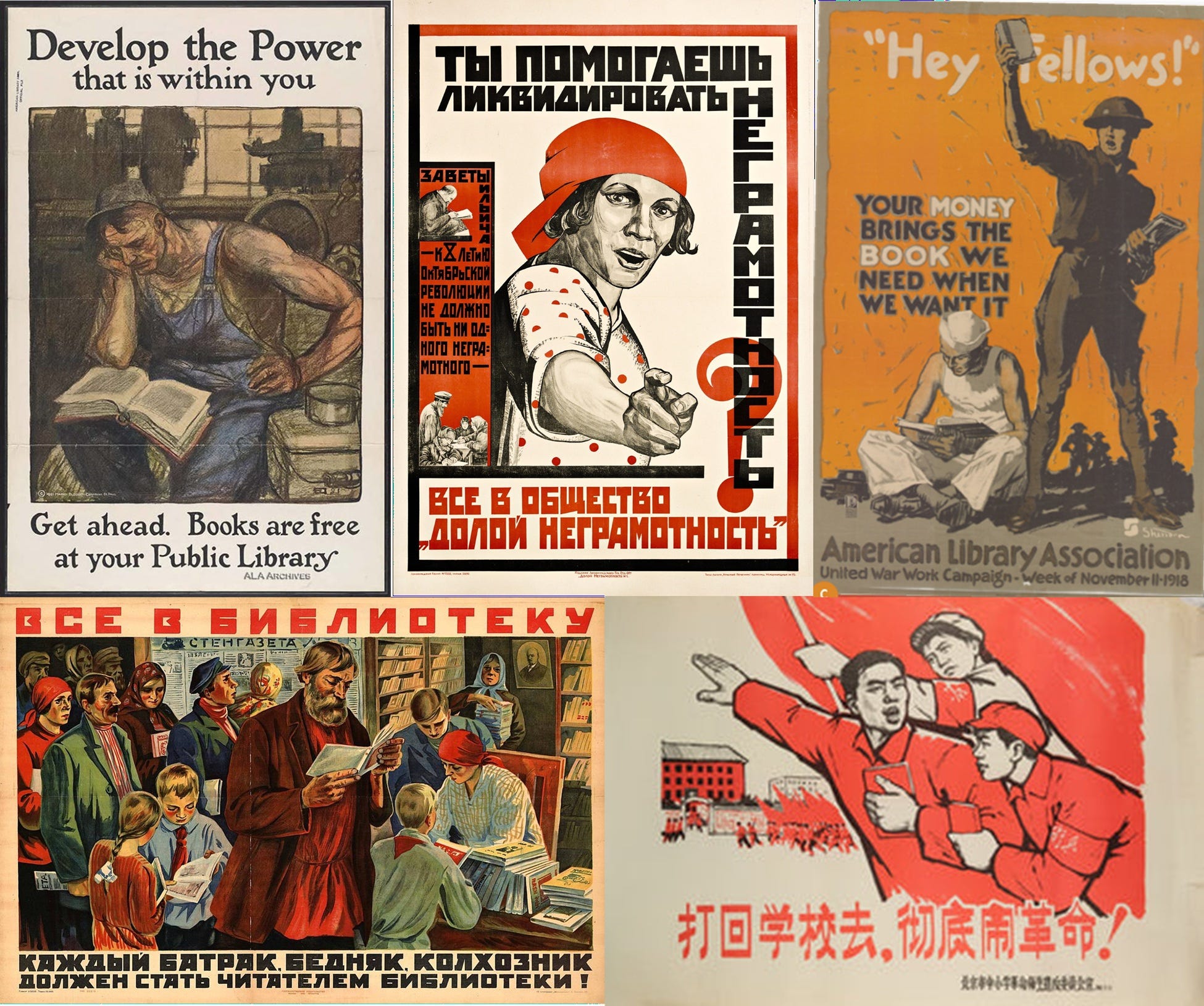
1. Because of AI, content is no longer king
1.1. Not only is content plentiful, but it is also now AI-generated.
1.2. With the arrival of AI, writers have lost their monopoly on creating narratives, both fiction and non-fiction.
1.3. An unknown number of people without writing skills, but with writing ambitions and strong prompting skills, have joined the club.
1.4. Prompting extends writing—and prompting also replaces writing.
1.5. AI, working as a research assistant and ghostwriter, can produce essays and books of comparable quality and in incomparably larger quantities than legacy writers.
1.5.1. With good prompts and editing, it’s not AI slop. AI-generated writing can be of decent quality. (Detective Del: “Can a robot write a symphony? Can a robot turn a... canvas into a beautiful masterpiece? Robot Sonny: Can *you*?)
1.5.2. But quality doesn’t even matter, because the enormous quantity oversaturates the market and draws already scarce reader attention away from human writers.
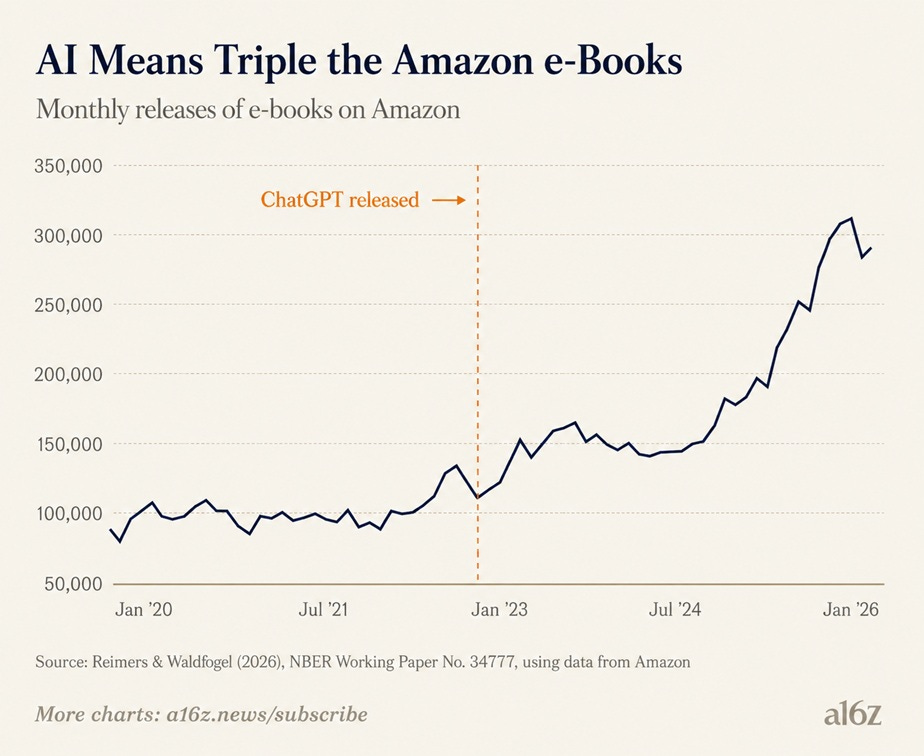
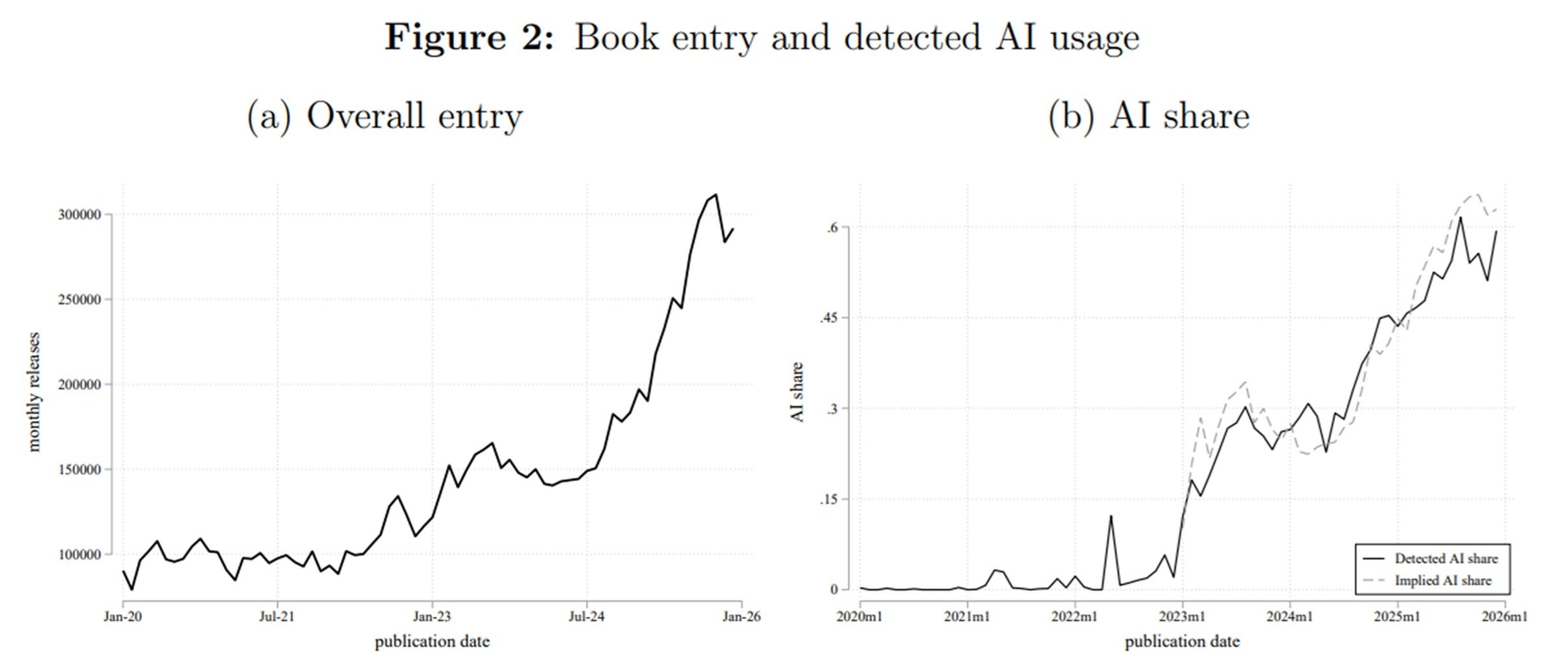
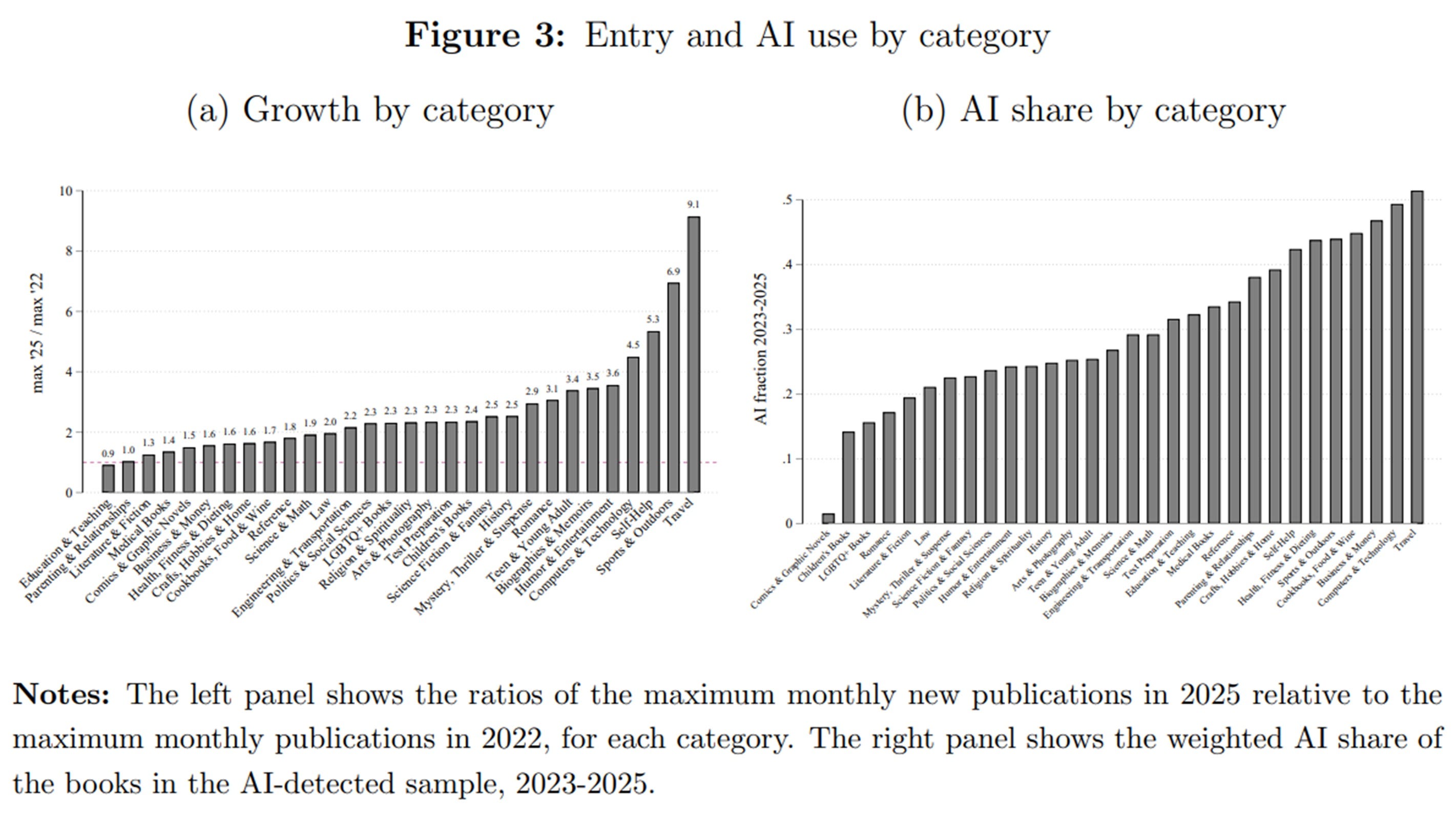
1.6. The data suggests that fiction categories are generally less affected by the LLM-driven surge in book production than non-fiction. Most fiction genres occupy the bottom third of the ranking, whereas non-fiction dominates the top.
1.6.1. This might mean that non-fiction either seems more lucrative or more doable for AI book prompters.
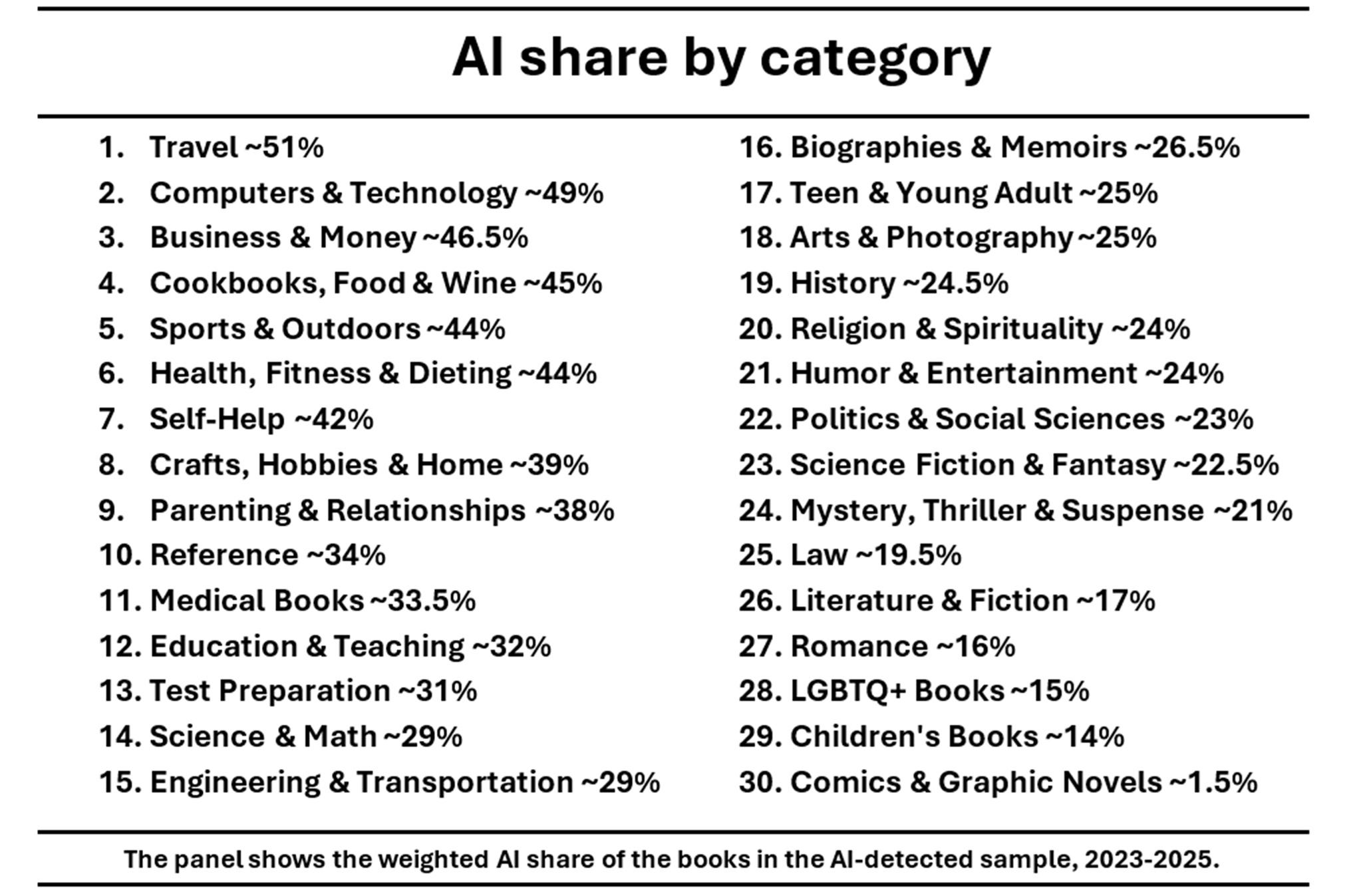
1.7. When AI triples the release of books amid fading readership, even quality books have vanishing chances of making an impact.
1.8. The decline is already noticeable in Amazon sales reports.
1.8.1. One may say that it is just that some books are not selling well, and that you need to write and market better.
1.8.2. You always need to do better, true, but there is also circumstantial evidence that the decline has already started.
1.8.2.1. For example, events that used to have a significant and long-lasting effect on book sales, such as a mention of your book in a leading outlet like The New York Times or The Atlantic, now have a boosting effect on sales that lasts only half as long as it did just a couple of years ago.
1.9. AI prompters have an advantage over writers: they produce content faster, without writer’s block, without the agony of creation, without self-doubt, and without procrastination.
1.10. The monopoly of legacy writers over literary creation is gone.
1.11. Writers are joining journalists, who were wiped out a decade ago by hordes of bloggers, influencers, and podcasters—by the emancipation of authorship.
1.11.1. Journalism suffered when the internet emancipated the authorship of the crowd. Now the internet has emancipated the authorship of an even more powerful competitor: artificial intelligence.
1.12. But there is one writer’s skill that neither AI prompters nor AI can confidently appropriate: mastery of new forms and styles.
2. I tried
2.1. I wrote The Digital Reversal: The Thread-Saga of Media Evolution entirely in tweets, with each paragraph strictly under 280 characters. With 1,295 tweets, it became the first “tweetise” in history, a reversal of “treatise.”
2.2. The result? Ambiguous.
2.2.1. Marketing. I thought it would stand out for its form, and many said it was cool, but the marketing boost from the form fell below expectations. There was too much noise from oversupply to break through with such a weak signal. And, of course, even a unique form needs more marketing resources than I have.
2.2.2. Readability. The tweet format disciplines the author: in plain prose, the book would have been twice as long. The brevity and the shorter book are good for reading, no doubt about that. But readers with more traditional habits also complained about the “terse” style. Someone noted that the experiment showed how the tweet format, designed for instant replies, conflicts with long-form prose meant to develop thoughts.
2.2.2.1. That is true. As Neil Postman said, “You cannot use smoke to do philosophy. Its form excludes the content... You cannot do political philosophy on television. Its form works against the content.”
2.3. The experiment with the “thread-saga” in The Digital Reversal was not a failure—it received plenty of enthusiastic responses and became one of my bestselling books. “Tweetise” is a cool feature. Yet the form itself did not become a success of scandalous proportions, as I had secretly hoped, so I need to look further.
2.4. But if this form has not become a solution, what guarantees do we have that another form will—or that any form is a solution at all?
2.4.1. We don’t.
2.4.2. But this is the only path a writer can still walk without being intercepted by AI.

3. Where to look
3.1. In the literary tradition, all experiments with form revolved around the task of packing: how to pack ideas and sensations into a specific form serving an aesthetic or intellectual purpose.
3.2. That approach has been made obsolete by AI. The issue is not even that AI can mimic any form of aesthetic or intellectual “packing.” The issue is that AI prompting has boosted supply and made packing irrelevant when the chance of unpacking is near zero.
3.3. The search for form has to tackle the issue of unpacking (digital reversal!). Market oversaturation and reader fatigue demand that any new form deliver instant impression, instant unpacking, and instant sense-making.
3.4. The post-literary forms of instant unpacking I am thinking about, to survive the remaining 3–5 years of human writing, are explainers, listicles (including the Wittgensteinian listicle), PechaKucha, posters and dazibao, and their various syntheses.
4. Explainer
4.1. Explainers were perhaps the first literary reaction to the shrinking attention span, because journalism was the first creative practice to face the extinction threat brought by the internet.
4.1.1. So we journalists have already experienced it, many of us more than once.
4.2. The explainer was a format of so-called explanatory journalism, designed to present data in plain language, but in a modular structure, for already weakened attention.
4.2. The major proponent of the format was Vox, founded in 2014 by Ezra Klein, Matthew Yglesias, and Melissa Bell. Other examples included The Upshot at The New York Times and FiveThirtyEight, founded by Nate Silver. This was a significant trend in the media at the time.
4.3. For writing under AI pressure, the explainer can be useful not for its essence (explaining) but for its modular form, which is easy to unpack: Q&A, cards, and so on.
5. Listicle
5.1. “Listicle” comes from “list + article.” It’s a short article written in the form of a list. The format is easily recognized by typical headlines like “10 Amazing Facts About Spider-Man” or “Seven of the Oldest Pieces of Art Ever Created.”
5.2. The first listicle was the Ten Commandments. The principle has also been used in books, for example, The Seven Habits of Highly Effective People by Stephen Covey.
5.3. Listicles are designed for rapid scanning. This was clearly a response to the demise of deep, linear reading among media audiences. BuzzFeed reached the peak of its popularity in the early 2010s almost exclusively thanks to its signature listicles.
5.4. Listicles relieve authors of the angst of composing a structure: you don’t need to tie the parts of your piece smoothly together if they are simply listed under numbers. You don’t even need a narrative structure. But that is a solution on the side of packing.
5.5. For easy unpacking, listicles offer modular reading, even skimming, that suits fragmented attention.
5.6. A listicle is also a proper way to reuse existing interesting content in the form of a summary, a format inherently designed for long packing and quick unpacking.
5.7. The main “unpacking” trick of the listicle is that readers anticipate something digestible if it is counted. The finite number in the headline promises brevity and specificity. Just compare: which would you choose, “Important Facts About Listicles” or “10 Important Facts About Listicles”? Or, even more intriguing, “10.5 Important Facts About Listicles?”
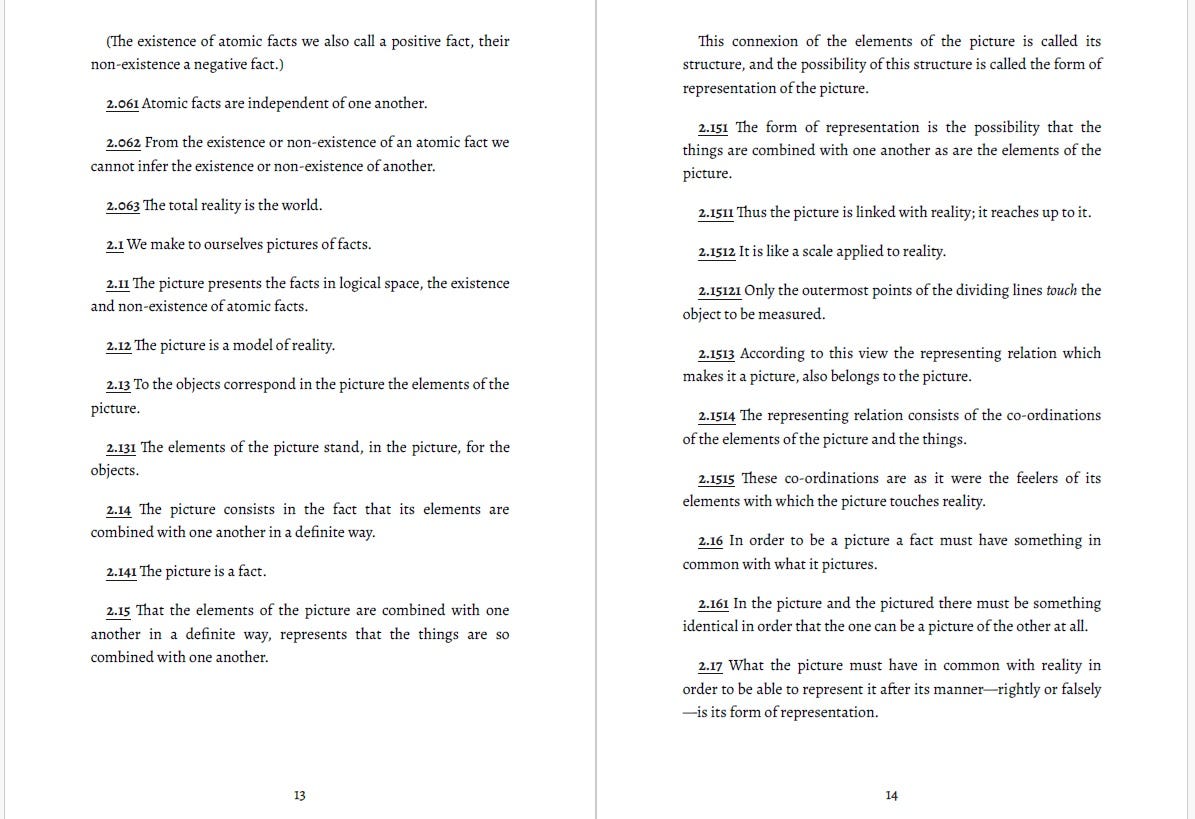
5.8. Personally, I like what I call the Wittgensteinian listicle, a format used by Ludwig Wittgenstein in his 1921 Tractatus Logico-Philosophicus. It adopts the modular form of the listicle but structures its modules into a hierarchy of subordinate levels, just as in this essay.
5.8.1. I believe this format is elegant. Does it serve quick unpacking? That depends on execution. But it certainly has the potential to seduce and guide the reader’s attention.
5.8.2. Most importantly, by segmenting a listicle into a hierarchy of thoughts, the author can command the rhythm of reading, somewhat like swing in jazz, if measured correctly.
5.8.3. There is a natural limit: you can hardly employ this style for an entire book; it would likely make the book overly cumbersome. The Wittgensteinian listicle can be a good form for a short essay and a component to mix with other formats in a book.
6. PechaKucha
6.1. PechaKucha is a slide-presentation format invented by architects in Tokyo in 2003 as a response to long, overloaded PowerPoint presentations.
6.2. Fast delivery and unpacking are built-in features of the format, thanks to the “20×20” constraint: 20 slides, 20 seconds for each, with auto-flipping, for a fixed presentation length of 6 minutes 40 seconds.
6.2.1. The format is inherently meant for long packing and quick unpacking.
6.3. One might wonder what this has to do with publishing. I found a practical application. Twenty years ago, when I was editing a financial magazine, I invited industry leaders and experts to share slides from their conference presentations. I selected a set of slides and developed them into a recurring PechaKucha section in the magazine, which became quite popular.
6.4. In print, PechaKucha resembles comics, but non-fiction comics.
6.5. The idea of mixing graphics with theses was used by Marshall McLuhan in his 1967 The Medium Is the Massage, created in collaboration with graphic designer Quentin Fiore.
6.5.1. But unlike the McLuhan–Fiore book, and much like comics, PechaKucha in publishing brings a modular uniformity similar to listicles or explainer cards.
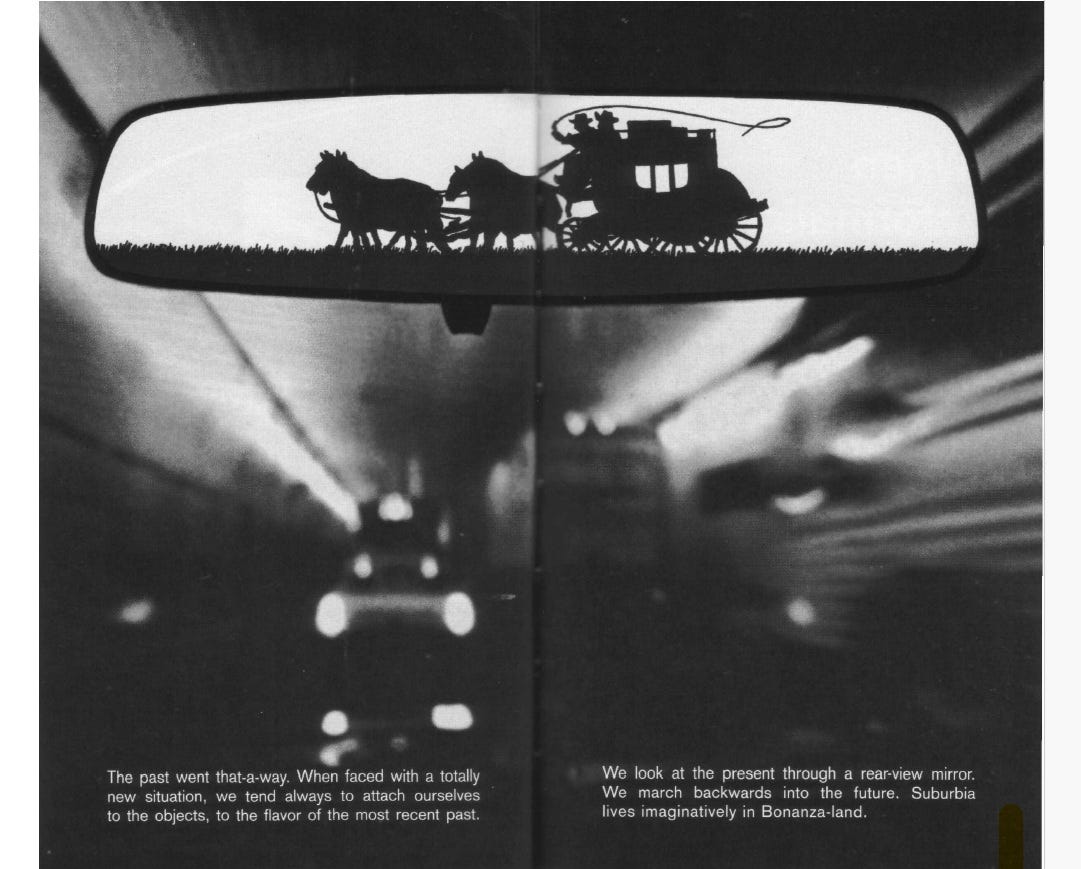
6.6. Non-fiction modular comics, a book made in slides, can be an interesting experiment, but it degrades deep linear reading, a typical accusation made against comics. It may work better as a graphic supplement or a section.
7. Posters, dazibao, etc.
7.1. Short texts presented in graphic form (dazibao, or big-character posters) or accompanied by graphic elements (posters) were typical of an era of rising literacy and strong residual orality, when the masses were still unable to engage in long, deep reading.
7.2. As digital media reverse print literacy into digital orality, these conditions are returning, but now as a regression, a movement backward, an “unlettering” of a sort.
7.3. So looking for any form that degrades literacy into modular, fragmented, rhythmic, visually arresting reading can help market non-fiction.
7.4. It has a price, of course: by leveraging the effects of these forms, a writer contributes to the demise of literacy.
8. Attention management
8.1. Why does mastery of form remain a human prerogative in writing? Charisma. One needs:
to decide to do this strange thing: not to follow patterns but to invent them, and
to pursue this decision with perseverance, yet also with a sense of adequacy.
8.1.1. This seems to remain human so far.
8.2. When digital media and then AI stripped journalism of what had long been regarded as its prerogatives—news, informing the public, creativity—it became clear what the true competence of journalists had been all along: content management and attention management.
8.2.3. These skills are universal, transferable, and highly demanded in the digital economy.
8.2.4. Others still learn; we journalists already know how to do it. It was a severance package we received from good old journalism.
8.3. Writers are about to discover what remains their exclusive prerogative once creativity and writing themselves are taken away by AI prompters.
8.3.1. My wager is that it is the mastery of form.
8.4. Also, as everything literary reverses and “progresses” backward, or downshifts, writing itself may be downgraded to journalism. Turning a book into a magazine may be an experiment that fits the conditions of vanishing literacy.
8.4.1. People did not read magazines so much as flip through them, stopping occasionally to read. The frequency and length of these stops characterized the quality of a magazine.
8.5. Multiformat and modularity can ease unpacking.
8.6. The future of the book is the blurb, said McLuhan.
9. Or not? Or is it nobler in the mind to suffer?
9.1. All these formal experiments reject and denigrate traditional deep linear reading.
9.2. Curiously, while deep linear reading will shrink among the masses, there will always remain bookworms who will keep reading to the end, unaware that the Singularity, or whatever passes for it, has already happened, until it literally hits them, pun not intended.
9.3. Just like Respublika Literaria, the medieval virtual community of learned men that formed at the dawn of modern literacy, or Castalia, the isolated province of scholars in Hermann Hesse’s 1943 novel The Glass Bead Game, a similar cocoon of the literati will condense during the decline of literacy.
9.4. Perhaps a writer must accept his fate and stick to those last readers.
9.4.1. You never catch up with changing times, especially when times accelerate.

See other books by Andrey Mir:
NEW! The Technological Imperative: Why We Develop Our Media. Essays on Human Agency and AI (2026)
The Viral Inquisitor and other essays on postjournalism and media ecology (2024)
Digital Future in the Rearview Mirror: Jaspers’ Axial Age and Logan’s Alphabet Effect (2024)

Ha! Just this morning I woke with the thought that I should write 10 love poems. A disciplined and rigorous process of giving unique form to my emotions and personal experience. A refuge and sanctuary for my creativity. Now you have made me consider the value of prologues and epilogues. Sometimes the very best bits of a book. Thanks again for keeping me thinking.