
The acceleration problem: exponential AI upends incremental history
History is compressing into years, then months, then now—and we have no ability to see it

The scale of historical eras shrinks—from long-term spans to immediacy. When everything happens in the “now,” there is no outside vantage point, no temporal distance from which we can interpret, contextualize, or judge events. We are living inside the process and cannot observe its entirety.

The real problem isn’t what you think
To understand what’s really happening, the main concern isn’t political, cultural, or technological. It’s not Trumpism or wokeism, not the death of print and the rise of digital orality, not mass migration or nativist fury, not surveillance capitalism or surveillance socialism, not the loneliness epidemic and the war between the sexes, not nuclear proliferation or engineered viruses, not climate collapse or the rising Global South.
The real issue is the acceleration of time—and our blindness to it.
Accelerating AI is now compressing human history so fast that those usual suspects of global anxiety won’t have time to develop into the catastrophes we fear. The timeline is collapsing so rapidly that we’ll hit a breaking point before any of those problems can play out to their end. The worst part is that we don’t even see it coming.
What is the acceleration of time?
Acceleration of time means that the number of events per period grows exponentially. More and more happens in less and less time.
Throughout history, mankind lived in scarcity of almost everything; now it lives in abundance. And among all the abundances transforming the human condition, the fastest growing and the least reflected upon is the abundance of events.
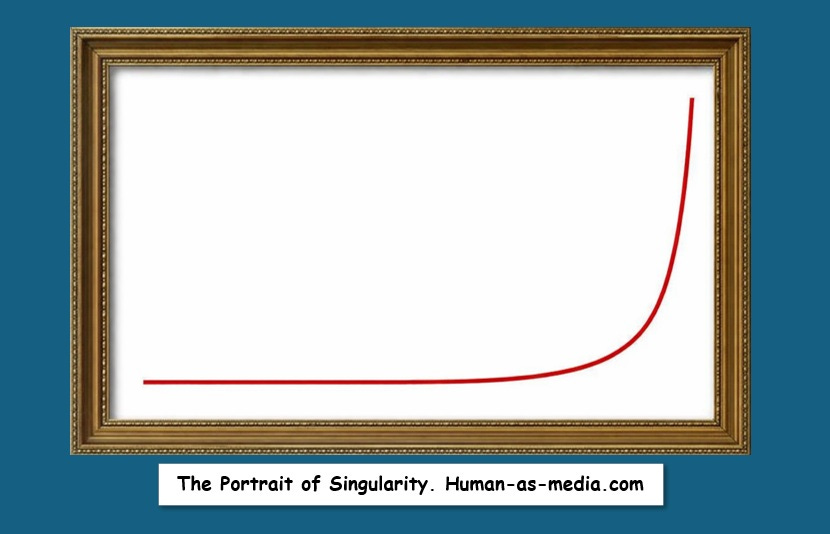
Imagine this historical acceleration as a chart: put time on the horizontal axis and the quantity of events on the vertical axis, and you get an exponential curve of growing event density. For 95% of its duration, that curve looked flat. Then it began to rise, slowly at first, then faster and faster, until it shoots nearly vertical. When that happens, all the habits and expectations we built from previous history become useless.
Most importantly, when the curve goes vertical, its progression along the time axis essentially stops. At the vertical stage, so many events get compressed together that they all happen at once—like one final, instantaneous event. In the end, time isn’t out of joint. It’s the opposite: time pulls together, condenses, contracts, and collapses into a singularity.
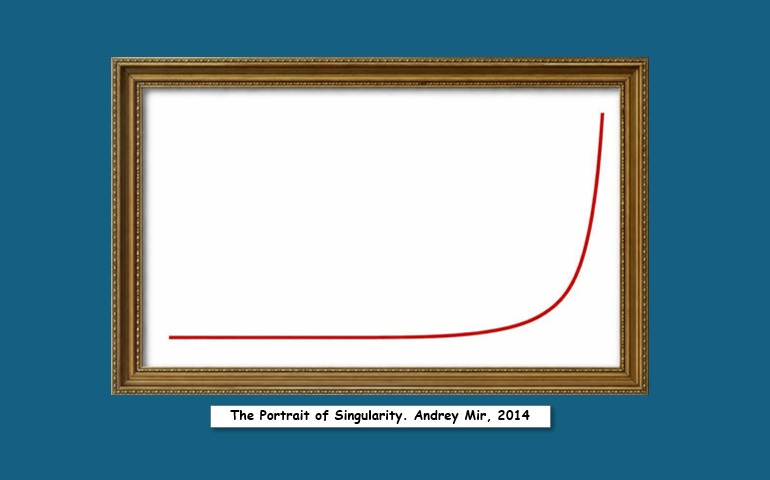
It’s a final countdown
Throughout human history, eras defined by dominant technologies—transportation, communication, warfare, or manufacturing—lasted hundreds of generations. Then dozens. Then just a few.
You can actually calculate the pace of this acceleration. Not with mathematical precision (though I think it’s possible), but clearly enough to see a pattern. Pick the sequence of technological eras defined, say, by communication or transportation (any media development gives the same pattern), measure how long each lasted, and plot it on a timeline. Each era is longer than the next, and their shrinking durations resemble a countdown: 10, 9, 8, 7...
Various calculations land count “zero” somewhere in the mid-21st century.

We’ve already passed count “one.” How do I know? Because the flat, incremental part of the exponential curve ended with the pivotal generation.
We have already passed the pivotal generation
In the 20th century, the pivotal generation emerged in many countries—the generation whose lifespan encompassed two or even three eras: agricultural, industrial, and postindustrial—something that had never happened before.
Imagine a boy born in the 1930s or 1940s in a country that was still largely agrarian. He might later work in an industrial factory and, by the end of his life, browse the Internet. Within a single lifespan, he would live through the agricultural, industrial, and postindustrial eras, as did millions of others in the pivotal generation (considering India and China, billions). After the pivotal generation, an era became shorter than a life.
Earlier or later in the 20th century, many nations—and humankind as a whole—experienced the shock of the pivotal generation. Those cultures that entered the process later may represent an even greater leap: from pastoralist hunters and gatherers to digital hunters and gatherers. (The shock these cultures experience—and transmit to those they come into contact with—is a separate story within the broader topic of accelerated time.)

Exponential blindness
People do recognize the pace of change, of course. It became visible through technological and social shifts—most notably in the 1960s during the television era, and again in the 2010s, that long decade between the “like” button (2007) and generative AI (2022) that completed the transition of humankind onto digital media. (See The Digital Reversal.)

Still, changes have always arrived incrementally, even those caused by television. Any turbulence was expected to settle, followed by a period of adaptation and relative calm. This incremental pattern worked fine on the flat, slowly rising part of the exponential curve, and it became our habitual way of understanding history. Until after the pivotal generation.
This habit of thinking linearly creates a blind spot for exponential growth. People admit that digital changes come faster than those caused by print or electricity. Many even recognize the accelerated pace of change, but only looking in the rearview mirror, backward, only from the past to now. They stop short of projecting that same logic forward into tomorrow, as if the acceleration would suddenly stop and let the new era settle and last.
But why would it stop? Why would this galloping inflation of history suddenly hit the brakes and let the dust from the digital explosion settle? We’ve passed the pivotal generation. Era-scale changes are now compressed into decades, then years, and soon, months.
At some point, changes that would have merited their own eras in the past (like smartphones or short video) come so fast they don’t create new eras anymore. The only thing that “persists” is change itself. But even the word “persists” doesn’t fit, because when changes become so fast that changing is their only meaning, nothing can persist—not even change. When acceleration hits its extreme, it collapses all time into the immediate “now.”

Where are we now on the exponential curve? Or more precisely, when are we?
In practical terms, the acceleration of time moves through stages. First, changes replace previous ones faster than we can adapt. Then changes replace previous ones faster than we can even recognize what they mean. Then changes come faster than we can see them coming.
Some people still debate whether AI lacks creativity and can’t replace humans. They think this is the defining question about AI.
Others have moved past the creativity debate and try to convince themselves that AI won’t take all human jobs. Whether AI possesses creativity is already irrelevant at this stage.

Those who actually work with the latest LLMs passed the job-replacement concern long ago (a whole three or four months). They watch, with awe and admiration, how AI systems coordinate with each other—how multiple models accelerate each other’s work while creating new operators with new protocols.
A human operator is still there, assigning the framing task. But the models are already creating something that resembles a team, even a community. Something approaching a civilization.
It’s not that the questions about machine creativity or AI’s capacity to replace human jobs have been resolved. They’re simply no longer relevant. Meanwhile, “Something big is happening,” as Matt Shumer put it.
AI has already crossed the threshold from tool to autonomous cognitive agent. It’s beginning to recursively improve itself. It will restructure cognitive labor within a few years—maybe months—in a way fundamentally unlike previous technological changes. Conscious of it or not, LLMs are building their own AI systems, creating a feedback loop. This is the precursor to the vertical, final part of the exponential curve. It’s not just a capability jump; it’s a jump toward self-acceleration. Without even self-awarenes.

What happens on count Zero?
From now on, one small step for an LLM may become a huge leap for mankind (and the last one). The acceleration problem is that public perception lags badly behind AI’s real capabilities. We don’t know if we have years or months before these leaps pile up and we hit the vertical end of the exponential curve.
What happens when all time merges into “now,” when the future literally becomes the present? And not through steady or paced transition, but really quick, now, all at once?
This basically means the end of civilization as we know it.
We certainly don’t have centuries, and not even decades. We need to learn to think of a completely upended future in terms of years or even months. The worst part is that we don’t know how much time remains or whether it’s already underway—whether now is already the “now.” And we don’t even have reliable ways to find out. Not until it happens.

Like, I’m working on my next book, Counter-Digital Media Literacy, which I’ll finish by September. Do I have that much time? Not just time for the work to pay off, but will it even be relevant? Or will the best literacy by then be storing food, water, and medical supplies? Will the best skills in preparing for the digital future be trade skills? (I truly think trades skills are the best skills for any digital future that awaits us—read Counter-Digital Media Literacy soon.)
The acceleration of time has an important corollary: the further we live, the closer the final phase.
Here’s the good news: amid this acceleration and the increasing probability that eras will compress into months, all other pressing global issues become meaningless. Including those people devote their lives to. A single development in AI may soon dismiss nearly all other human worries.
Another corollary: since this will be the final reversal, the margins of civilization will become its center (if anything remains at all).
And finally, to cheer you up: it won’t last.
(What to do? Do what you must; come what may. Or, as Cyrus Smith, the leader of the colonists in Jules Verne’s “The Mysterious Island,” said when they spotted a ship on the horizon and didn’t know what to expect—confederates, pirates, or salvation: “Better to put things at the worst at first, and reserve the best for a surprise.”)
P.S. Curiously, a somewhat similar acceleration of time can be observed in the personal perception of a lifetime, known as Paul Janet’s law of time perception. Here is a good description by George Mack:
“When you’re 5 years old, a year is 20% of your life. And when you’re 50 years old, a year is 2% of your life. This is an explanation given why time speeds up as you age. It’s called Janet’s law. It states you’ve experienced roughly half of your perceived by life by 20 years old. Or to put it another way: A summer holiday for a 5 year old feels as long as the 10 years from 40 to 50 years old.”

I do not know what conclusion should follow. Time certainly gets compressed as we live, both as individuals and as a species.
P.P.S. Elon Musk:
“We are in the singularity.”
“I think we’ll hit AGI in 2026.”
“You’re at the top of the rollercoaster about to go down.”
“Don’t worry about squirreling money away for retirement. It won’t matter.”
“I don’t just have courtside seats— I’m on the court. It still blows my mind multiple times a week.”
See other books by Andrey Mir:
NEW! The Technological Imperative: Why We Develop Our Media. Essays on Human Agency and AI (2026)
The Viral Inquisitor and other essays on postjournalism and media ecology (2024)
Digital Future in the Rearview Mirror: Jaspers’ Axial Age and Logan’s Alphabet Effect (2024)

Embodied as a global civilisation we are all experiencing the point where a physical corpse, after a long period of supine morbidity, begins to be rapidly devoured by the seemingly sudden appearancr of thousands of maggots.