
Understanding the Law of Reversal (III): Interview with Andrey Mir
The discussion of McLuhan’s Laws of Media and the Law of Reversal; interview by Carlos A. Scolari


This interview concludes the cycle of reflections by Carlos A. Scolari on McLuhan's Law of Reversal in the context of The Digital Reversal (2025), which he read and kindly reviewed. The previous parts of the cycle are:
Understanding the Law of Reversal (I): Humans as Extensions of the Media.
Understanding the Law of Reversal (II): Towards a Critique of Total Reversal.
This interview is reposted with the kind permission of Prof. Scolari from his website Hypermediations. I thank Prof. Scolari for his thoughtful reflections on the book and the insights he shared in our exchange. — A.M.
By Carlos A. Scolari: First of all, I must thank Andrey Mir for his willingness to answer these questions. He is currently launching his new book, almost an “extension” of The Digital Reversal. It is titled The Technological Imperative (a concept I mentioned in the first part of this series) and I will try to read it as soon as possible. Now, let’s move on to the questions.

CAS: I’ve been teaching the Laws of Media for several years now. They’re a powerful tool for analyzing the media and, above all, for generating meaningful debates. The laws embody a dual dimension: on the one hand, they function as emergent principles or patterns; on the other, they operate as analytical tools (and that’s how we usually use them in the classroom). As I said in the second part of this series of texts inspired by your book, I think laws are applied primarily to confirm reality rather than challenge it. In other words, they always seem to “work,” and reality rarely contradicts them, something that wouldn’t have satisfied Karl Popper. How do you see this issue in relation to the Laws of Media?
AM: It’s an interesting epistemological challenge. How do you prove or disprove that the medium is the message? How do you do it in a way that satisfies Karl Popper? In a sense, we media ecologists are invincible to Popper. Which is good.
The laws of media are based on pattern recognition. Denying patterns makes no sense. You either use them or you don’t, but why prove or disprove them? That’s a different epistemology.
It’s easy to imagine people who do not know that the medium is the message or who ignore it, but it’s hard to imagine any benefit for people saying, “no, no, the medium IS NOT the message!” What’s the point? If you think that the medium is not the message, fine. You just miss the opportunity. For example, Umberto Eco famously said, literally, that the medium is not the message and that the message is what the receiver makes of it. All right, it’s not wrong; it was a very common understanding at the time, but what’s the point of reiterating it? If only to protect the territory. Just imagine: what if the medium IS the message? Where will it get us — and the receiver with his or her delusions? As for Marshall McLuhan, in such a situation he would say, “If you don’t like those ideas, I’ve got others.”
I see pattern recognition as an optic that you can use or not use. Does it allow you to see things right, effectively matching what you see with your own and others’ needs and experience? Let’s say, how can you describe the Eiffel Tower? The most verifiable way is to count the bolts and nuts. But seeing, sensing, or knowing the bolts and nuts does not give you the Eiffel Tower. In the meantime, even a very amorphous and foggy silhouette clicks instantly, summoning all the cultural knowledge of what the Eiffel Tower is. This is pattern recognition. It needs others, it needs collective and individual experience, both “lived” and theoretical. It would be interesting to discuss this with Karl Popper .

But your questions can’t be answered satisfactorily, I think. Of course, this alternative epistemology of pattern recognition can become a sort of shamanic knowledge. Sometimes I think that it is very close to dowsing, the search for underground water with a forked vine, which is also based on “pattern recognition.” As long as you find water, everything seems fine, seems to be working. Yet something is off, because it relies too much on the figure of the “pattern recognizer.” The epistemology based on pattern recognition is shared by media ecologists with artists and shamans, and it’s not always prestigious to pose as them.
That’s why we must maintain a kind of “epistemic vigilance,” as my friend Paolo Granata calls it in his recent book, Generative Knowledge . Abstracting experience and patterns into principles and laws is important. I think Marshall McLuhan intuited this: he began with poetry and rather metaphorical analyses of advertising and arrived at the idea of creating universal laws of media.
CAS: From my perspective, Robert K. Logan is one of the most robust and creative theorists in media ecology. The Digital Reversal develops one of his key ideas: the centrality of the Law of Reversal. This law emphasizes discontinuity, focusing on the moments when processes become their opposite, whereas other laws—such as the Law of Reversal—highlight continuity (e.g., “the content of one medium is another medium”). To what extent does privileging the Law of Reversal create an imbalance that risks overshadowing continuities in media evolution?
AM: First of all, I want to say that Robert K. Logan is undoubtedly one of the classics in media ecology of our time, and I have drawn heavily on his work. In his book McLuhan in Reverse: His General Theory of Media (GToM ), he pointed out that many of Marshall McLuhan’s concepts can be understood as reversals: figure/ground, cause/effect, percept/concept, explosion/implosion, hot/cold, and so on. He even suggested that “the medium is the message” is, in essence, a reversal, which is a very cool revelation, I must say.

Of course, as we know, McLuhan insisted that all four laws — enhancement, obsolescence, retrieval, and reversal — work synchronously. Yet, I would dare to isolate reversal and its significance for our time specifically. The condition of reversal occurs when a medium or a technology reaches its limits, extremes, or full potential. And there is one parameter of our dominant medium that has pushed everything exactly to its limits and extremes, ushering in the reversal of everything. This is the speed of our interaction with each other and our environments. It’s instant, you simply cannot go faster.
Electricity did it to communication: communication reached instantaneity, just as immediate communication in the conditions of orality, and society started reversing from literacy to tribalism, according to McLuhan. But digital media went even further: the click made not just communication but all our interactions instant. With just a simple click, we can instantly change processes, locations, and even who we are.

This completely overturns not just society but our sensory-cognitive capacities. Never before were environmental reactions to our actions as fast as our own neural impulses. The limitless digital environment is connected to our nervous system instantly and nearly seamlessly. McLuhan foresaw it when he said that electricity extends our central nervous system to all of humankind. But it is really happening now, with digital connection.
With instant interaction, we are approaching the limits of our physical extensions which was a sort of “meaning” of media evolution until now. This seems to be upending human history and compressing the future into the present.
It is unorthodox, but I think that yes, the law of reversal overshadows the other three: enhancement, retrieval, and obsolescence. As we have reached the limits of interaction speed, media study now is the study of reversals. Of course, it’s a matter of optic that you may or may not prefer to use. But I would say that the optic of reversals allows for very practical interpretations of digital media effects — from politics to education, from gender to epistemology, and so on.
CAS: Your reasoning often operates at a high level of abstraction. How do you conceive of the relationship between these theoretical laws and empirical research? What kinds of methodologies would be most appropriate for testing, refining, or even falsifying claims derived from the Law of Reversal?
AM: I can say again that it’s an optic you can use or not, but there is a lot of practical, empirical evidence of reversals across multiple areas of human life. Reversals have real embodiments, often visualized, for example, in statistical data, which can be easily measured and reproduced. If you see a trend that suddenly switches direction, or if you see crisscrossing curves representing interconnecting processes, it is a reversal.
To give a visual clue, imagine the consumption of news from traditional media, which clearly goes down, and the trend of receiving news from digital media. These two trends crisscrossed sometime in the early 2010s, more or less simultaneously everywhere. This is one of the basic digital reversals. However flattered I might be to present it as a figment of my imagination, it is not. This reversing process exists aside from the patterns I “want” to recognize.
Or, in the field of my professional training, journalism: news outlets went from having abundant advertising revenue to desperately seeking digital subscriptions. This is clearly a reversal, and it happened everywhere the news industry encountered the internet. The media-ecological reversal from broadcasting to engagement caused a business reversal from ads to subscriptions, and this business reversal caused an editorial reversal from news supply to news validation — what I call postjournalism.

All these reversals are documented in numbers, human manifestos, and people losing money and jobs. There is a lot of very grounded material reality behind these and other specific reversals.
CAS: Given your emphasis on the Law of Reversal, how do you account for temporal asymmetries in media evolution? In other words, reversals don’t always occur with the same speed or intensity as the processes they reverse. How does your theoretical framework address these unequal temporalities and delayed effects?
AM: When we isolate a certain media effect, it’s something we do in our mind. In reality, all media effects are entangled in very messy ways. Moreover, media effects from different media and eras accumulate, compound, and overlap. For example, coding is a remote byproduct of electricity, but it is also a very distant descendant of the alphabet. This means that the internet simply could not emerge in a non-alphabetic culture. To grasp this, we need to build a very complex mind map of compounding media effects.
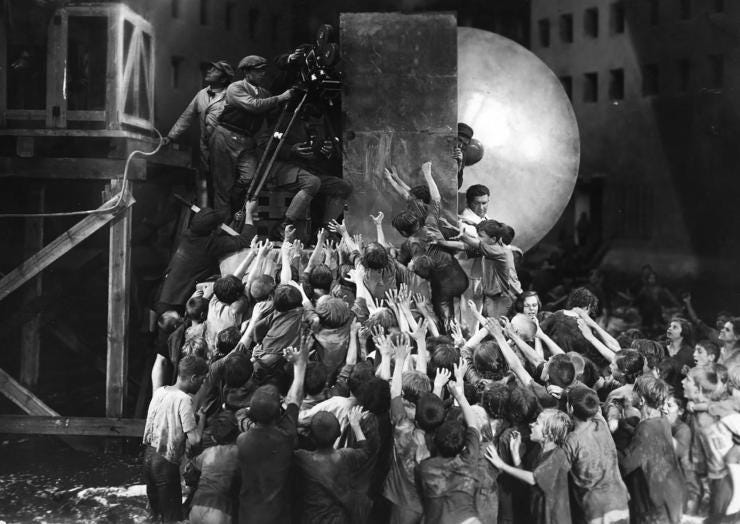
Behind any media effect unfolds a complex historical picture. For example, one of the grievances related to digital media is the decline of literacy. But post-literacy began long ago, in the modern era. The first signs of post-literacy, like sentence shortening, are traced back to the time when the Enlightenment and the printing press began the process of the democratization of literacy. The democratization of writing and reading made literacy more interactional, which is an oral feature. Then the invention of pulp paper, the rotary press, and the linotype in the 19th century made newspapers cheap and dependent on the masses, not on political elites, favouring oral and interactional over literate and abstract. Then came radio, the first illiterate mass medium, favouring the rise of the “mass man,” to use the term by Ortega y Gasset. And now, when typing has reversed text into texting, the long trend of post-literacy is actually coming to its completion: the reversal of print literacy into digital orality.
Or consider identity politics—it’s a media effect too. It was caused by the reversal from writing, which is inherently reader-blind, to mass media targeting specific demographics. The process evolved over centuries, with mass communication centering less and less on the message and more and more on the audience. TV repackaged former social classes into commercially targeted audiences. This is where identity politics emerged, sometime in the 1970s. In the TV era, the prevalence of demographic identifiers over personal and class characteristics served commercial targeting. But social media brought another reversal, enabling personal customization of content. From media, society adopted demographic-targeting identifiers as a dominant principle of social structuring. Along with other digital effects, like the intellectual escalation of academia into activism, this reversed identity politics from commercial to political use, from managing consumers to managing citizens.
Therefore, we need to take into account all these cumulative and overlapping effects. They are what weave the temporal fabric of civilization and anchor human history in the evolution of media. For me, unraveling and recognizing patterns in these compound media effects is a fascinating exercise.
CAS: As suggested in the review of your book published in Seoul (The Great Digital Reversal; English version), the strict application of the Law of Reversal can sometimes lead to rather apocalyptic scenarios that seem to go beyond Marshall McLuhan’s original perspective. Is it possible to apply the Law of Reversal without veering towards apocalyptic interpretations?
AM: This is a tough one. The acceleration of historical time, another effect of galloping media evolution, leaves us little room for optimism. By the way, as you know, McLuhan, when asked about it, said that he was neither optimistic nor pessimistic but “apocalyptic.” He added, however, that apocalypse is not necessarily gloom, as it promises salvation, which perhaps reflected his Catholic view. But I think he was rather teasing here, as he often was.

I’ve just published my new book, *The Technological Imperative: Why We Develop Our Media* , in which I try to look at the future to which media evolution leads us. The technological imperative is a concept that McLuhan mentioned only in passing, but I see it as a driving force of history, an invisible hand of media evolution. The technological imperative means that any medium seeks better performance. Take the hammer: all historical forms of the hammer embodied some ideal design that made it the best possible extension of the fist and hand. Whoever invented each form of the hammer is not important. That design would have emerged anyway as the next, improved approximation of the hammer’s ideal form.

This is the technological imperative: if a medium can emerge and improve, it will do so. It is not intentional, it has no agency, yet it drives media evolution in a certain direction. We humans select and improve functional forms of media through their use and redesign, so we perform natural selection for media in exchange for the conveniences — extensions — they provide to us.
As media extend, or replay, our functions — I use Paul Levinson ‘s concept of Human Replay here — they develop toward maximum replay, maximum extension. Currently, they can replay our persona and our intelligence. So, the technological imperative drives us toward artificial intelligence.
The issue is that the technological imperative, now seeking ever better performance of artificial intelligence, does not have to stop at the level of human performance. Why replay humans if humans are already outplayed, as in chess and poetry and many other formerly human activities? The technological imperative will push the development of AI further, beyond replaying human capacities. Apocalypse or not, we are bound to see very interesting events, and very soon — because of the accelerating pace of media evolution.
CAS: Paul is another one of my favorite media ecologists. Ultimately, by taking the Law of Reversal to its extreme, one could argue that, in a sense, you’re inverting Marshall McLuhan himself: pushing his arguments to the extreme and arriving at opposite conclusions. Returning to the initial question, to what extent does this approach risk shifting from “pattern recognition” to “pattern imposition” when analyzing complex media processes? Can reversal explain everything, a kind of “one-size-fits-all law”?
I think this is exactly what is happening: by recognizing patterns, we shape the patterns of our perception and then act accordingly. But if they are wrong, it backfires.
The concept of reversal is useful for speculation, because it cannot be rejected or disproved. If, suddenly, a reversal does not happen, or if it happens in a different way, you can always say that this is a reversal of reversal. So yes, the optic of reversal can be universal and universally manipulative.
But frankly, what for? There is no intellectual epiphany in adjusting the hypothesis to the outcomes post factum. It is much more productive to use the optic of digital reversal for exploration and explanation, but also for projection and even planning.
For example, it’s clear to me that we will no longer have calm, quiet periods between media changes, as we did in the past. After, say, printing or electricity changed everything, things used to settle down, society adapted, and life returned to a more or less lasting “normal.” We will no longer have this kind of calm “normal” because of the pace of change. It is too fast. What used to be a media era is now shorter than a human life. Changes that once defined long eras now arrive within years, and soon within months. So we need to reconsider our lives and adjust them to the condition of constant reversals.

Another conclusion is that reversals never bring back what they reversed before. It’s not a pendulum. For example, the reversal of patriarchy is feminism, but when feminism reaches its extremes, it does not reverse back to patriarchy; it reverses into sex fluidity. And so on.
By comprehending these and other characteristics of reversals, we probably won’t learn how to predict or manage them — we simply do not have time for that. But at least we can learn how to make sense of what’s going on and develop some individual strategies. I am working on one such strategy now. My next project is called “Counter-digital media literacy.” I am developing the idea that, in the digital era, media literacy is not about how to use media but how not to use them. I want to reverse the very approach to media literacy. It teaches us better and more engagement with media, which is redundant or even harmful. What’s the point of aiding the persuasive design of media, which makes users addicts? So the idea is to develop tools and tips for counter-digital media literacy. Let’s see if we can fight the technological imperative and trigger media reversals to our benefit.
Bonus tracks
Media Determinism (Substack) by Andrey Mir
The Great Digital Reversal (Seoul) by Eugenio Palopoli
Books by Andrey Mir on Amazon
Media Ecology: Environments, Evolutions and Interpretations by Carlos A. Scolari (here is the introduction)
On the Evolution of Media by Carlos A. Scolari (English edition in Routledge: On the Evolution of Media)

See other books by Andrey Mir:
NEW! The Technological Imperative: Why We Develop Our Media. Essays on Human Agency and AI (2026)
The Viral Inquisitor and other essays on postjournalism and media ecology (2024)
Digital Future in the Rearview Mirror: Jaspers’ Axial Age and Logan’s Alphabet Effect (2024)

 | A guest post by
|