
As speech shrinks — thought starves. Cognitive effects of digital orality
Digital orality: fewer words, more interaction, less abstraction

There is a popular belief that Hemingway averaged 10 words per sentence. Studies don’t confirm it – the estimate is closer to 15. He was surely a master of short sentences, but that was a deliberate style. The shortening of speech we see today is not.

Researcher Arjun Panickssery tracked how the average sentence length has plummeted over centuries – from 50 words per sentence for Chaucer and Spenser to 12 wps in the Harry Potter books.
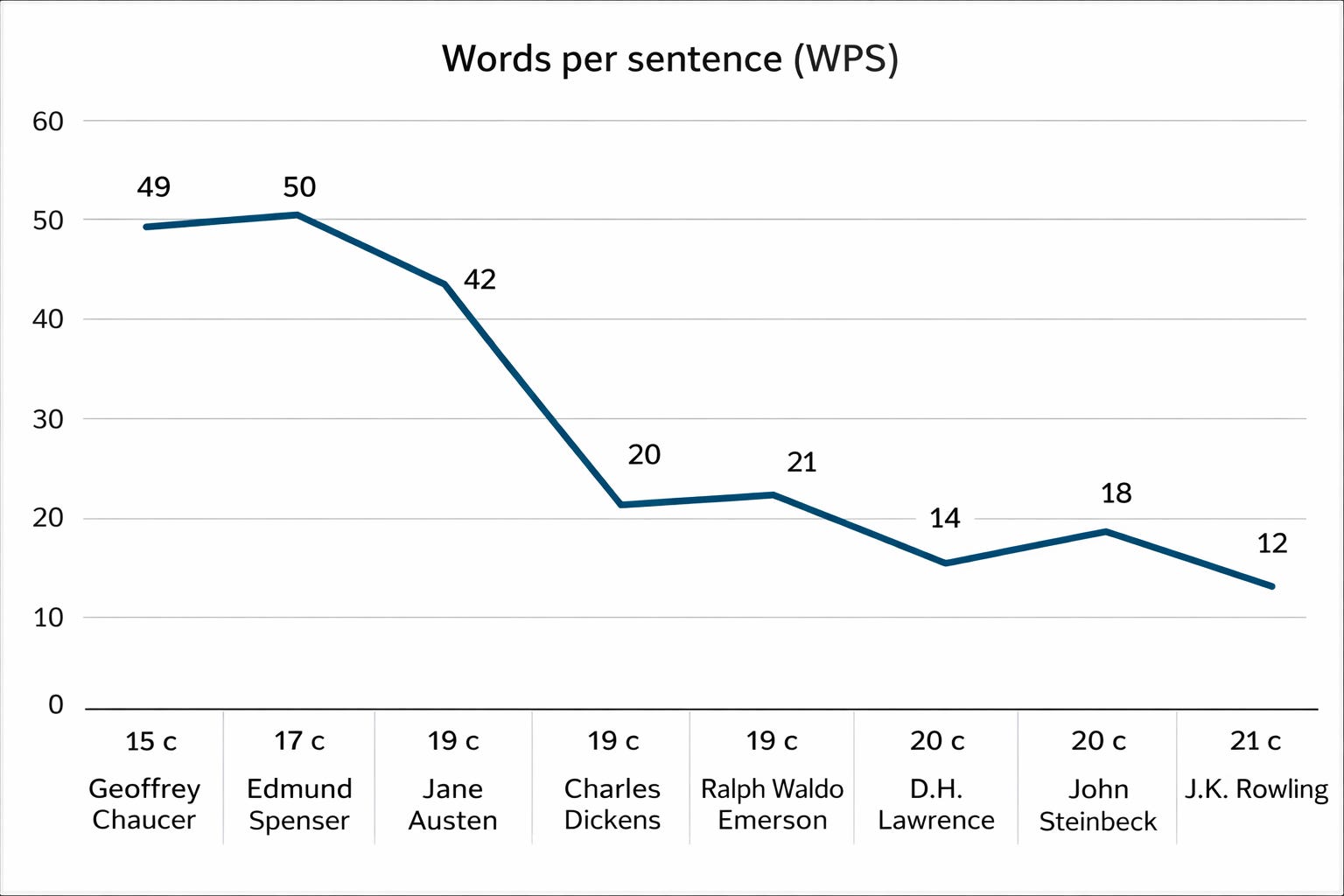
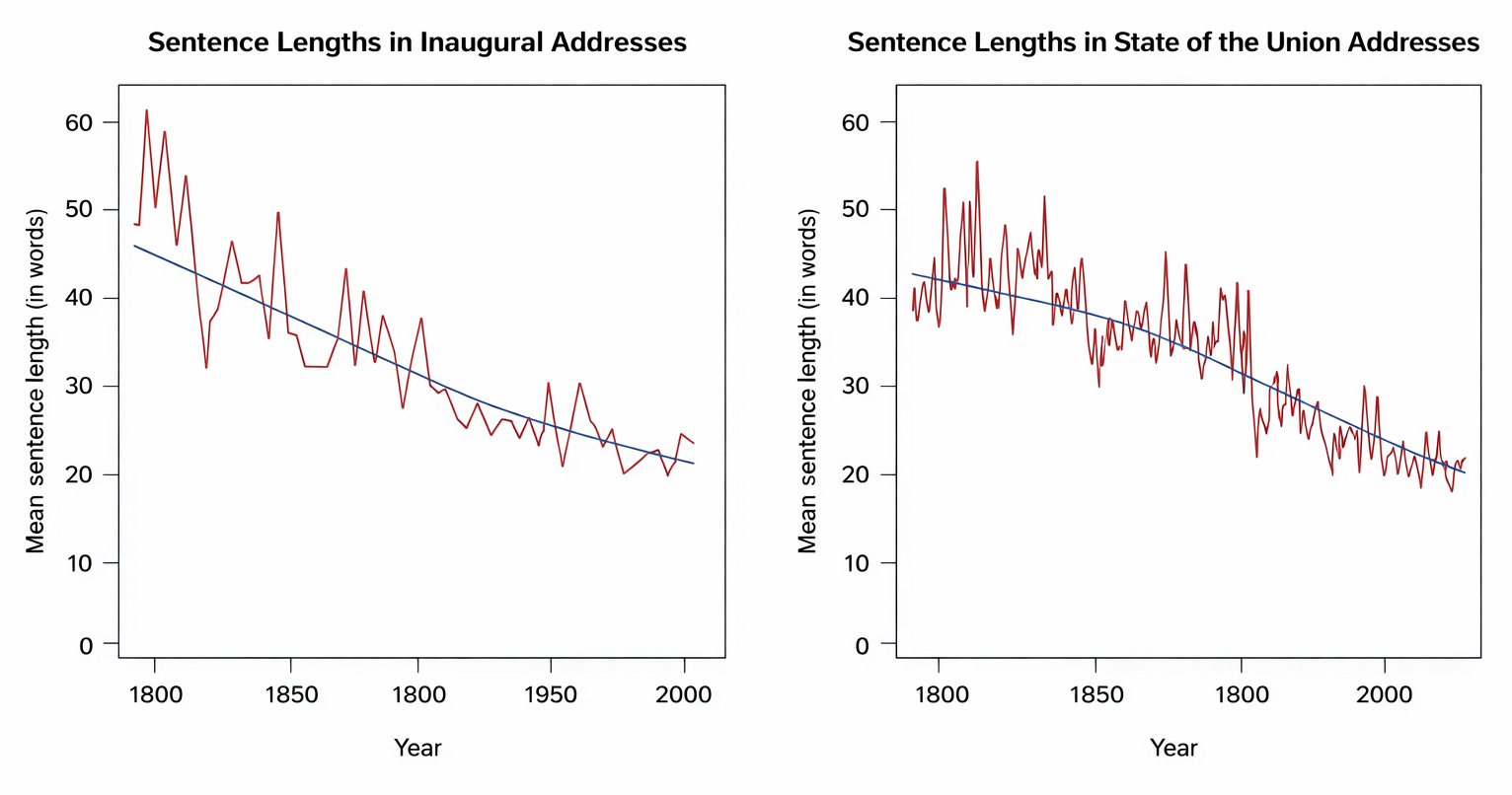
According to Panickssery, this pattern appears everywhere. Newspapers shrank from 35 to 20 words per sentence between 1700 and 2000. Presidential State of the Union addresses dropped from 40 to under 20 wps. Even Warren Buffett’s shareholder letters compressed from 17.4 to 13.4 words per sentence between 1974 and 2013.
Why? Panickssery offers several explanations:
the shift from reading aloud to silent reading;
the fact that only the smartest and most educated could read and write in premodern times, naturally producing complex sentences; and
the rise of journalism with its space limits and punchy style.
The data reveals something important: the shortening of sentences began long before radio, television, or the internet. The shortening of phrasing seems to correlate with the expansion of literacy – suggesting that the underlying cause is the democratization of literacy itself.
The pinnacle of literacy: the semi-literacy of the early modern era
Early writing created craft literacy – a skilled trade of priests and scribes who recorded decrees, taxes, debts, contracts, and so on (see: Media platforms of mind). With rare exceptions of early scholars and authors, writing mostly served bureaucratic functions.

With the growth of scholarship, semi-literacy emerged. Its defining characteristic was that writing expanded beyond recordkeeping into scholarly prose, but the number of readers remained roughly equal to the number of writers. The literati wrote for one another and comprised the audience for one another, as in the Respublica Literaria, the international community of early modern intellectuals.
They didn’t hesitate to construct intricate arguments spanning pages. Not coincidentally, systematic philosophy and speculative thinking flourished during this period. Abstract thinking is tied to writing; before writing, oral people were immersed in concrete situations and did not have a need for abstraction. It seems that abstract thinking fully unfolded precisely in the era of the most complex writing: semi-literacy, when only the most educated wrote and read.
With the rise of printing, literacy became a beneficial social and economic strategy for merchants and craftsmen – the emerging bourgeoisie. Printing was the first industrial enterprise, and profit depended on mass production and consumption, so market forces became an additional driver pulling the masses into literacy.
In Amusing Ourselves to Death, Neil Postman noted that between 1640 and 1700, the literacy rate for men in Massachusetts and Connecticut reached 89-95 percent – probably the highest in the world. Women’s literacy hit 62 percent, also likely higher than elsewhere. This was, of course, the effect of printing and its derivative, Protestantism, which demanded personal reading of the Bible, pushing literacy into the masses even more. It is no surprise that the US became a rare case of a nation established by writing and in writing – and therefore founded on reason and abstract ideals, the effects of literacy.
Mass literacy as the beginning of literacy’s decline
As literacy spread downward and across the demographic pyramid, the writing–reading privilege of the smartest and most educated was diluted by new demographic arrivals. Literacy grew more diverse and inclusive. Popular literature and the mass media emerged, restricting authors by the limits of space and packaging. Some of the most talented journalists came to define literary style: Twain, Whitman, Hemingway, and others. Journalism taught the reading public that “shorter is better.” Not depth of thought, but marketing and speed of interaction began defining writing styles and sentence length.
The semi-literacy of early modernity unfolded the intellectual potential of selected individuals; the democratization of literacy set out to unfold humankind’s collective intelligence, where the overall speed of exchange is more important than intellectual depth.
But there was a trade-off. The growth of literacy through democratization manifested the first signs of post-literacy. Writing grew less abstract and more interactional, intended to amuse the audience. Written sentences became shorter and terser.
It may well be that writing’s greatest effects – abstract thinking and reasoning – reached their peak when literacy was confined to the most educated few, who inevitably practiced heavy and cumbersome prose. Since then, writing has traded scholastic depth for popular breadth and the speed of interaction.
Electricity speeds everything up
The telegraph was the first medium to separate communication from physical transportation.[1] News wire agencies emerged. Telegrams were expensive, charged per letter, encouraging extreme brevity (and, by the way, factual reporting). The telegraphic style and the inverted pyramid – putting the most important information first, which gives the option of cutting less important details – became journalistic standards. As the telegraph tremendously increased the amount of information available to the public through mass media, competition for attention became fierce, further shortening sentences.

The trend accelerated throughout the 20th century. The Economist analyzed hundreds of New York Times bestsellers and found that “sentences in popular books have contracted by almost a third since the 1930s.”
Enters orality
It is becoming widely acknowledged that digital media retrieve some features of orality in our communication, or what I call “digital orality.” Paradoxically, however, the features of orality began to grow well before digital media, just as the shortening of sentences did.
As mentioned above, Arjun Panickssery writes that presidential State of the Union addresses dropped from 40 to under 20 words per sentence, with inaugural addresses following suit.
Not only that – it turns out that presidential inaugural addresses have also become “more oral.” There is an app, Havelock.AI, created by Joseph Weisenthal of Bloomberg, that allows users to measure the “scores” of orality and literacy in any text by analyzing specific linguistic features of orality. Using Havelock.AI, Paul Williams found that 19th-century inaugural addresses were predominantly literate in character, while 20th-century speeches showed an increasing ratio of orality. And this happened long before digital media.
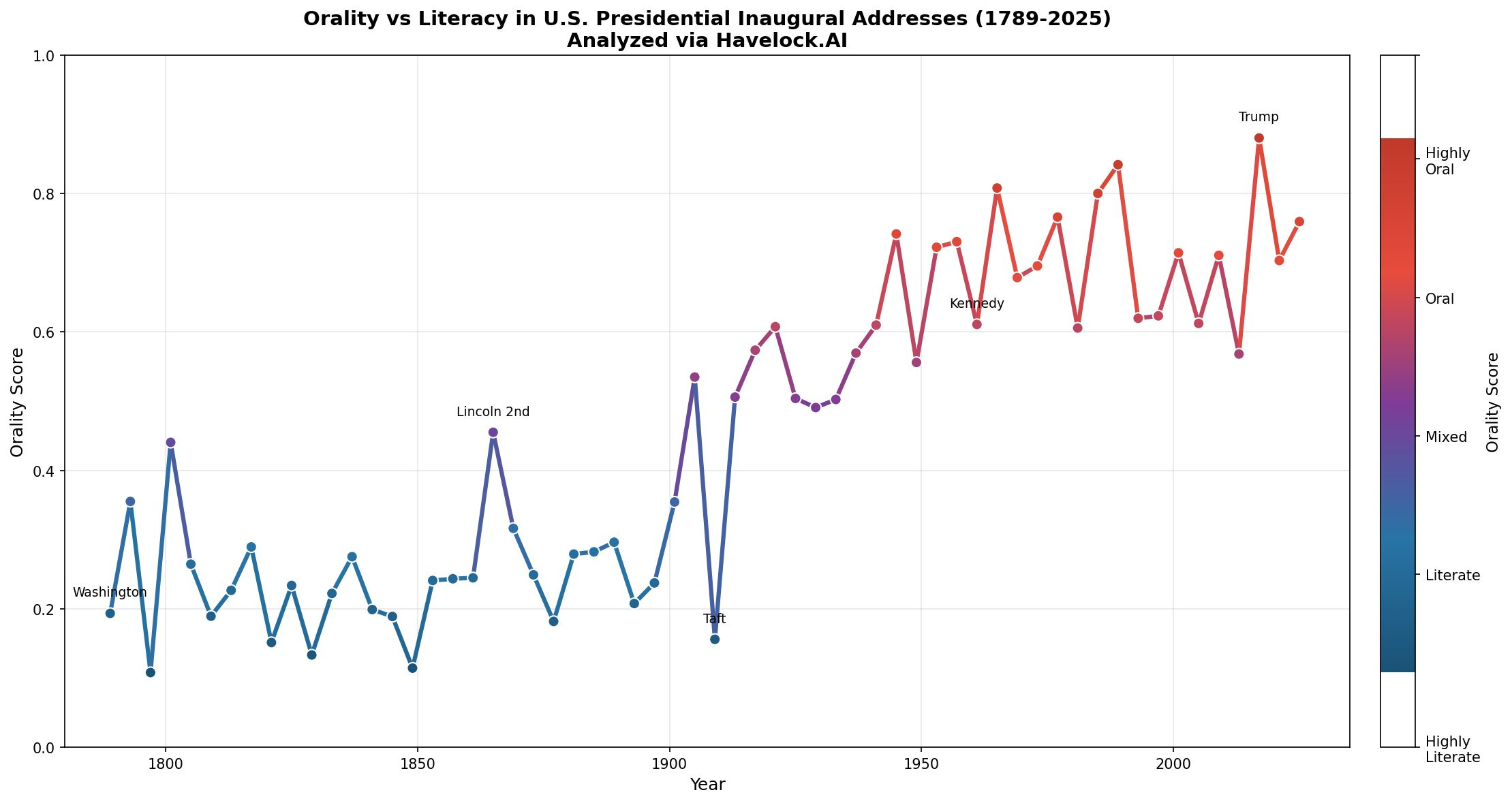
Of course, public political speeches are meant to be delivered orally. And yet, the earliest of them demonstrated a high level of literacy. And only sometime in the 1930s did their oral nature become prevalent. Why?
I can think of several major factors that contributed to the growth of orality in ceremonial political speeches and elsewhere in public communication:
The penny press. The invention of cheap pulp paper, linotype machines, and rotary presses in the 19th century drastically reduced the cost of newspaper production. This made the press independent of party funding and dependent on mass readership. The mass media became truly mass. Of course, mass literacy was required – and had largely been achieved in the West by that time.
Populism. Getting a taste of public news, the masses entered the public sphere. They became a decisive factor in politics. Not surprisingly, universal suffrage appeared. Politicians needed the masses. The language of politics shifted from literate to oral.
Industrial capitalism. Industrial production required the masses; it also required mass media to deliver advertising. The rise of advertising followed, making the media rich and influential and placing them at the center of shaping public opinion.
Media boom. The confluence of booming mass media, populist politics, and industrial capitalism created an unprecedented intensity of printed news – remember morning and evening (!) newspapers? The norms of journalistic writing came to shape the style of public discourse.
Audiences as a commodity. The mass media pivoted from delivering content for readers to delivering audiences to advertisers. Attracting audiences meant accommodating their tastes and language, inherently more oral than the language of the elites.
Radio! Radio became the first non-literate mass medium. McLuhan called radio the tribal drum; radio not only delivered news instantly but also synchronized the masses within national languages, which favored both oral unity and empires.
The emergence of the “mass man” (Ortega y Gasset), with Bolshevism, fascism, unions, and so on as side effects.
The emergence of electric empires built on printed and radio slogans. The last three empires in human history, the communist, Nazi, and commercial ones, were based on the hybrid of print and electricity. It was the poster plus the god-like voice declamation – newspaper portrait with headline (a sort of dazibao) plus radio – that created these empires. This demonstrated how literacy and orality blended to reach masses who remained more oral than literate (what Walter Ong called “strong oral residue”[2]).
All this happened between 1900 and 1930.
Everything is a media effect. To absorb the masses, the public sphere had to become less literate and more oral. The era of post-literacy had begun. Presidential addresses just reflected this tectonic shift.
Digital orality: the hybrid of talking and writing
The shortening of sentences and the growth of orality go hand in hand. We need shorter phrases and fewer words to converse than to write. The reason is simple: in conversation, meaning comes not just from words but from tone, gestures, facial expressions, context, and rapport. People prompt each other with cues and build conversational structure together, making syntax less demanding. Writing lacks these extra-verbal means, requiring grammatical rigor and lexical precision to make sense.
In other words, writing has to be complex, while oral conversation provides richness of expression by employing extra-linguistic drama and acting, which allow language to remain simpler in both grammar and vocabulary.
The shortening of sentences and the growth of oral features started with mass literacy and accelerated with electricity. Now, digital media are completing the reversal of literacy and the retrieval of orality. Digital technology sped up printing into typing and created texting, a hybrid of spoken and written language. Like oral speech, texting is immersive and conversational. Like writing, texting separates words from the speaker to deliver them beyond immediate conversation.

Instead of nonverbal means of primary orality – tone, gesture, facial expression, and rapport – texting uses their digital substitutes: emojis, gifs, and abbreviations, thus allowing acting and drama by typing-and-tapping, relieving us from the rigor of literate grammar and vocabulary.
This hybridization creates digital orality – a state of mind and culture that detaches people from physical reality while immersing them in digital behavior. Digital orality is interactional, and this contributes to a further shortening of verbal structures.

Texting: cut the talk – cut the thought
Texting substitutes and suppresses both face-to-face conversations and long reading. What happens to our language capacity when digital orality replaces print literacy? More importantly, what happens to how we think?
When practiced regularly, extended and abstract vocabulary, along with complex grammar, required significant cognitive effort. By detaching words from situations, writing isolated their lexical meaning and enabled new cognitive structures. This is how writing not only reflected abstract thinking but also prompted it.

If there are no cognitive needs for abstraction, there are no words for them. Digital orality reduces the need for abstract thinking by immersing us in situational perception, just as orality did. Texting – the medium of digital orality – additionally shrinks grammar and vocabulary. Use it or lose it. Both the need and the means for complex expression are shrinking.
This might resemble a chicken-or-egg dilemma. If our mental abilities are primary and writing is secondary, then texting just simplifies how we express ourselves—no big deal. People stay as smart as they were when everyone read books; our expression just shortens to match digital speed.
But if it was writing that shaped the cognitive capacity for abstract thinking – and it was – then the shrinking of language means the shrinking of thought. It’s not that just one aspect of our life – digital – is becoming less demanding of expression and thinking. As this aspect grows to replace everything else, our general faculties of expression and thinking adapt to accommodate the increasing demand for speed and interactivity, while neglecting depth and reflection.
New media change how we think, not just how we express ourselves. The major transformation is the demise of literacy, which leads to the simplification of language and thinking in the fashion of orality – for instant connectivity and interaction. It started before smartphones and social media, but now texting is completing the process, expanding its effects from communication to cognition.
These changes run much deeper and are more harmful than the usual suspects of digital media: post-truth, fake news, or polarization. Digital media rewire our brains by replacing inward reflection and abstract thinking, typical of literacy, with oral-style thinking focused on immediate interaction.
One can say, well, this is the world we are going to live in, so cognitive “acclimatization” is inevitable and even required. Media evolution is inexorable, indeed, especially at a global scale. But there is always room for personal choices, if we want to preserve human agency and underlying cognitive capacities, like abstract thinking and the richness of expression. To pursue this choice, one needs to “deconstruct” digital orality back into joyful orality and hardcore literacy – into live human interactions and deep reading, which is essentially the foundation of counter-digital media literacy.
See other books by Andrey Mir:
The Viral Inquisitor and other essays on postjournalism and media ecology (2024)
Digital Future in the Rearview Mirror: Jaspers’ Axial Age and Logan’s Alphabet Effect (2024)

[1] Carey, James. (1983). “Technology and Ideology: The Case of the Telegraph.” In: Carey, James. (1989). Communication as Culture: Essays on Media and Society.
[2] Ong, Walter. (1982). Orality and Literacy: The Technologizing of the Word.
The - deliberate- master of condensed language: 17th century English diarist Samuel Pepys, of whom it has been said his perfect daily entry would have been:
'Woke up, ate, went for a walk, had an ale, went to the Admiralty, went home, had dnner, went to bed'.
Of course, since he lived in interesting times (he wrote a first hand description of 1660s London plague epidemic, the great London fire and the naval wars with the Dutch (quoting a gentleman of the Admiralty "By Jove, it's as if the Devil s**** Dutch!"), and since he had no inhibitions writing even about his mistress, his diary is absolutely worth it
Project Gutenberg free version:
"The Diary of Samuel Pepys — Complete" by Samuel Pepys is a historical account written in the mid-17th century, specifically spanning the years from 1659 to 1669. This richly detailed diary offers a firsthand perspective on daily life during a transformative period in English history, including the Restoration of Charles II. Pepys documents his personal experiences, work as a naval administrator, and the socio-political events of his time, thus providing readers with an intimate look at both mundane and significant occurrences.
https://www.gutenberg.org/ebooks/4200
Post-literacy is the shift to visual literacy, the shift from arbitrary to specific imagery that's spatial, concatenating. Orality is veering extinct as well. We need an entirely new paradigm.