

“Of all the arts, the most important for us is cinema,” said Vladimir Lenin in 1922. Soviet filmmakers would routinely cite Lenin’s dictum to demand more privileges from the Party. Few knew Lenin’s full quote: “As long as the people are illiterate, among all the arts, the most important for us are cinema and the circus.” Soviet dissidents loved the lost bit about the circus.
But that’s not the point I want to make. To counter McLuhan with Lenin’s formula, I say: “Of all the Laws of Media, the most important for us is reversal.”
Laws of Media: the McLuhan Tetrad
For people outside media theory: Laws of Media: The New Science was Marshall McLuhan’s major late project, completed after his passing by his son and co-author, Eric McLuhan. McLuhan advanced the idea of universal media laws, bundling them into what he called the tetrad—the four laws of media. According to McLuhan, any human technology, medium, or artifact: 1) enhances something, 2) makes something obsolete, 3) retrieves something obsolesced from the past, and 4) reverses its effect or flips into its opposite when pushed to extremes or when approaching the limits of its potential.
The clearest example is the car. The car: 1) enhances mobility, 2) obsolesces horses and carriages, 3) retrieves travel on roads like rivers, with infrastructure developing along them, and 4) when pushed to extremes, reverses its effect—creating traffic and restricting mobility.
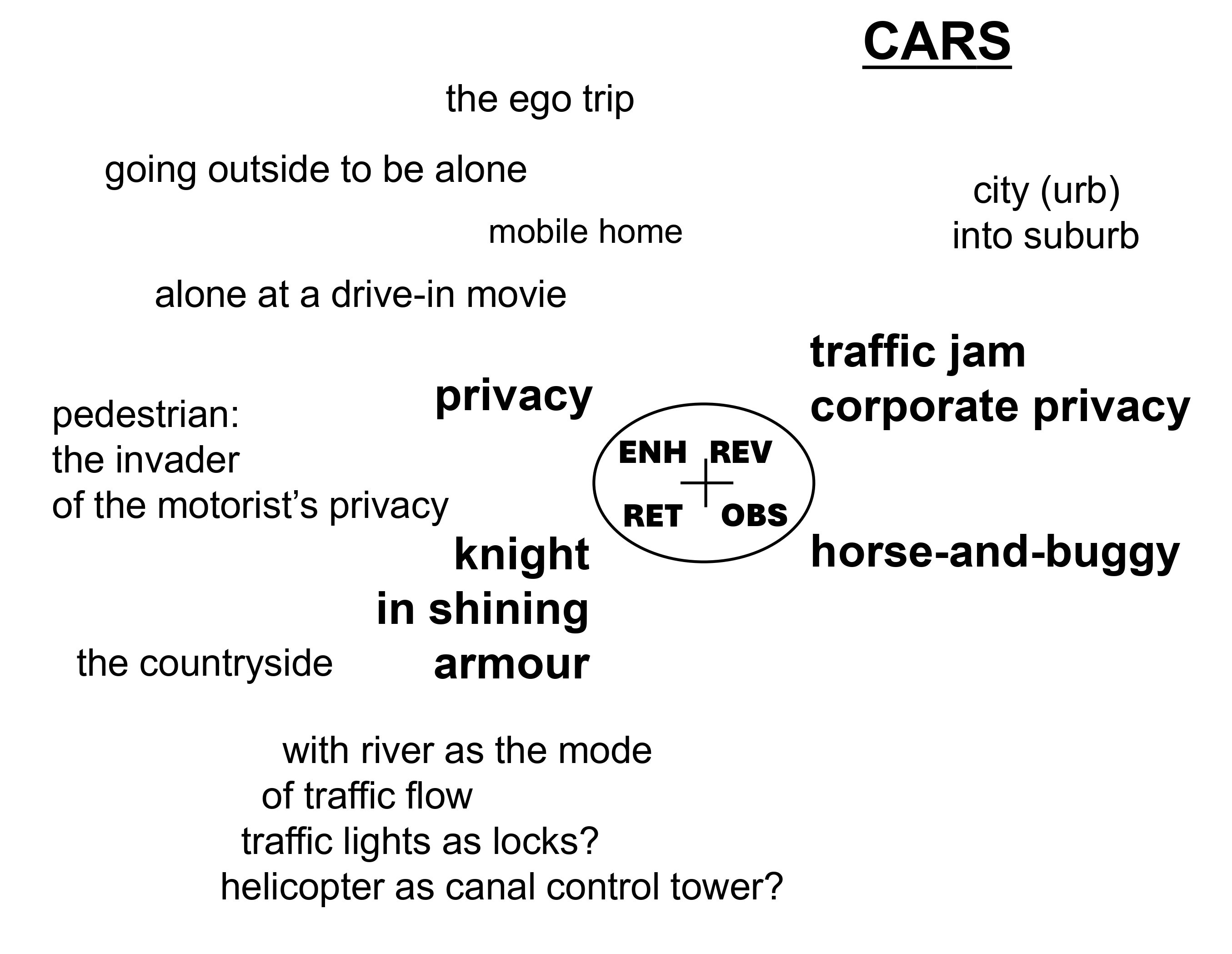
The Tetrad is a powerful tool of media analysis, applicable to anything that mediates human interactions. Here are some examples:
Money: 1) enhances trade and commerce, increases transactions; 2) obsolesces the barter system; 3) retrieves potlatch or conspicuous waste; 4) reverses into credit, which is not money at all. (Based on a Tetrad by Marshall McLuhan.[2])
Social media: 1) enhance online connections and non-local friendships; 2) obsolesce face-to-face socialization; 3) retrieve long-distance correspondence; 4) reverse into social isolation, fake identities, fake news. (A Tetrad by Robert Logan.[3])
Texting: 1) enhances speed, silent communication, literacy; 2) obsolesces phone talks, pencil-paper, keyboard; 3) retrieves consonantal spelling (abjad); 4) reverses into dependence on charge and signal, collapse of spelling, all-thumbs dexterity. (A Tetrad by Rita Leistner.[4])
Unbundling the Tetrad
The Tetrad’s central principle is that all four laws work simultaneously, not successively or chronologically. All four effects happen at once whenever a new medium appears.
Curiously, people outside media theory often split the Tetrad in half without even knowing it exists. Everyone “just knows” that new media, first, make something easier to do and, second, quietly take something familiar away—basically, enhancement and obsolescence. This simple pair of media effects is intuitively obvious. Reversal and retrieval are much harder to see, so naïve media analysis rarely singles them out.
The first media scholar to emphasize the importance of reversal was Robert Logan, a co‑author with Marshall McLuhan. In his 2021 book McLuhan in Reverse: His General Theory of Media (GToM), Logan argued that McLuhan’s entire approach can be described in terms of reversals. [5] Electric media, he wrote, reversed the visual space of literacy into the acoustic space of orality and turned the whole planet into a village—the global village. Logan even made an amazing discovery in the most cited and commented-on of all McLuhanisms: he argued that “the medium is the message” is, essentially, a reversal—and it is!

Reversals attract the attention of other leading scholars in media ecology. Responding to my The Digital Reversal, Carlos Scolari asks what happens when we detach reversal from the Tetrad. In his essay, “Understanding the Law of Reversal (II): Towards a Critique of Total Reversal,” Scolari notes that applying reversal separately eclipses the other three laws and disturbs the “delicate” balance of the Tetrad, but “the exercise is fascinating.”
And he joins the exercise. Scolari puts reversal in the framework of the Hegelian dialectics of thesis-antithesis and notes that emphasizing reversal “doesn’t clearly lead to a superior synthesis, but to an accelerated chain of reversals, implosions, and extremes. Instead of the thesis-antithesis-synthesis cycle, we would have an infinite cycle of thesis-antithesis-antithesis-antithesis-…”
I couldn’t agree more. A reversal emerges in conditions of extremes, but it does not “resolve” extremes and does not restore balance. Under conditions of accelerated time and compressed media eras (which we live in now), a reversal rapidly accelerates to its own extremes and triggers the next reversal, often leading to a chain reaction of reversals overthrowing each other (for example: “patriarchy”—“feminism”—“trans-activism”). This is what we have reached at this point of media evolution, and that is why everything feels upside down compared to just 20 years ago (this is the leitmotif of The Digital Reversal).

Here is my favorite part of Scolari’s critique:
Now I can say it: taking the Law of Reversal to its extreme results in an out-of-control interpretive explosion. In that case, the other three laws cease to function as balancing rods in the theoretical reactor, preventing it from exploding. By “liberating” one of the laws and declaring it autonomous from the others, the analytical engine spirals out of control. A McLuhanian apocalypse.
“Yes” to all, except: what if it’s not just the analytical engine that spirals out of control? What if it’s what this engine reflects? A McLuhanian apocalypse it is: the accelerated extension of humans by media reaches its full potential, its extremes, and the explosion of humans into the world reverses into the implosion of the world into humans. (Alas, it was all already pre‑scripted by McLuhan; we only rewrite it: “The stepping-up of speed from the mechanical to the instant electric form reverses explosion into implosion.”—Marshall McLuhan, 1964.[6])
Further, Scolari illustrates how insightful such a disturbance in the Tetrad’s canonical equilibrium can be. He imagines what happens if we also separate the other laws from the Tetrad. He writes:
We could imagine other books, close relatives of The Digital Reversal, for example, a possible “The Digital Obsolescence” or “The Digital Retrieval”… Now that I think about it, both books have already been written. One was published by Nicholas Negroponte in 1985: Being Digital. In that volume, Negroponte decreed the end of analog media (he even took a swipe at the poor fax machine) and left in his wake a graveyard of media fossils. The other book was written by Jay David Bolter and Richard Grusin and is titled Remediation: Understanding New Media (2000). It’s a monument to the Law of Retrieval.
Separating the other laws of media—whether enhancement, obsolescence, or retrieval—was timely at the beginning of the digital era indeed. Now it’s time for reversal.
It is not we who choose to fracture the Tetrad; it is media evolution that does so.
Testing the Tetrad in the time machine
The integrity of the McLuhan Tetrad depends on how you locate it: as a structural, synchronic grammar of a medium, or as a diachronic, historical account of media change.
The Laws of Media work simultaneously—but when they are applied synchronically. Their simultaneity and even integrity shatter when taken diachronically. I would even say that the simultaneity and integrity of the Tetrad have to reverse into a fractured state when taken to diachronic “extremes,” such as the beginning of time, for example.
Imagine the first Promethean media, like fire, clothes, or the digging stick. What do they retrieve? At the beginning of time (of media evolution), the first media had nothing to retrieve, as there were no prior media effects. At the beginning of time, the first media also had nothing to reverse, as they had not yet reached their extremes or limits. The only thing the digging stick could retrieve was a juicy primordial potato.
In this thought experiment, the first Promethean media:
Enhanced whatever human faculties fire, clothes, and the digging stick enhance (the digestive system, body heat, skin, hand, etc.), and
Made the previous, animal state of humans obsolete.
That’s it.
We can debate, of course, that fire retrieves the sun, or that the digging stick retrieves claws or tusks, but those are weak objections. Fire does not retrieve but extends the sun, and to admit that the digging stick retrieves claws or tusks, we need to presuppose that claws or tusks were earlier human “interfaces” that had been obsolesced.

So there are conditions under which not all Laws of Media apply equally—or apply at all. Here is the heretical claim: at the beginning of time, with the first Promethean media, the Tetrad did not work. The “diachronic” extreme—the imaginary beginning of time—breaks the Tetrad down into “pairs of ratios” (Eric McLuhan[7]) and singles out the pair “enhancement–obsolescence.”
But that was at one end of media history, at its beginning. At the other end, at the end of time, when events are galloping and all time is compressed into the “now”—when everything reaches its extreme forms—we get the opposite picture. Enhancement and obsolescence do exist, but they no longer matter, or matter far less than they did in the “slow” media eras. With the acceleration of time, multiple and accelerating enhancements and “obsolescences” merge into one perpetual disturbance that we call “change”: everything is changing.

But what really dominates media effects and all changes under the final acceleration of time is reversal, because when human conditions escalate to their extremes, everything reverses.
And this is what makes reversal so special now
With digital media, in the long digital decade between the like button (2007) and ChatGPT (2022), humankind has completed its transition to the digital and reached several “extremes”:
We have reached the instantaneous speed of interaction: you simply cannot interact with the world faster than by clicking.
We have transferred nearly all our activities to the digital, subjecting them to the effects of instant interactions.
Digital media have proliferated across all countries and social demographics, subjecting them to the effects of instant interactions.
The Digital Reversal has ripened.
It’s not just a thought experiment but also the objective conditions that drive reversal as the leading effect of contemporary media, eclipsing the other laws in the McLuhan Tetrad. With today’s speed of media change, things do get enhanced, obsolesced, and retrieved, but above all, nearly everything gets reversed, and this effect is the most impactful.
So, the applicability of the Tetrad depends on historical location and temporal pace.
When time begins, enhancement matters most, it drags obsolescence with it, while the other two effects are not applicable.
When time moves slowly, through incrementally unfolding eras, all four laws of media operate at once—just as Doctor McLuhan ordered.
When time gallops and collapses into the “now,” reversal matters most, it drags retrieval with it, while the other two effects are not applicable.
Under this logic, the Tetrad functioned holistically and with integrity “only” during the period between the first Promethean media and the last Turingian medium, meaning throughout all of media history except its very beginning and very end.
As we approach the end of media evolution and the final reversal of humankind looms on the horizon, media studies become the study of reversals.
The Fifth Law of Media
In the preface to Laws of Media, Eric McLuhan wrote:
We found these four... and no more. He <Marshall> spent the rest of his life looking for a fifth, if there be one, and simultaneously trying to find a single case in which one of the first four doesn’t apply.[8]
So, they tried to find more than four laws. Here is how Marshall and Eric McLuhan describe this search:
The tetrad was found by asking, “What general, verifiable (that is, testable) statements can be made about all media?” We were surprised to find only four, here posed as questions:
• What does it enhance or intensify?
• What does it render obsolete or displace?
• What does it retrieve that was previously obsolesced?
• What does it produce or become when pressed to an extreme?
Over more than twelve years of constant investigation, alone and with the help of colleagues, we have been unable to find a fifth question that applies to all media or to locate a single instance in which one of the four is clearly absent or irrelevant. We issue this challenge to the reader: Can you find a fifth question that applies in all, or in even a significant many, instances? Can you locate an instance in which one of the four questions does not apply?
Your answer is of the first importance as it determines the kind of our science.[9]
Some media scholars took up this call and tried to come up with a fifth law. The most cited attempt was by Frank Zingrone, who proposed extending the Tetrad into a Pentad by adding a law of syncretism,[10] or fusion. This amendment holds that technologies systematically interplay, hybridize, and give rise to new technologies, as when Xerox and the telephone merge into the fax machine, or the stove and electromagnetic waves combine to produce the microwave, and so on.
In another attempt, Duncan Echelson, Gerry Fialka, and Robert Logan proposed completing McLuhan’s four questions with a fifth: “What would have happened—or not happened—if a tool, medium, or artifact had not been invented or developed?” They apply this additional question to probe: what if we had not invented the alphabet and the abacus? Then “the idea of zero would not or might not have emerged.” And we would not have digital technologies, for example. The imagined absence of a medium shows which connections between other media or inventions would disappear and thus clarifies the network of dependencies that each innovation creates.[11]
But in practice, everyone treats the Tetrad canon as sacrosanct. The search for a fifth law is usually framed as an intellectual exercise—an arena for probes in a McLuhanesque spirit, rather than a serious bid for doctrinal revision. The Tetrad appears too harmonious and complete to admit an additional term. Its four laws form a pairs-of-ratios structure that simply does not translate into five. Within that logic, a fifth law is impossible.
Unless you shift the logic itself from synchronic grammar to diachronic praxis and then push that diachronic praxis to its extremes—toward the beginning or the end. This creates a fifth position outside the Tetrad’s internal symmetry by changing the register entirely, just as the time dimension in physics stands apart from the three spatial dimensions.
So, here is the new fifth law to add to the McLuhan Tetrad:
In the beginning was Enhancement,
and Enhancement made humans’ fusion with nature obsolete. In the end will be Reversal—the Reversal of humankind—and this Reversal will retrieve the fusion of humans with their new environment in a new form.
Of course, one may object that AI replacing humankind is an enhancement. And it is—but not of humankind. For humankind, transcending biology is reversal. Actually, the ultimate, final reversal. But that is a topic for another debate.
Here I stop shaking the pillars, for now. Only a month remains before the annual convention of the Media Ecology Association. I hope the comrades do not expel me from the Party and banish me somewhere in the far north, in the North American Siberia... which is Canada anyway, so not much to lose.
Many cultural, political, and epistemological reversals that prefigure the ultimate reversal of humankind are collected and analyzed in The Digital Reversal. Check it out on Amazon:

Appendix
Robert Logan: Cataloging McLuhan Reversals
This is an excerpt from McLuhan in Reverse: His General Theory of Media (GToM) by Robert K. Logan (2021). Published with the kind permission of Robert Logan.

This chapter is a catalog of McLuhan reversals based on his writings and his observations of the oral, written and electric ages of communication. In addition, it also contains a projection of what his reversals might have been if he had survived into the digital age, which sadly he did not. The purpose of this chapter is to collect all of McLuhan’s reversals and McLuhan-like reversals in one place to support the hypothesis that thinking in terms of reversals was an integral part of McLuhan’s approach to understanding media and their impacts and is also a useful tool for understanding the digital technologies that he never had a chance to experience.
McLuhan’s reversals have been divided into three categories based on his writings and a fourth category has been added, namely McLuhan-like reversals for the digital age:
1) reversals that were part of McLuhan’s methodology as used in his General Theory of Media;
2) reversals that are associated with the transition from the age of oral communication to the age of written communication and mechanical forms;
3) reversals that are associated with the transition from the age of written communication and mechanical forms to electric forms of communication; and
4) reversals that are associated with the transition from the age of electric forms of communication to digital age of communication formulated in the spirit of McLuhan reversals.
1) Catalog of McLuhan’s Use of Reversals in His Methodology
figure reverses into ground or environment
percept reverses into concept
cause reverses into effect
environment reverses into anti-environment
media reverse into extensions of man
extensions of man reverse into amputations
media reverse into environments
medium reverses into massage
environments as passive wrapping reverse into environments as active processes
a medium pushed too far reverses into complementary or opposite form
a work of art or performance reverses into the public or audience
content reverses into user (“the user is the content”)
exposition reverses into exploration
service of media reverses into disservice of media
patterns of technology use reverses into patterns of societal organization
obsolesced technology reverses into an art form
invention reverses into mother of necessity
user of a medium reverses into servomechanism of that medium
jokes reverse into grievances
content or message reverses into the medium (“the medium is the message”)
communication as the
transmission of information reverses into communication as
participation in a common experience
2) Reversals from Oral Age to the Age of Written Communication
ear reverses into eye
oral reverses into literate
acoustic space reverses into visual space
bard reverses into scribe
poetry reverses into prose
Homer reverses into written history as in Thucydides
Eric Havelocks’s tribal encyclopedia reverses into codified law
tribe reverses into city state
tallies reverse into numeric notation
apprenticeship learning reverses into formal education
3) Reversals from the Age of Written Communication and Mechanical Forms to the Age of Electric Communication and Forms
the literate reverses into the electric
mechanical technology reverses into electric technology
patterns of written communication reverse into patterns of oral communication
visual space reverses into acoustic space
the written page reverses into the movie and TV screen
linear causal connections reverse into a field or ecological approach
consumers reverse into producers
the age of manufactured goods reverses into the age of “do it yourself”
automation reverses into do it yourself
DIY as home improvements reverses into DIY as a culture
goal-seeking or job reverses into role-playing
centralism reverses into decentralism
specialism and expertise reverses into interdisciplinarity
expert reverses into group discovery and the task force
individual effort reverses into task force
monopolies of knowledge reverses into crowd sourcing
linear sequential mechanical ordering reverses into instantaneity and all-at-onceness
fragmentation, specialization reverses into wholeness, diversity, involvement
separation of function reverses into integrated and organic integration
detachment reverses into involvement
Eastern cultural forms reverse into Western cultural forms
Western cultural forms reverse into Eastern cultural forms
country side reverses into the city as focus of commerce
city reverses into countryside as place of leisure
joke reverses into one-liner
classification reverses into pattern recognition
fixed point of view reverses into interface and pattern
connection reverses into pattern
answers reverse into questions in education
hardware reverses into software
mechanical forms reverse into electronic forms
explosion reverses into implosion
local culture reverses into universal global culture
city forms reverse into highway forms
highway form reverses into city form
in modern industry the artist reverses from the ivory tower to the control tower
industrial labor reverses into learning as a paid occupation
4) Reversals in the Digital Age
With the exception of the reversal of electric mass media into the digital media the reversals of the digital age are the same as those in the electric age. All of the above reversals for electric media apply for digital media. However, some of the reversals in the digital age are different in character because they are more pronounced. We list here each of these reversals that are more pronounced. We indicate for each of these (in parentheses) in what sense they differ from the same reversal in the electric age.
pattern of digital communication reverses into pattern of oral communication
(Internet-based writing such as email and texting have a more pronounced oral characteristic to them.)visual space reverses into acoustic space
(The Internet facilitates the arrival of information on a global scale. Smart phone users are bombarded on all sides from a variety of electronic messages unlike the viewers of TV and the listeners of radio.)linear causal connection reverses into a field or ecological approach
(In the digital age there is the addition feature that the field elements are interconnected by the Internet and other forms of networking.)consumer reverses into producer
age of manufactured goods reverses into the age of “do it yourself”
automation reverses into do it yourself
DIY as home improvements reverses into DIY as a culture
(There are more “do it yourself” options available in the digital age than the electric age such as: self-publishing, making things using 3D printing. In addition, because of the two-way flow of information with the Internet users can create their own artistic or journalistic creations and find audiences using such outlets as personalized Web sites, blogs, podcasts, and postings on YouTube, Vimeo, and social media such as Facebook, Instagram, Snapchat, Twitter, Reddit and TikTok.goal-seeking or job reverses into role-playing
(Many more folks are self-employed using the Net and the Web as a platform to earn a living or start a business online.)centralism reverses into decentralism
(The Internet and the Web are totally decentralized. With personal computers and smart phones connected to the Internet users are at the center of a global flow of information that they can access from almost any place on the planet. In addition, because of the two-way flow of information that the Internet facilitates they can also get their message out anywhere they find themselves.)specialism and expertise reverses into interdisciplinarity
(The reversal from specialism and expertise into interdisciplinarity because of the ease of access to information and collaborators. The reporting of research is not so siloed because of the Internet.)expert reverses into group discovery and the task force
(The Internet facilitates collaboration on a global scale.)individual effort reverses into task force
(more so in the digital age because of the ease of access to collaborators using the Internet)monopolies of knowledge reverses into crowd sourcing
(The Internet facilitates accessing the knowledge of others on a global scale.)linear sequential mechanical ordering reverses into instantaneity and all-at-onceness
(the transmission of information speeds up with digital media and hence things are even more instantaneous and all-at-once.)Eastern cultural forms reverse into Western cultural forms
Western cultural forms reverse into Eastern cultural forms
(Cultural exchanges increase through the use of digital technologies that facilitate communication on a global level.)mainframes reverse into personal computers [a McLuhan prediction]
products reverse into services [a McLuhan prediction]
printed book as a product reverses into a service [a McLuhan prediction]
(McLuhan’s predictions from the electric age were realized in the digital age for all three of these developments with e-book as the format in which the printed book becomes a service.)hardware reverses into software [a McLuhan prediction]
(This is what literally happened in the digital age)explosion reverses into implosion
(all forms of human knowledge and expression implode on the Internet)local culture reverses into universal global culture
(The Internet facilitates cultural exchanges and hence facilitates the creation of a universal global culture)
See other books by Andrey Mir:
NEW! The Technological Imperative: Why We Develop Our Media. Essays on Human Agency and AI (2026)
The Viral Inquisitor and other essays on postjournalism and media ecology (2024)
Digital Future in the Rearview Mirror: Jaspers’ Axial Age and Logan’s Alphabet Effect (2024)

[1] McLuhan, Marshall, and McLuhan, Eric. (1988). Laws of Media. P. 148.
[2] McLuhan, Marshall. (1974). “Living in an Acoustic World.” A lecture at University of South Florida.
[3] Logan, Robert. (2021). “Marshall McLuhan’s General Theory of Media.” New Explorations: Studies in Culture & Communication, Vol 2, No 1, (Autumn), p. 87.
[4] Leistner, Rita. (2013). Looking for Marshall McLuhan in Afghanistan. Text and iPhone Hipstamatic Photography. Rita Leistner worked as a photojournalist in an experiment called “Basetrack”—an American military initiative to use social media to bring the Marines closer to people back home. She was deployed to Afghanistan in 2011, where she photographed the lives of both Marines and locals. Her trip coincided with the rise of social media and the 100th anniversary of McLuhan. A Torontonian and semiotician, she wrote the remarkable book Looking for Marshall McLuhan in Afghanistan (2013), which features several notable Tetrads. This and some following Tetrads are taken from her book.
[5] Logan, Robert K. (2021). McLuhan in Reverse: His General Theory of Media (GToM).
[6] McLuhan, Marshall. (1964). Understanding Media. The Extensions of Man. P. 35.
[7] In the Preface to Laws of Media, Eric McLuhan writes: “Gradually, as we searched for the fifth law, other discoveries and implications began to emerge. The single largest of these was that of an inner harmony among the four laws—that there are pairs of ratios (emphasis mine—A.M.) among them—and of the relationship between that and metaphor.” McLuhan, Marshall, and McLuhan, Eric. (1988). Laws of Media: The New Science. P. ix.
[8] McLuhan, Marshall, and McLuhan, Eric. (1988). Laws of Media: The New Science. P. viii, Preface, by Eric McLuhan
[9] McLuhan, Marshall, and McLuhan, Eric. (1988). Laws of Media: The New Science. P. 7.
[10] Zingrone, Frank. (1991). “Laws of Media: The Pentad and Technical Syncretism.” McLuhan Studies, 1.
[11] Echelson, Duncan, Fialka, Gerry, and Logan, Robert K. (2022). Expanding and Enriching the McLuhan Tetrad. New Explorations: Studies in Culture and Communication, 2(2).