
The McLuhan oar and Salvador Dali’s fax to the McLuhan Centre
Marshall McLuhan’s longtime associate Derrick de Kerckhove shares memories of their work in the 1970s—Part I

Derrick de Kerckhove is perhaps the only person in the world who took Marshall McLuhan’s class twice, for two closely linked but opposite reasons. On the one hand, he was fascinated by McLuhan’s thinking. On the other, he didn’t quite understand it and wanted to work his way through it. That second year unexpectedly grew into nearly fifteen years of collaboration, during which Derrick became McLuhan’s French translator and an associate at the Centre for Culture and Technology.
If there is such a thing as apprenticeship in the modern world, Derrick was McLuhan’s true apprentice—but also a colleague and collaborator, and later even his successor in both intellectual and administrative roles. Soon after McLuhan’s death in 1980, Derrick de Kerckhove became Director of the McLuhan Program in Culture and Technology, leading it for 25 years—from 1983 to 2008. He went on to write several important books on media, including The Skin of Culture, The Augmented Mind, and, most recently, Quantum Ecology: Why and How New Information Technologies Will Reshape Societies.
Over the years, Derrick has become one of the central figures of the Toronto School of Communication. He now lives in Rome and rarely visits Toronto, but new technologies allow us to stay in touch: he has participated in McLuhan Salons via Zoom. At the recent Media Ecology Association Convention in Winnipeg (June 25-28, 2026), Derrick de Kerckhove delivered the keynote address and received the Neil Postman Award for Career Achievement in Public Intellectual Activity. It was the perfect occasion for us to sit down and talk about his years working with McLuhan.


Andrey Mir: How did you meet Marshall McLuhan?
Derrick de Kerckhove: I met McLuhan because of my fiancée. But before that, a short introduction is needed. I came to Canada from Belgium, where my family was low-level noblesse. That might sound romantic, but in Belgium it’s almost a religion to be noble, and I didn’t like that. We lived in New Delhi for a time, where my father was acting ambassador, and as a kid I played with the sweeper and did not know any difference. Kids have this sense of natural equality, and I took it in as something fundamental. But Belgium negated that.
So, I have a natural democratic sensibility. In 1962, after studying first in Belgium and then at a French high school, where I did my baccalauréat, I came to Canada, where my brother worked. And I loved it here very much. Of all the countries I’ve been to, Canada gave me the strongest feeling of living in a democracy.
But there was a problem. My French and Belgian education gave me Cartesian thinking—logical, analytical, rational—a good base, but boring for a young man with some uncertain intellectual ambitions. I wanted something else, different, uncharted, and I felt miserable writing papers I didn’t consider important in any sense: no cutting edge, no real discovery. So, I complained to my future wife, then fiancée, and she said: look, there are three stars at the University of Toronto—go study with them!
That was a great idea. First was Northrop Frye, the literary critic with a big reputation at the time. He wasn’t a good speaker, but he was a very good thinker. The only problem was that his thinking was along the same lines as what I was pursuing in the French department—pretty much the same systematic literary analysis that didn’t excite me. Then there was Robertson Davies, an excellent novelist, a great raconteur, a sort of salon person. He was fine, too. They both fully deserved their reputation.
And then there was Marshall McLuhan. A complete reversal of everything I knew about university teaching. The first time I listened to him, I thought, “This is what I’m here for!” I had finally found something deserving my full, devoted attention, even though I didn’t understand a word. It was just two years after his Culture and Technology program was established, so it was 1965.
There was a group of fifteen or twenty postgrads, and I was at the lower end of the class—I barely scraped a “B-.” It was so amazing to learn, but since I didn’t understand McLuhan in the first year, I decided to take his class again the following year. That second year set the course of my entire life.

AM: This is how you started working with McLuhan? How did that happen?
DK: Yes, in my second year in his class, McLuhan got a proof from Le Monde, the most important newspaper in France, with his interview on education. I happened to be there, and Marshall said, “Oh, Derrick, you’re French, you can read this.” About twenty minutes later, he came back and asked what I thought. I said, “It’s not bad. Not perfect, but not bad.”
He asked, “Why not perfect?”
I said, “Because here, here, and here it doesn’t quite sound like what I understand of your thinking.”
Marshall looked at me and said, “Really? You know my stuff after all.”
I said, “I wouldn’t dare.”
And I meant it. But he wasn’t bothered at all. He turned to Barrington Nevitt, who was working with him on Take Today, and said, “Barry, from now on Derrick de Kerckhove will be our translator.” And that’s how I started.
AM: What did you translate?
DK: The first thing I translated was From Cliché to Archetype, written by Marshall McLuhan and Wilfred Watson. And right away, something memorable happened. In that book, sections were arranged alphabetically by the first letters of their titles. But the section “Index” wasn’t at the end, as usual; it was placed in the alphabetical sequence with other sections, under “I.” It was one of his clever, playful ideas.
And that playfulness gave me another idea. I remembered that in Bouvard et Pécuchet, one of Flaubert’s novels, there was a Dictionary of Received Ideas at the end—a dictionary of clichés, a catalog of what “everyone says.” Since our translation was about clichés too, I said to Marshall: “What if we add to each section an entry from Flaubert’s dictionary of clichés that begins with the corresponding letter?” He was delighted—he thought it was a great idea.
And so we did. Under French copyright law, Flaubert’s novel was old enough for us to use it, and we inserted clichés from nearly a century earlier into our own catalogue of clichés. You can still find this French translation of From Cliché to Archetype. It’s very different from the English original because of this interplay with Flaubert’s clichés. This was, of course, very relevant to francophone readers.
AM: I know McLuhan influenced your PhD thesis. How did that happen?
DK: Well, I struggled with my thesis for six years. I couldn’t find a proper way into my topic: the decadence of tragic art in eighteenth-century France. I was getting nowhere and felt miserable about it.
One day, I was sitting at the Centre for Culture and Technology with my head in my hands. Marshall came in and said, “Oh, Derrick, you look very glum today.” I said, “I think I’m going to leave the university.” He said, “Oh, no.” He was very attentive and kind. Usually, he didn’t get involved in things like that, but this time he did. There was nobody else there, so we sat down together.
He said, “Why? What’s wrong?” I told him I just couldn’t write the thesis.
He said, “That’s because you don’t know what you’re looking for. What’s the theme?”
I said, “Tragedy.”
He asked, “So what do you think tragedy is about?”
I said, “It’s drama, an art form.”
He said, “No. It was a Greek invention to absorb the effects of the phonetic alphabet.”
I said, “I don’t understand the connection. Please explain.”
He said, “I call it QUID—quest for identity. The alphabet turned the community into individuals, and that separation was tragic. Think of Oedipus.”
It hit me like lightning. It turned everything around. It was cryptic and illuminating at the same time. Illuminating, because it was so totally different from what I had been looking for. And exciting, because it needed unpacking, and that’s what inspired me. Four months later I had written four hundred pages! After six years of getting nowhere! Marshall was the only person outside the committee to attend my defense.

AM: What was he like to work for?
DK: He was quite commanding, almost authoritarian. He could call late at night without apologizing. I often felt he thought of me as someone at his service. But it was clear between us that he also offered something of much greater value in return: his ideas, observations, and opinions. It was much like the relationship between a master and an apprentice who learns a great deal by doing various tasks and simply being around.
And that was the privilege I accepted with constant gratitude: working on translations, accompanying him to lectures, traveling with him to France, going to church together for the 12:10 Mass at St. Michael’s, having lunch in the faculty cafeteria at St. Mike’s. Driving him home took about twenty minutes, and that was my guaranteed one-on-one time with McLuhan. Sometimes, if he was interested in the topic, we’d park outside his house, and he’d keep talking in the car. It was constant learning, never a dull moment. He was always making spontaneous discoveries as he spoke, and you could see the ideas emerging in real time—what is known as his “probes” and “one-liners.”
AM: For example?
DK: I wish I had recorded everything. It was so natural, so mundane at the time, and yet so fascinating if you stop and think about it. For example, we once discussed figure and ground (one of the key concepts in McLuhan’s thinking—A.M.), and he said, “The crunch between figure and ground creates monsters.” I’ve never seen that quoted anywhere else, so my memory may be the only evidence that he ever said it. But once you start unpacking it, you see how deep it is. A good example today is Donald Trump: the professional “figure” of a local “CEO” becoming the “ground” of global change, not to mention that person’s specific traits.
Or, on another occasion, when I was driving him home, I brought up the declaration of 1975 as the International Women’s Year. I had just written a paper on feminism and was very excited about it, so I asked, “Marshall, what do you think of feminism?” He said, “The sound of one hand clapping.”
Another time, I took a phone call from France. They wanted to invite him to speak and asked how much he wanted to be paid. I turned to him and asked. Marshall said, “What’s the theme?” I told him it was education or television—I don’t remember which—and he said, “That’ll be five thousand dollars.” They said, “Fine,” and we got the invitation. Later that day, driving him home, I said, “Marshall, five thousand dollars—that’s a sizable sum.” He answered, “Well, that’s how I do it. If I’m interested, I don’t ask for any money. But if I’m not going to learn anything from the topic, I ask five thousand.” Five thousand dollars at that time would have been perhaps twenty-five thousand in today’s dollars. It was really a lot of money.
Another time he was very personal with me was when I asked him for a recommendation for a Canada Council grant. I didn’t like doing it, but I needed the grant.
He said, “Do you really want this grant?”
“Well, yes. I’m here to ask for it.”
“Okay,” he said. “If you really want it, don’t ask me.”
“Why not?”
“Because if they see my name on it, you definitely won’t get it.” He knew how distant he was from the university brass.

AM: Did he struggle with that alienation at the university? No one is a prophet in his own land, right?
DK: Yes, no one is a prophet at his own university. I think he felt it, for sure. But he also called it upon himself, too. He had a way of dealing with colleagues. I remember him literally brushing off John Leyerle, the head of the School of Graduate Studies, as if he weren’t there. I don’t think he was making many friends in academe.
He wasn’t trying to be unpleasant, and he didn’t attack people gratuitously. But when someone made an objection, or said something he thought was ridiculous, he made it very clear. Beyond that, though, he attended conferences and gatherings, was attentive and engaged, took notes, and stayed in touch with colleagues. Right to the end, he was eager to learn, and he appreciated that in other people.
The second part of this conversation, “Lost Salvador Dalí artwork, faxed to the McLuhan Centre, rediscovered,” is coming soon.
A Footnote
Rediscovering Derrick de Kerckhove in an old photograph and the Story of McLuhan’s Oar
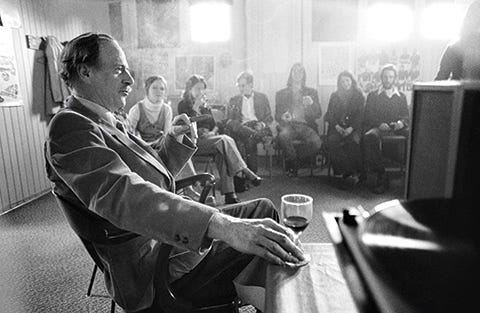
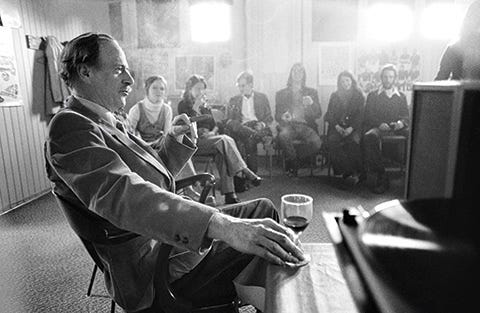
This popular 1973 photo, taken by Robert Lansdale (U of T Archives), shows McLuhan leading one of his famous Monday Night Seminars at the Coach House. I used it many times without realizing that the young man in the white shirt in the background is… Derrick de Kerckhove!
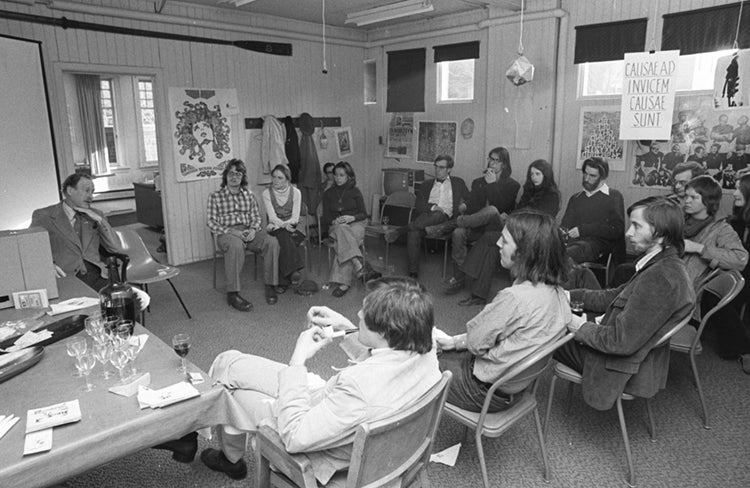
Here are other views of the same seminar. Derrick says he is 99 percent sure that the young man in the white shirt is him, though he cannot recall the exact moment when the photograph was taken. “It is exactly the way I dressed and looked,” he says, “down to the foulard around the neck.”
These photographs are full of remarkable details. McLuhan drinks wine and smokes a cigar, then sits at the table with a beer. That was unusual at the time, and would be impossible now. Yet such a relaxed atmosphere has always been natural to intellectual conversation.
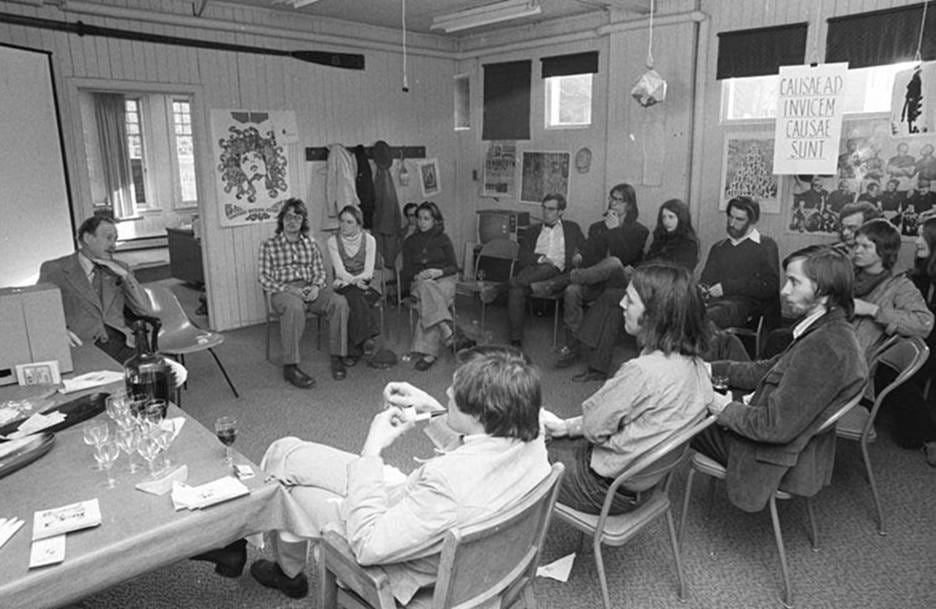
Another distinctive detail is the oar above the entrance (above the spot where John Lennon and Yoko Ono sat four years earlier). McLuhan brought it back from his time at Cambridge and, as Derrick recalls, “was very proud of it.”
Someone described it as “his totemic Cambridge oar, a trophy from Cambridge’s triumph over Oxford: McLuhan was a member of the victorious racing shell.” Totemic, perhaps, but it certainly was not “from Cambridge’s triumph over Oxford.”
The oar is from the 1936 Lent Bumps, Cambridge’s inter-college rowing races, in which McLuhan rowed in his college’s fifth crew, Trinity Hall V, as the inscription on the oar itself indicates.
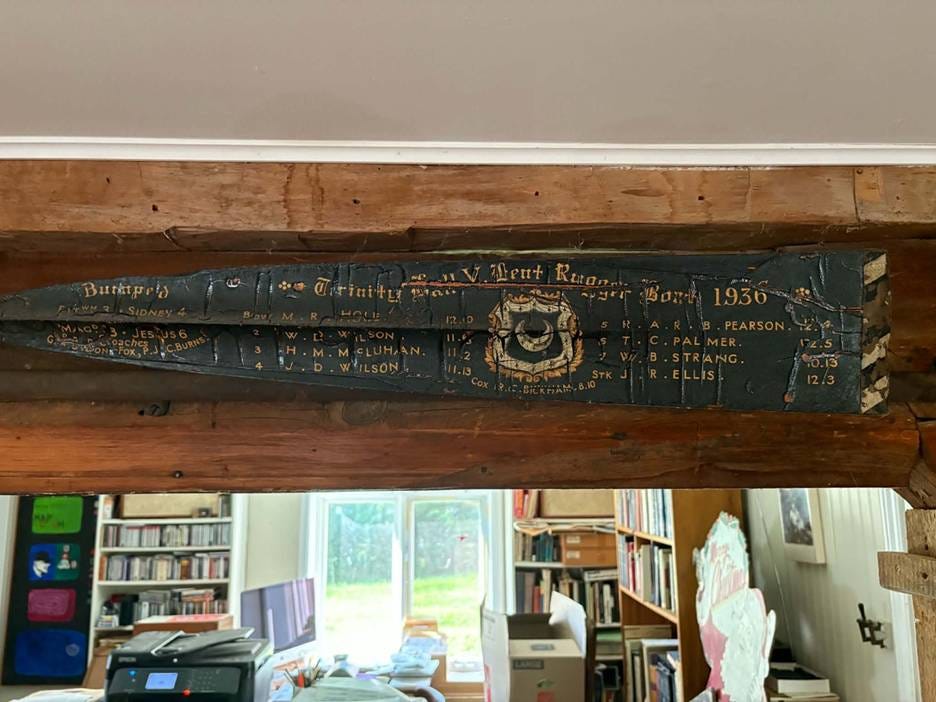
The McLuhan Oar in the Eric and Andrew McLuhan Scriptorium. Photo courtesy of Andrew McLuhan.
This oar, a remarkable piece of McLuhan history, now hangs in the Scriptorium, a barn in a small town outside Toronto that Eric McLuhan, Marshall’s eldest son, turned into a library and an office. It is now the library and office of Andrew McLuhan, Eric’s son and the director of The McLuhan Institute. (But the full story behind the McLuhan oar is yet to be unveiled—hopefully soon, as sources familiar with the matter told me.)

See other books by Andrey Mir:
NEW! The Technological Imperative: Why We Develop Our Media. Essays on Human Agency and AI (2026)
The Viral Inquisitor and other essays on postjournalism and media ecology (2024)
Digital Future in the Rearview Mirror: Jaspers’ Axial Age and Logan’s Alphabet Effect (2024)
