
The last class of Marshall McLuhan
B.W. Powe, one of McLuhan’s last six students in 1978-79, recalls his time with McLuhan—and a never-published one-liner.

“A neo-Romantic hyper-Modernist whose milieu is composed of trees and screens, wind and wires, mythology and media, sentences and sensations” – that’s B. W. Powe. His formative years at the University of Toronto were unique: he was a student of two outstanding Canadian visionaries, Marshall McLuhan and Northrop Frye. McLuhan’s media ecology and Frye’s “literary ecology,” as Powe calls it, shaped who B.W. became: a Canadian poet, novelist, essayist, philosopher, a teacher at Toronto’s York University, and portraitist of modern Canadian intellectualism; he has personally met and known eight Canadian prime ministers and many other northern luminaries.
We met on June 8, 2026, in Stouffville, just north of Toronto, to talk about his memories of McLuhan, refined over the years. I sent my main questions to BW in advance, so he’d have time to recall special memories. It paid off: he came up with untold stories about McLuhan—real gems, as you’ll see.
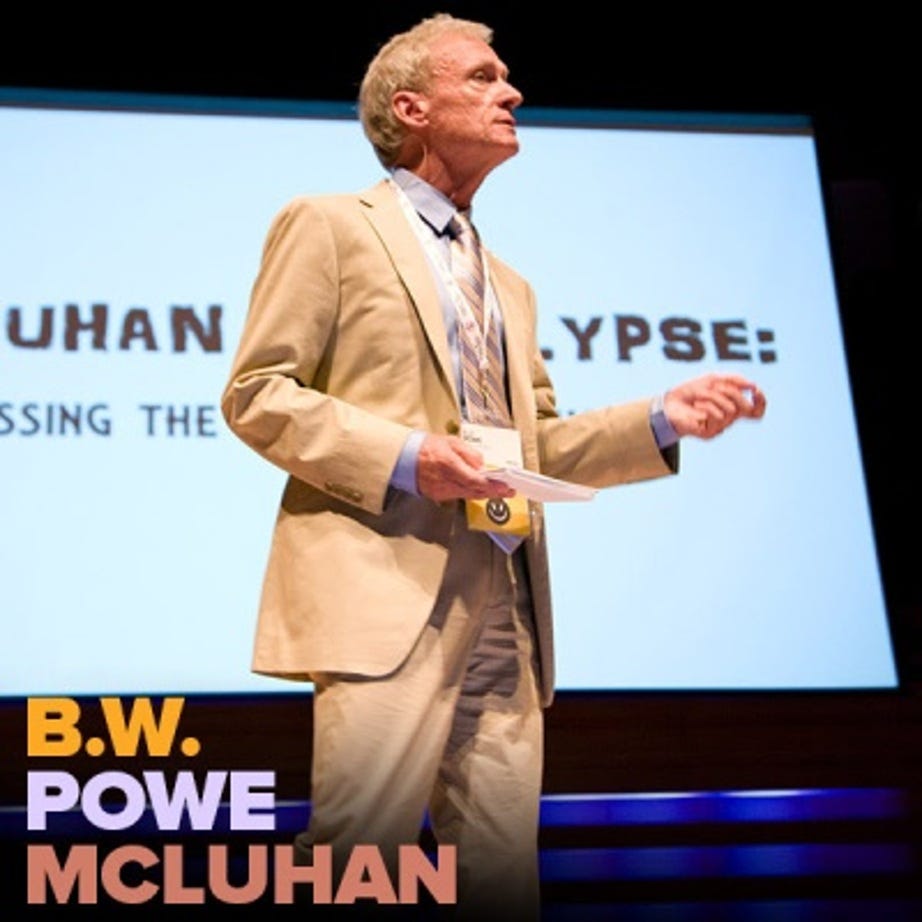
Source: McLuhan Galaxy. B.W. Powe Nominated for the 2022 Medium & Light Award, February 10, 2022. York University Associate Professor Powe won the prestigious Medium & Light Award, which recognizes the universal dimensions of the life and work of renowned Canadian philosopher Marshall McLuhan.
AM: How did you meet McLuhan?
BW: I left undergraduate school with the intention to write. I traveled for a year or two with manuscripts under my arm, novels and poetry. None of them were good, but writing was what I wanted to do with my life. Then I was lucky to win a scholarship and go to the University of Toronto, where I studied with McLuhan and Frye.
I was eager to get into McLuhan’s class. I wanted to be in his presence—because of his books and my obsession with media. It was 1978; I was twenty-three. It turned out to be the last class he taught. There were only six students. The class was really an informal discussion in his office: he’d sprawl on the couch and we’d listen. His health wasn’t good. He would fall asleep at times. But to me he was a larger-than-life figure, almost mythic. I listened more than I talked. I wanted to absorb what he was saying.
Keep in mind that he’d become isolated by that time. To many at the University, he was no longer the media guru, no longer the major cultural figure that he’d been in the ’60s and early ’70s. Yet he was one of the most original minds of our time. So, there was bitterness in him about being sidelined, a certain crankiness and anger. At his own University, an English literature professor who’d become the world-renowned media guru was regarded with skepticism, if not contempt. My MA adviser discouraged me from taking his class, saying I’d find it useless. That, of course, only made me more determined to study with McLuhan.

AM: How would you explain his loneliness or even rejection in academia? Was it envy? Was it a backlash against his popularity in mass culture?
BW: He’d been a household name for years, so yes, there was envy. There was also territoriality: he explored many subjects from many angles; he was always crossing into someone else’s specialty. And there was, as you said, the mass-culture aspect of his fame. Some people in academia took that as a sign that he wasn’t “the real thing” —unlike them, the “true academics.” He was iconoclastic about what he said and did, and that too was regarded as anti-academic. He was also complex in his relations with others; he could be very provocative and forthright.
But it was different for us, the students. There were only six of us, we got a lot of attention. I think he was sensitive to how isolated he was, and it affected the way he spoke to people. When he was with those he saw as part of his circle, he was attentive and protective. It was his way of insulating himself from the unremitting hostility he was experiencing outside this circle. To those who really listened—his students—he was congenial, collegial, and cordial. He was deeply welcoming; he’d always make time for you. You could go to see him, and he’d walk out of a meeting to talk to you.
He had an extraordinary sense of humor—he loved to laugh and loved to make others laugh. He kept files of jokes that he pulled out when the moment called for it. Jokes mattered to him: as he said, there’s always a grievance behind a joke. A joke often reveals your ground, your context. He encouraged us to bring in jokes, too. I’ve tried doing that in my own gatherings.
His congeniality showed in many ways. He would invite our class to his home around Thanksgiving and before Christmas and over Easter. He’d bring us over and ply us with wine or beer, something that would get you untenured in a hurry today. That’s how I came to know Corinne and Teri McLuhan (wife and daughter — A.M.). Corinne was a warm, witty hostess. She liked to make Punch for her guests and pour alcohol into it. Close friends and colleagues would be there too. Marshall would smoke his cigar, sip his wine, and hold forth. He was happy in his home environment.
Besides the students, you’d see Bob Logan, a young professor, Derrick de Kerckhove, his associate at the Centre for Culture and Technology, and Eric, McLuhan’s eldest son, who worked with him on Laws of Media. I got to know them, and they became lifelong friends. Part of why I still revere and idealize that time is that it felt like a utopian garden of study and ideas, where I could discuss anything with remarkable people.

I think we sensed that McLuhan was teetering on the edge of the abyss. There was a feeling that we had to take what we could from him and preserve and carry forward his legacy. He had a stroke in September 1979, so Bob Logan completed his next class. (McLuhan never fully recovered from the stroke and passed away on December 31, 1980.—A.M.)
AM. Can you share any particular personal story about McLuhan?
BW. One memory stands out: my final exam with McLuhan. He didn’t really like my papers very much. I was 23 and didn’t know anything. All I knew was that I had to create. But he had read some of my pieces in a university newspaper—poetry, stories, that mix of essay and poetics that I was trying, which was in an embryonic state at the time. He’d read some of those writings and liked them. He was genuinely encouraging, and it wasn’t just a professorial pat on the shoulder. I’d written a two-part series on Ezra Pound, and he was fulsome in praise. But not when it came to the student papers I submitted in the course. He thought they were figure without ground—but that wasn’t something I could understand at the time.
For the final, there was an extensive reading list covering science, art, technology and poetry: students had to choose six books and discuss them. We talked, then I asked Marshall a question, and he spoke for forty minutes non-stop. I don’t think he ever knew my first name—he called me “Mr. Powe”. When he finished, he said, “Well, Mr. Powe, that was an interesting conversation. I’ve entered an ‘A’ for you.”
In retrospect, I like to think that maybe I just asked him the right question. One that triggered his thinking and was worthy of his forty-minute monologue. Again, I truly believed my role was to listen, to absorb, not to give an opinion.
And that was it. Then he asked me if I was going to continue in postgraduate school and do my PhD. I said no, I was going to go out and write. He sat back and said, “Well, Mr. Powe, that’s a dangerous road to take.”
Then he invited me for lunch. He said, “Please come by and have lunch, but you’ll come as a friend now, not as a student.” A few months later we had lunch and we talked. You asked about his quirks: he was the worst dresser I’ve ever seen. In his famous article “What if he is right?”, Tom Wolfe mentioned that Marshall didn’t seem to care what he wore, and it was true. That day at the St. Michael’s faculty cafeteria, he was wearing a flowered Hawaiian shirt that was just sort of, you know, verging on the undignified. Not what you would have expected. His conversation over lunch was packed with comments and recommendations. He knew by then I was serious about leaving school to write books, and he said, “Well, Mr. Powe, you’ll have a very interesting destiny.” Looking back, I’m not sure if he meant destiny or fate.

AM. What did he mean when he said writing is “dangerous road?”
BW. I don’t think he meant “dangerous” as in starving, though that was implicit. But that side of it didn’t bother me—it sounded thrilling. He meant stepping off a safer career track and taking the obscure path, following creativity and inspiration, where the words will go. The danger was getting lost, becoming obscure and enigmatic, even to yourself, with no one understanding you. Over time the dangers became clearer: it was impractical, financially precarious, hard on mental health and love relationships, and I eventually realized I couldn’t survive on writing alone and had to become a teacher.
After Marshall had a stroke and returned from the hospital, Eric invited me to see him at the house. There was a communal aspect around McLuhan with Derrick, Bob, and Eric; they became a kind of fraternity in the way they helped Marshall and each other. They helped me, too. They were older and I was just a former student, but they knew I wanted to write, and they stayed in touch, especially Bob, who to this day supports my books and ideas. At one point, Eric hired me to work for his consulting company so I could keep working on The Solitary Outlaw. I taught grammar and rhetoric to businesspeople. The family was supportive, too—Corinne, Michael, Stephanie, Elizabeth and Teri. Teri became a good friend; she’s been encouraging and inspiring ever since. They took me under their wing and made sure I kept going.

The Solitary Outlaw (1987—A.M.) became my first authentic book, and one of the first books to advocate McLuhan’s centrality to communication studies. If I may, it was also one of the first works to recognize Pierre Trudeau, the former prime minister, as an intellectual with a vision of Canada as a cosmopolitan country with a different destiny from both the United States and the European Union. That destiny, for Trudeau, rested, not on civil wars or violent revolution or disruption, but on multilingualism and communications that could link vast, various territories. Trudeau drew on de Chardin’s vision of human interconnection through the evolving noosphere, which also resonates with McLuhan’s global village. He championed many linguistic, cultural identities rather than a national or market identity—a powerful idea. This means a multitude of voices: personae, not persona. Multiple selves, multiform expressions. A cosmopolis, without walls.
AM: It’s well known that Trudeau was in McLuhan’s orbit and that they discussed politics, culture, and communication. Bob Logan tells a memorable story about Trudeau attending McLuhan’s Monday night seminar at the Coach House. How did you come to know Trudeau? Was it through McLuhan?
BW: I came to know Trudeau through Teri McLuhan. I was writing The Solitary Outlaw, which had sections on Glenn Gould, McLuhan, and Trudeau—three Canadian visionaries—and I said I wanted to meet him. Teri gave me his home address and said, “Write to him, and if he’s interested, he’ll answer.” I wrote a letter to him, and to my surprise a couple of weeks later he phoned. He said, “I’m not interested in interviews. I don’t do them. But if you want to have lunch, you can make of it what you will.” After that, we would have lunch once or twice a year, and we talked, right up until the year he died. We talked a great deal about what we were reading.

AM: Can you recall any remark of McLuhan that could have become a famous one-liner but has never been published?
BW. Once in class, we were talking about music and art. The range of his conversations was always astonishing and stimulating. Sometimes he’d pause and seem to blank out for a moment, then say something oracular. One afternoon he paused, then suddenly said, “In the electronic age, we’re living entirely by music.”
I have to say this went straight into my soul like nothing else. I’ve never found it in anything he wrote. Nowhere in his letters, nowhere in his papers. Over the years, I asked Eric and Teri if they knew it: they’d never heard him say this. Maybe I hallucinated it. But that aphorism has been the spark for everything I’ve done.
“In the electronic age, we’re living entirely by music” seems an offhand remark. But it’s a beautiful sentence. It likely replays Walter Pater’s idea in The Renaissance that all art aspires to the condition of music, in a variation and extension.

AM. What does it mean—by music? Did he mean spherical resonance, audial space, the features of orality retrieved by electric media?
BW. He meant the currents’ rhythms, intonations, pulsations, the polyphony of voices and echoes, everyone speaking and flowing together, like the vocal textures of Finnegans Wake. It’s a stream of thought contrary to systematic, linear conception: it’s associative, echoing, reverberant, spherical, vortex-like. It resonates with me very much. I know my books are narratively challenged, but that’s because I’ve tried to make riffing, resonance, pulsing and reverberation—the tonality and the momentum—a key to writing and reading.
When I discussed this McLuhan phrase one day with Derrick de Kerckhove, he said that everything I’ve done has been a footnote to that aphorism. I found that very charming. (A McLuhanist will immediately recognize the reference: McLuhan said that his own work was just a footnote to Harold Innis.—A.M.)
McLuhan thrived on taking inherited ideas and reinventing them in his immediate way. As I said once at a seminar at the U of T, “Have you noticed how McLuhan vaporizes his collaborators?” When he worked with Harley Parker or whoever, they ended up sounding like him. He absorbed them completely. By the end of the day, you wouldn’t remember Parker, you’d remember McLuhan. Bob Logan and Derrick were there, and Bob—who had collaborated with McLuhan—with deepest humility said: “Yes, it’s true.” When you were around McLuhan, you started to sound like him, and the ideas that emerged sounded like his.
AM. Speaking of linear versus spherical. This is my point of disagreement or rebellion against McLuhan. In City as Classroom and elsewhere, he argued that print literacy locked the West into conception, while electric media push us into a spherical, simultaneous, audio-tactile mode of perception that the West had largely lost. So he insisted that we needed to train perception. And that was very acute and relevant in the 1960s and 1970s, as he urged us to prepare for the electric maelstrom. But now that maelstrom has already happened. Concept-driven literate culture reached its peak in the West by the end of the twentieth century and is now reversing. McLuhan observed how it began with television, but digital media are completing the reversal of print culture—what I call the digital reversal. We now live in an oral-like, spherical, simultaneous mode of perception. What we are lacking now is not perception at all: everything is perception in digital orality. What we are lacking now is conception. We lack literate, alphabetic qualities: linearity, sequence, structure, rationality, deep focus, individual inquiry, the separation of the knower from the known. Instead of totalizing environmental immersion in digital media, we need our literate detachment back. It’s the only way to resist tribalism. So I’d say we no longer need to train perception; we need to train conception. Do you agree? Shall we revise McLuhan in this regard?
BW: Yes, I’ve noticed this in your books and in our email conversations. I have a series of responses to that.
First, a non-systematic, non-linear, analogical, allusive, vortex-like way of thinking is natural to me. It’s intuitive, it’s not a theory, or a construct. It’s how I sense and think. I was trained in music: my mother was a musician, I was a guitarist, I started out in music at YorkU. I tend to think musically, associatively. And for me, music isn’t just about systematically following a score; it’s more like jazz: you’re improvising, co-creating, modulating, quoting, listening, echoing. This carries over into writing, which for me is a matter of voicing. When I hear the voices, the book works: if I can’t hear its voices, it’s a struggle.
The question you’re raising makes sense to me: our e-domain is now like this with perception dominating conception, and everything echoing and linking to everything else. A way to deal with the tension between perception and conception is to see them as environment and counter-environment: they need each other for us to become aware of where we are, who we are, what we’re doing, where we may be going.
I noticed an interesting process of response in my students. When we talked about McLuhan and Frye, they admired McLuhan, loved his aphorisms, loved playing with their openness. But they responded well to Frye because he’s linear and systematic. They could see what I call “literary ecology” in his work, a deep reading approach emergent through conceptualizing and the line of persuasion, which, incidentally, drove McLuhan crazy in their agon with one another. (B.W. Powe wrote a book analyzing the groundbreaking theories and tense relationship between his two teachers: Marshall McLuhan and Northrop Frye: Apocalypse and Alchemy, 2014.—A.M.)

McLuhan’s creative approach to expression was intuitive and acoustic. He could write linear prose, but he preferred riffing, gaps, echoing, and multiple voices. Frye’s lectures—and this is surely interesting— were a stupefying drone, because he’d simply read what he’d written. Yet when you read the lectures yourself and track them in your mind, you can follow his argument and see where he’s going. His highly principled effort to give you a cohesive literary philosophy profoundly appeals to people, because they may want harmonious ordering, the codes of the imagination. That was the difference in their styles of delivery. My students, I think, liked to mix McLuhan’s aphoristic thinking and Frye’s symmetries. You can see them as opposites, like perception and conception, and you can see them as two approaches igniting and enriching each other.
There’s a paradox here, I agree: digital media favors sensation, not conception as print did. Should we emphasize conception or perception, given the whirlwind of technological transforming? I take your point that a linear, sequential counter-environment makes sense when experience is “all at once” and constantly consumed by present e-technologies. But I wouldn’t frame it as an “either-or.” It’s a perpetual figure/ground dynamic, concept and percept speaking to and altering each other as environment and counter-environment.

There are concepts in my work. You’d find this in Mysteria (Mysteria is BW’s latest book; check out my review of it. – A.M.). You can just flow with it, but Mysteria has a crisis concept. It evokes a sensibility before and during the isolations and breakdowns of the pandemic. Breakdown, break in, break loose, break on through to the other side. I’ve been shaped by call and response, echo, reverberation, intervals, discord, disjunctions, pulse, story telling, silences. I sense these, hear them, work with them, live with them; if I rejected or reformatted these, Mysteria wouldn’t have come from my immersion in breakdown, breakthrough.

In your book, Andrey, there’s a fascinating story about an experiment showing how people like reading AI-generated text. This set off alarm bells for me and brought back questions central to Frye’s literary ecology, questions I make pivotal for my students: why read? Why do we read at all? In the experiment you described, people read for content, which is why AI-generated writing statistically prevailed. I read for style and the dreamlike mutability of forms. I see McLuhan and Frye as leading Canadian literary stylists—I know this may be a subversive approach to them. Whether you agree with their content, you can read them for their styles of writing and thinking, drawing your inspirations and reflections from that, beyond whatever content you find in them.
AM. And their styles of writing and thinking are kind of opposite.
I believe they’re complementary: yin and yang. They—and others who express the originality of the Canadian psyche, like Gould and Trudeau, Alice Munro and Anne Carson—are unique not only for the concepts they produced but also for the style and forms of their writing, thinking, and creativity.
You know, when I read some commentaries on McLuhan, I think—can we see that he was conceptualizing at a level of literary poetics and wit and he was perceiving on the go? He could do both: linear and spherical, conceptual and perceptual. I see it like that, rather than an “either-or” dialectic. An all-at-once dynamic, where the mutability and interaction of these forms transform into something new. McLuhan always said: make it new.

And I like to add, make it strange. And wild. These may be responses to your questions. Yes, the environment of literacy and linearity is being replaced by the counter-environment of spherical digital simultaneity. What if we found new forms instead of clinging to old ones? It may seem merely eccentric—but let’s explore the wilds. What I’m trying to preserve and reveal is strangeness. I don’t find AI strange; it’s homogenizing. I mean, the phenomenon of AI is strange, but not its effects. To stay not-AI, look for style, inspired forms and voices.
Merging and synthesizing forms may illuminate the tension between the oral and literary, the perceptual and conceptual. The environment created by AI isn’t literary, yet it isn’t analog or metaphorical either. But there may be another approach to creating a counter-environment in the age of AI: embracing eccentricity, spirit and strangeness, weaving content into style and concept into percept, just as our original teachers did in their envisioning.

See other books by Andrey Mir:
NEW! The Technological Imperative: Why We Develop Our Media. Essays on Human Agency and AI (2026)
The Viral Inquisitor and other essays on postjournalism and media ecology (2024)
Digital Future in the Rearview Mirror: Jaspers’ Axial Age and Logan’s Alphabet Effect (2024)
