
On rising unhappiness in the West and the Smartphone Theory of Everything
Cultures with stronger alphabetic literacy HAVE TO suffer from digital reversal the most

Since the Anglosphere is (1) deeply rooted in alphabetic literacy, which (2) eventually led it to originate digital media, digital reversal hits the West hardest. (According to McLuhan, reversal happens when a form peaks.) On the other hand, cultures with strong oral residue (1-2 generations of mass literacy or less) suffer from digital reversal from literacy to digital orality to a much lesser degree, as they have less to “lose” - to reverse.
According to a widely publicized study, “The Anglosphere is increasingly miserable. The World Happiness Report shows it diverging from the rest of the world.” The original report is here.
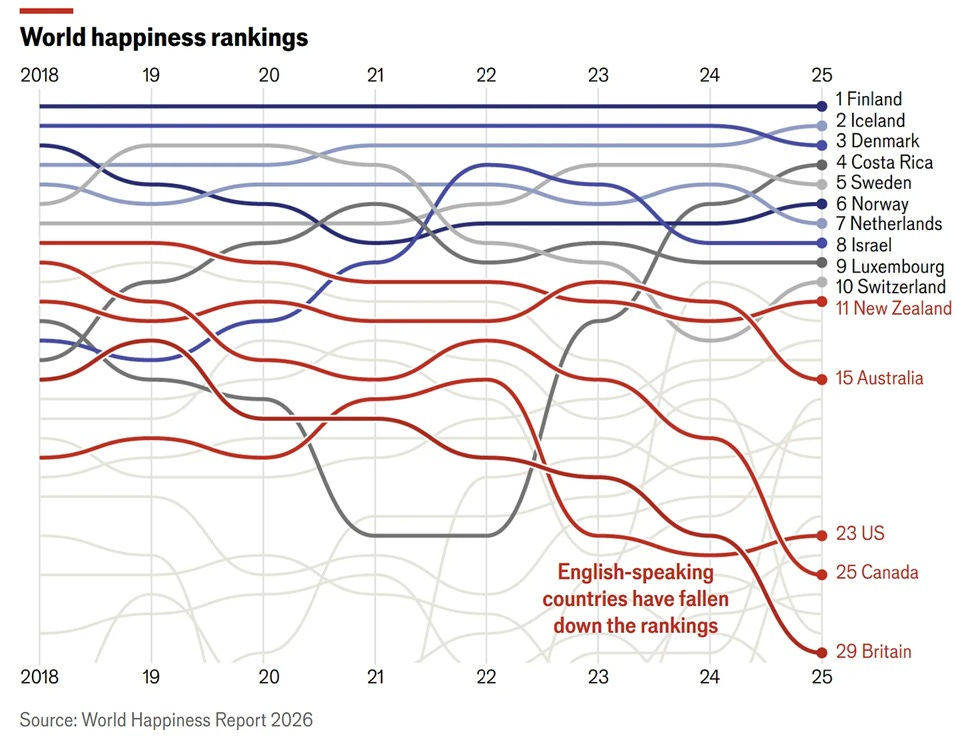
Many have hurried to connect it to the Smartphone Theory of Everything (the term coined by NYU professor Arpit Gupta in 2025). Derek Thompson has just published “Is the Smartphone Theory of Everything Wrong? A Comprehensive Investigation,” where he ranks the 10 most popular claims about phones into categories of strongest, mixed, and weaker evidence. Comprehensive indeed.

I want to add my 2 cents, which I believe explains what is behind and beyond the Smartphone Theory of Everything. I analyze technological or technologically related turmoil hitting the West the hardest through McLuhan’s concept of reversal: any medium or technology, when reaching its extreme, full potential, or limits, reverses its effects to their opposites. Like cars: they enhance mobility, but when there are too many cars, mobility reverses into gridlock. Too many signals reverse into noise, and so on.
Humankind is now experiencing the digital reversal because, with digital media, not only our communication but all our interactions have reached the limit of speed—instantaneity. Never before has human interaction with the environment been faster than the impulses in our nerves and neurons. This is the precondition for a global reversal—the digital reversal.
And cultures with stronger alphabetic literacy—the Anglosphere—HAVE TO suffer from digital reversal the most. Here is a short excerpt from my 2025 The Digital Reversal, speculating on why the more literate a society is, the harder the digital reversal hits.

The totality and selectivity of the digital reversal
Reversal happens when a form peaks. That’s why the digital reversal started with educated elites: young professionals in media, tech, academia, and the broader knowledge economy—the apogee of print culture. (Young, because they pioneered digital media and became the vanguard.)

It may sound counterintuitive, but Trump and his supporters weren’t the source of the ongoing reversals. Even more counterintuitive: Trumpism and conservative ressentiment belong to the old world of print literacy, not digital orality—despite their many oral features.
The trick is that conservative ressentiment was a residue of orality within literacy. Trump was always an oralist within literacy: as a TV personality and by nature, he represented oral residue in a literate world—this type belongs to literacy, as strange as it may seem.
Even in literate culture, most people retain oral residues. Universal education gave them the uniformity of the world and the supremacy of absolute truth, shaped by books (the Bible, textbook). So, their everyday orality is framed by literacy. Orality runs strong in many of us.
People embodying oral residue in literate culture are less vulnerable to digital reversal—they don’t have much to reverse. They feel the loss of literate order, and this loss fuels nostalgia and resentment. But behaviorally, they blend easily into digital orality: oral to oral.
On the contrary, young progressive intellectuals, the finest product of the Western alphabetic-print capitalism, have become the engine of digital reversal. True to the nature of reversal, the former vanguard of literacy reverses into its opposite—the vanguard of digital orality.
***
Under the pressure of digital media, the masses have not changed as much as the educated class has—over just a decade. The educated class was the most advanced in alphabetic literacy—so the digital reversal impacted them the most.
For example, the reversal from objective to relative truth affected academia incomparably more than politicians or the general public. Politicians and regular folks were always flexible with truth—oral residues have always been strong among them.
Now, people who were less committed to literacy no longer feel “ashamed” of their essentially oralist behavior. Digital orality has unleashed their “organic” oral residues, once the reversal of society from literacy had been executed and legitimized by the educated.
So, however paradoxical, the conservative ressentiment is a backlash of 20th-century literacy’s oral residue against 21st-century digital orality pushed by the progressive-educated class that gained cultural and political power during the Digital Rush.
But the conservative backlash cannot return things to a “normal,” balanced past. As any reversal is a product of extremes, it never returns anything to previous conditions. Instead, it amplified the divide between competing tribes shaped by residual orality and digital orality.
In general, digital reversal drives digital and residual orality into peculiar historical and geopolitical twists. That’s why, for example, the Western campus and anti-Western radicalism align (though rather virtually). They share patterns of orality.
***
Environmental detachment and the objectivation of nature, both driven by the alphabet,[2] shaped the West’s advantage: excellence in appropriation. After reaching its limit, appropriation reversed into self-deprivation. “Each civilization has its own methods of suicide,” said Innis.[3]
Non-alphabetic cultures, even those that developed long traditions of writing with some degree of abstraction, kept their writing ideographic. They preserved a significant power of ecological, analog thinking—still connected to the environmental immersion typical of orality.
In cultures that never suffered alphabetic detachment from the environment, digital reversal is less of a shock than it is for the West. For societies without centuries of print culture, it’s not even a reversal—just a transition from one oral state to another, now digital.
Digital media emerged in the West because coding was a distant but direct descendant of the alphabet. Any successful medium, however, becomes the asset of all humankind, regardless of its place of origin—be it the chariot, ironware, or printing.
Since the West is (1) deeply rooted in alphabetic literacy, which (2) eventually led to digital media, digital reversal hits the West hardest. But that’s just the beginning. From there, through the role of the West, the effects of digital reversal will spread to all humankind.
Anticipating questions about Finland, Denmark, and the Netherlands, which are seemingly less affected by anxiety, according to the 2026 World Happiness Report, despite being alphabetic cultures with a long tradition of literacy (especially the Netherlands), I would think of several mitigating factors. These cultures did not actually reach the peak of literacy—coding, the source of digital media and the precursor of digital reversal. Due to their size, they have also preserved a high degree of communal life, which signals strong oral residue. Also, the factor of happiness (the anxiety of reversal) is only one and rather a superficial manifestation of the digital reversal; other digital reversals (political, epistemological, gender) are likely manifested there, too.
The Digital Reversal. Thread-saga of Media Evolution was published in 2025. The future of the book is the blurb, said Marshall McLuhan. As the future arrives, this short book is written in tweets—each paragraph under 280 characters, 1,295 in total, which makes it a reversal of the treatise, the first tweetise in history. Structured in thread-chapters, the book explores and explains what media evolution has done to us.


See other books by Andrey Mir:
NEW! The Technological Imperative: Why We Develop Our Media. Essays on Human Agency and AI (2026)
The Viral Inquisitor and other essays on postjournalism and media ecology (2024)
Digital Future in the Rearview Mirror: Jaspers’ Axial Age and Logan’s Alphabet Effect (2024)

[1] Lenin, Vladimir. (1905). “Party Organization and Party Literature.”
[2] I covered the affordances of the alphabet in: Mir, Andrey. (2024). Digital Future in the Rearview Mirror: Jaspers’ Axial Age and Logan’s Alphabet Effect.
[3] Innis, Harold. (1950). “Industrialism and cultural values.” In: The Bias of Communication. (2008). P. 132.
I don't buy the argument about why the populations of the Netherlands, Denmark and Finland are less affected. As regards the embedding of code in the society, the Netherlands in particular contributed substantially to the field of computer science since the beginning of the field. Software is as deeply embedded there as anywhere in the Anglosphere, and probably even moreso than English speaking countries like Canada or New Zealand that are commodity driven economies. The average Dutchie will speak English as well as anyone in the Anglosphere. The disparity is probably due to other structural factor in those societies offsetting the discomfort of the digital reversal