
Lost Salvador Dalí artwork, faxed to the McLuhan Centre, rediscovered
Marshall McLuhan’s longtime associate Derrick de Kerckhove shares memories of their work in the 1970s—Part II

Read the first part of the interview: “The McLuhan oar and Salvador Dali’s fax to the McLuhan Centre.”
Derrick de Kerckhove was Marshall McLuhan’s translator and associate in the 1970s, and later became his successor in both intellectual and administrative roles. Soon after McLuhan’s death in 1980, he became Director of the McLuhan Program in Culture and Technology, leading it for 25 years, from 1983 to 2008.
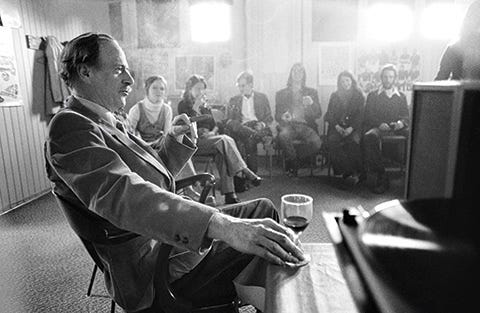
AM: As McLuhan’s associate, you must have witnessed plenty of his meetings with notable visitors, like Pierre Trudeau or John Lennon and Yoko Ono, who came to see him at the Coach House in the 1970s. You must know quite a few behind-the-scenes stories.
DK: Unfortunately, I wasn’t there for those two visits. I did, though, speak with Pierre Trudeau about McLuhan—we produced a radio series about him, and I interviewed Trudeau in the Prime Minister’s Office. Trudeau enjoyed sharing anecdotes about his relationship with McLuhan. The one I remember shows how perceptive he found Marshall to be about image. In 1979, between his terms in office, Trudeau travelled to the Arctic and grew a beard. When McLuhan saw it, he advised Trudeau to shave it off because it “cooled his image by several degrees.” Trudeau was quite amused by the pun. They were both extremely intelligent men who immensely enjoyed each other’s company.
(“Hot-cool” is an important dichotomy in McLuhan’s media philosophy. High-definition, information-rich “hot media,” like radio, require little audience participation. By contrast, “cool media,” like the telephone or comic books, leave more for the audience to fill in and therefore require greater participation. McLuhan thought Trudeau’s public persona was cool—reserved, dialogic, and reluctant to provide packaged answers. He advised Trudeau to use TV, which he classified as a cool medium, by appearing in conversational settings like small-group discussions (cool) rather than relying on formal speeches (hot). So, in McLuhan’s opinion, the Arctic beard cooled Trudeau’s already cool image too much. That’s what he meant by advising Trudeau to shave it off—and that’s what amused Trudeau.—A.M.[1])

Over the years I helped arrange or translate at many of Marshall’s meetings, especially with French-speaking intellectuals—Pierre Schaeffer, Jean Duvignaud, Pierre Babin, Nathalie Sarraute, Roland Barthes, Jacques Derrida, and so on. We also talked with people like Julian Jaynes, Buckminster Fuller, John Cage, Bill Moyers, and many others.
AM: Wow, we should do a separate interview about those meetings. Tell me the story behind Dalí’s fax. Did you ever talk to Dalí?
DK: I did, but there were actually two different stories. Because Marshall was so interested in new technologies, our Centre for Culture and Technology had one of the first fax machines at the University of Toronto—possibly even in the city—in 1972. People would come to us just to send faxes. At one point, Robert O’Driscoll, a colleague and friend of McLuhan, invited Dalí to The Celtic Consciousness conference and asked us to fax the invitation. Dalí couldn’t attend, but he was flattered and sent back a drawing along with his reply, as a sort of apology. This is how we received a fax from Dalí.
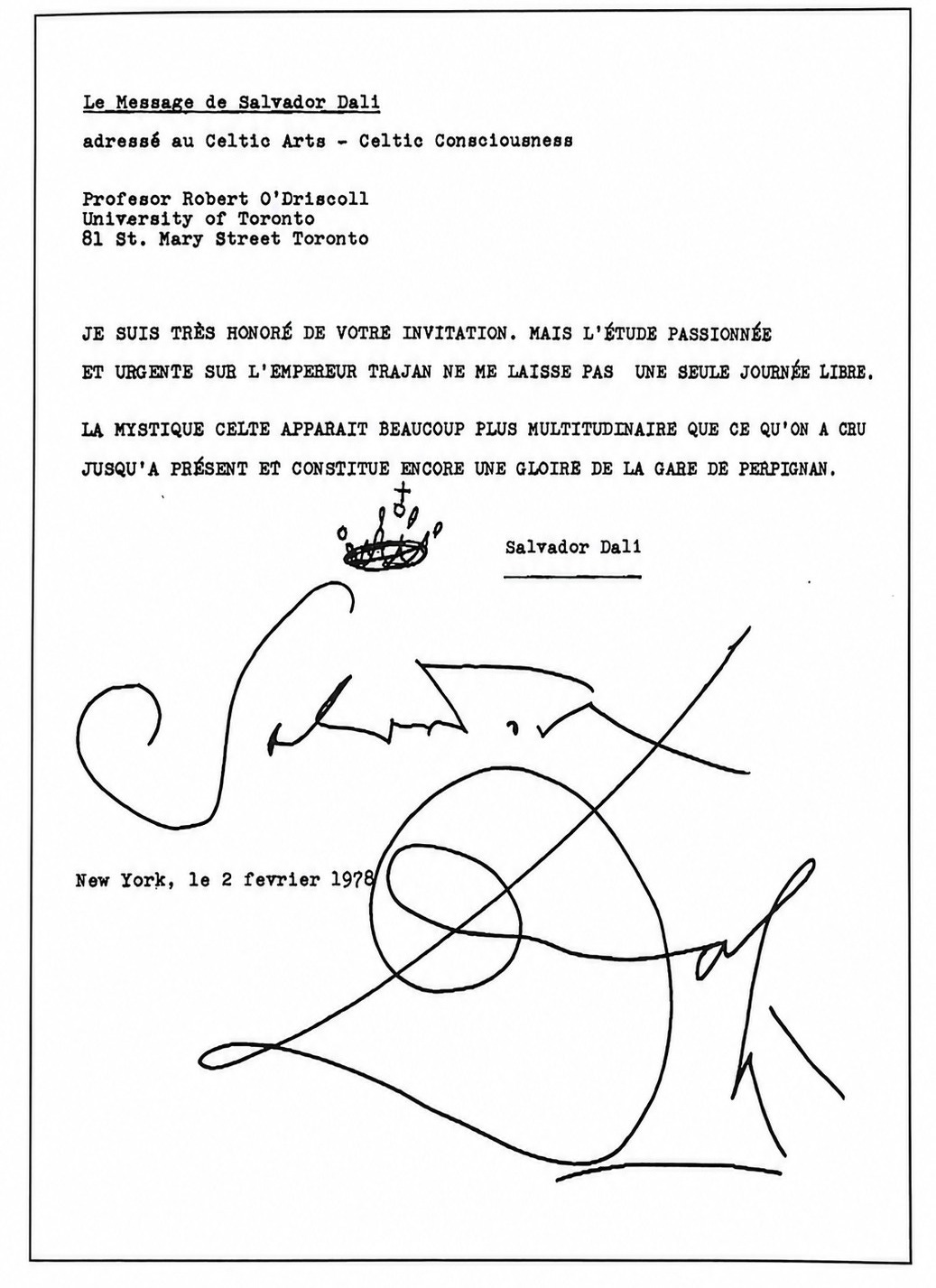
The Message of Salvador Dalí
addressed to Celtic Arts – Celtic Consciousness
Professor Robert O’Driscoll
University of Toronto
81 St. Mary Street, Toronto
I AM DEEPLY HONORED BY YOUR INVITATION. BUT MY PASSIONATE AND URGENT STUDY OF EMPEROR TRAJAN LEAVES ME NOT A SINGLE FREE DAY.
CELTIC MYSTICISM APPEARS TO BE FAR MORE “MULTITUDINOUS” THAN HAS BEEN BELIEVED UNTIL NOW, AND IT REMAINS ONE OF THE GLORIES OF THE PERPIGNAN RAILWAY STATION.
Salvador Dalí
New York, February 2, 1978
…And there was another story about a meeting between Marshall and Dalí that was scheduled but never happened.
AM: How’s that?
DK: Suzanne Paradis, who edited a Montreal business magazine with a cultural angle, asked me to bring McLuhan to meet Dalí and record their conversation. It would have been sensational, as you can imagine. I called Dalí in New York, and he immediately agreed to meet Marshall. I expected someone a bit crazy and a funny exchange, but he wasn’t like that at all. He sounded completely normal: very matter-of-fact, much more serious than I expected.
Then Marshall and I sat down a couple of times to discuss Dalí’s Oui, a small book in French that had just been published. (“Oui: The Paranoid-Critical Revolution” was a 1971 collection of writings, essays, and short fiction by Dalí.—A.M.) The conversations were enjoyable. Marshall seemed quite inspired by the topics he might discuss with Dalí.
It was the weekend, Friday or Saturday morning. The tickets were booked, and we were about to leave when, at the last minute, Marshall said, “No, I’m afraid I can’t go.” I said, “Why?” He said, “Oh, something’s wrong with Corinne’s feet.” (Marshall’s wife.—A.M.)
I think, despite talking about Corinne’s feet, it was really he who got cold feet. The next Monday, when I arrived at the Centre and asked Marshall, “How are Corinne’s feet?” he said, “What about them?”
AM: You think he was intimidated by the greatness of Dalí?
DK: Not so much Dalí’s greatness as his zaniness. That was my impression—that he felt uneasy about it. Also, from what I observed, Marshall was not at ease with people who spoke another language, when he couldn’t fully control the context or the cultural background.
AM: Did he like to appear confident, to dominate the conversation?
DK: Oh, yes. His usual way of answering questions was simple: he answered beside the question, not the question itself. He didn’t bother with the question.
AM: So, he would monologue?
DK: He would, absolutely. He loved questions and debates when they sparked his thinking. But he didn’t like being contradicted, especially toward the end. Not at all.
He was a master of his own perception, his vision, his way of understanding. At some point, I think, he realized that many people simply didn’t have the education or intellectual depth to fully grasp what he was saying. He encountered that often enough to grow impatient with misunderstandings and contradictions. What he really cared about was thinking in motion—the live unfolding of ideas, the play of words and contexts—and he disliked anything that got in the way. At the same time, he didn’t show much emotion. He was very English in that sense, quite reserved. He used humor for that, and I think it was also a way of keeping his distance.

AM: You were part of his closest circle during his final period, from his stroke in September 1979 until his passing on December 31, 1980. What do you remember from that time?
DK: A couple of moments stand out. One was in April 1980. I was recording interviews for a CBC radio show directed by Damiano Pietropaolo—the same show I interviewed Pierre Trudeau for, along with Jonathan Miller, Peter Brooks, Walter Ong, Tom Easterbrook, Tony Schwartz, John Culkin, Tom Wolfe, and a few others. I also came to interview Corinne McLuhan at their home in Wychwood Park, a prestigious enclave in Toronto. Marshall was present, but silently, of course, as we all knew that he could not speak after the stroke. Then, at some point during the interview, he suddenly stood up, walked to a window, probably looking out at the snow, and, to everyone’s utter surprise, said: “April is the cruellest month,” a line from T.S. Eliot’s The Waste Land, close to one of his favorite quotes: “These fragments I have shored against my ruins.” Corinne, seeing my astonishment, added that, very rarely, Marshall was able to quote things, usually poetry.
The second moment was in September 1980, the day CBC Radio aired the first episode of the series. Corinne called me at my residence in Toronto and said, “Marshall wants to speak to you.” I had no idea how he could possibly tell me anything. He did come to the phone, only to say, “Yes, yes”—forcefully, repeatedly—to express his appreciation, as Corinne enthusiastically confirmed, for the work I’d done on the broadcast.
Later that year, a week before he died, we had lunch at a small Hungarian restaurant. Eric was there, (Marshall’s eldest son – A.M.), Bob Logan, along with a couple of other friends. It felt quite heavy. Marshall couldn’t speak. But he could laugh.
AM: Oh, really? So he participated in the conversation by laughing?
DK: Yes. We were delighted to entertain him. We were exchanging jokes, telling silly stories, and he laughed.
AM: It must have been terrible for him not to be able to speak because he seemed to live and think by speaking.
DK: What McLuhan did not have was self-pity. Self-pity was not his style. He was stiff upper lip, the well-educated Englishman, though he wasn’t English at all—I think he was Irish. He was very self-controlled, and I don’t think he would have spent a minute feeling sorry for himself. He was really impressive in self-control.
That was the last time I saw him before he died. There was no sense that a week later he’d be gone. I remember being stunned when I heard the news.
AM: What happened to the Centre for Culture and Technology after that? How did you become its director, and what did the Centre do during those years?
After Marshall’s death, the University of Toronto wanted to shut it down. The decision sparked protests among intellectuals in Toronto and abroad. Even Woody Allen, who gave McLuhan a famous cameo in Annie Hall, wrote a letter saying, “You must be out of your mind. This man is one of the most important thinkers you’ve ever had, and you’re going to discontinue it?” Influential people in Toronto sent letters. People made noise.
After that, a committee was formed to find someone to take responsibility for the McLuhan Program. David R. Olson and I were among the candidates, but nothing happened, so I left Toronto for a sabbatical in France. Eventually, Olson was appointed.
Then, in the spring of 1982, Olson called to ask if I’d be coming back in the fall and whether I’d serve as acting director. He had another offer and was ready to take it, but he wanted to keep his position at the Centre as well. I agreed and moved my family back to Toronto. Then John Leyerle, the Dean of Graduate Studies, called to tell me there was no such thing as an acting director and that Olson had no authority to appoint one. That was unsettling, since we had already returned to Toronto. Then, out of nowhere, he appointed me—not as acting director, but as co-director of the Centre, I think just to teach Olson a lesson.
So, it was a strange affair, but this is how my adventure at the McLuhan Centre began in my new role. It was a difficult partnership with Olson, who disliked my more fanciful approach to scholarship, but we worked together for eight years. Then, in 1991, the University cut our tiny $20,000 budget altogether. Olson dropped out, and the Centre was on the verge of extinction again.
Two influential board members, Abraham Rotstein and Bruce Westwood, took me by the arm and said that if I didn’t take over the Program, it would be shut down. I agreed on condition that I’d resign if I couldn’t raise funding by year’s end. Within weeks, Michael J. Paine—a wealthy entrepreneur descended from Thomas Paine, the rebel philosopher and contributor to the American Constitution—granted the Centre $100,000. Soon after, Eckart Wintzen, the Dutch entrepreneur who’d also commissioned, funded, and published my first bestseller, Brainframes, in Europe, bequeathed the Program a million dollars.
That kept us going. We continued our classes and research on media, and we kept running the famous McLuhan Monday Night Seminars. As Olson began working in cognitive science and brought it to the Centre, I later organized seminars on neurotechnology. Over time, we organized seventeen international conferences, hosted art and technology events, and brought in many scholars. It was quite a journey.
I would especially mention the artistic programs we organized. Marshall always said that, to understand how new media affect culture, you should ask not an academic or a government official, but an artist. Artists do not live in the past or the future, they live in the present. Artists immediately sense how technologies change perception and put them to use. We invited artists, especially those working with new technologies, and created many projects exploring new media through art. There was, for example, a transatlantic interactive dance performance. We even organized the world’s first transatlantic arm-wrestling match using linked mechanical devices. We proved that a physical, tactile relationship was possible across 6,000 kilometers. All this belongs to the Centre’s history.

AM: How would you assess the demand for McLuhan today?
DK: From what I see here at the Media Ecology Convention in Winnipeg and beyond, McLuhan scholarship is very much alive. It has become even more established than his envious colleagues feared. His name comes up regularly in books and articles, he has become a legitimate authority by default on many subjects related to media.
Is he needed? Even if you don’t fully subscribe to his Tetrad (Laws of Media.—A.M.) as a scientific method for analyzing social change, McLuhan’s core insight still matters. You cannot understand the world through media content alone—you also need to understand what media themselves do to us and to the world. I, for one, regularly apply his M=M (McLuhan’s shorthand for “the medium is the message”—A.M.), and it keeps working—for digitization, for AI, for quantum physics’ potential impact on humanity and the planet. That said, I am happily out of academe and find much joy in the mental and social freedom this new situation gives me.
We are all on edge, right at the edge of time, space, and self. We are going through a major media transition, probably the trickiest in human history. We may collectively lose our bearings simply because of a lack of awareness and general confusion. McLuhan helped me ask the right questions—and he still helps. Asking the right questions and paying attention to what really changes our lives may be the only way to get across this divide.

See other books by Andrey Mir:
NEW! The Technological Imperative: Why We Develop Our Media. Essays on Human Agency and AI (2026)
The Viral Inquisitor and other essays on postjournalism and media ecology (2024)
Digital Future in the Rearview Mirror: Jaspers’ Axial Age and Logan’s Alphabet Effect (2024)

[1] See: Kahn, Elaine. (2021). The Letters of Marshall McLuhan and Pierre Elliott Trudeau: Privacy/Private Matters. Laws, 2021, 10(2), 42. Also: Been Hoping We Might Meet Again: The Letters of Pierre Elliott Trudeau and Marshall McLuhan. Edited by Elaine Kahn, with a foreword by Paolo Granata. It contains the complete surviving correspondence between Marshall McLuhan and Pierre Elliott Trudeau from 1968 to 1980, with annotations and historical context.