
Before AI eats it all: summer reading, human edition
All my media titles in one place, discounted for a month, for readers who still buy human books and occasionally recommend them

Hello, media determinists. This is an unconventional post, focused on publishing housekeeping and full of shameless self-promotion. So feel free to skip it if you don’t have time or patience for that sort of thing. It’s fairly short, though.
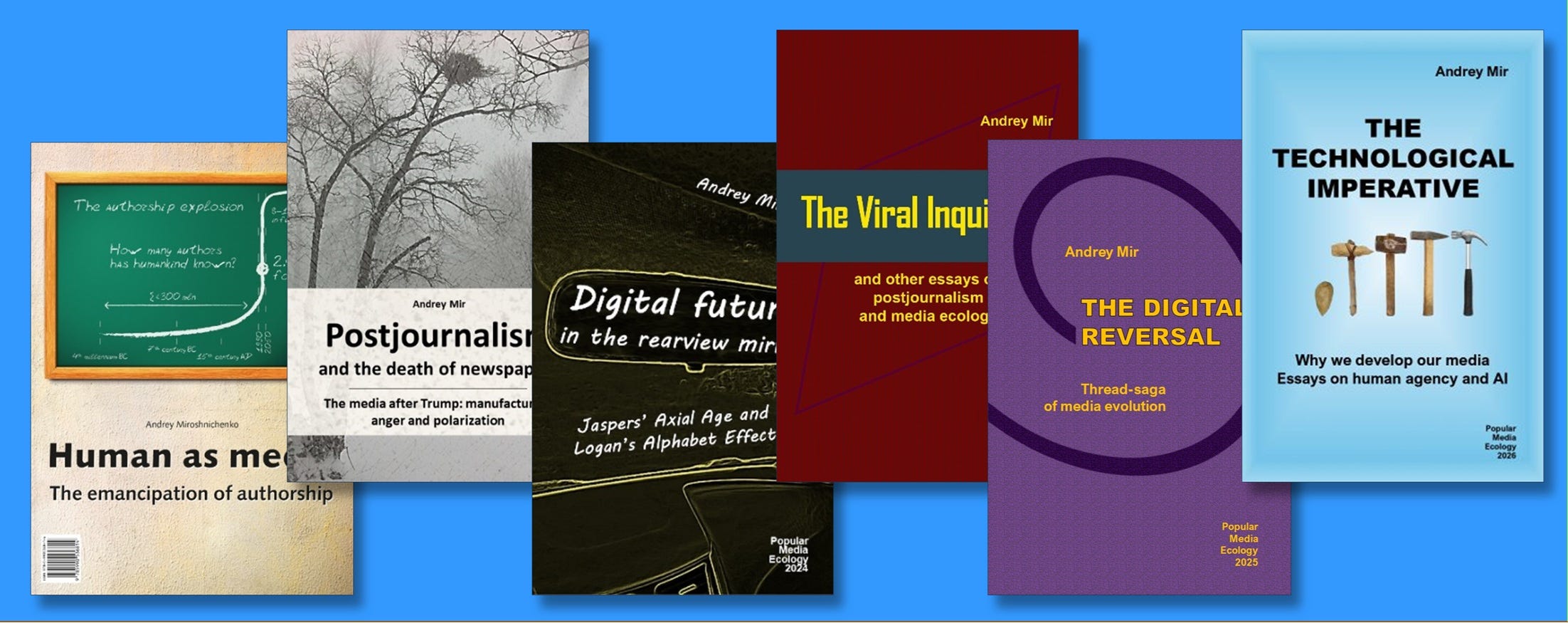
As vacation season begins, people may read more. Seasonal marketing is a cheap trick, of course, and among people interested in media, book choices most likely aren’t really driven by discounts. Yet this is still one of the few options left to an author, beyond writing.
The competition with AI is ramping up. AI hits the book market twice. On the production side, it has already tripled the number of new releases. On the consumption side, it is replacing deep reading with quick Q&A exchanges with ChatGPT or whatever people use. To keep human reading of human writing alive, not many options remain. Every little bit helps, so a seasonal marketing campaign it is.
The writers who established themselves with major publishing houses before AI, in the era of book printing, have secured more or less sustainable positions in the era of book prompting. The writers who are just starting out now have vanishingly small chances. I’m stuck somewhere in between. I’ve been writing about media for a couple of decades, but it was mostly a side hustle until recently. I wish I’d had 3–4 more years before ChatGPT and Claude began crashing the book market, but we have what we have.
I’ve got a list of six books on media, written during this long decade of digital transition, between the Twitter revolutions and the emergence of AI. Some of them have sold in the thousands, which is not bad for indie publishing. I thought they would become an asset that would grow in value, especially as I kept writing, adding a book every year or so: the new and old titles compounded and sold one another.
And it did go rather well, at least up to roughly a year ago. I still think they store a decent amount of good ideas, but content inflation, driven by book prompting instead of writing, has shortened the future of this investment to the “now.” No complaint here; the logic of the technological imperative is implacable—who would know better than me, the one who wrote the book on human replay as human replacement. But there is still some room for human maneuver: for human-to-human interaction and for humans supporting humans.
So the prices of all my books drop by 20–40% for the summer reading month, from June 8 to July 8. If you came across one of my titles and liked it, you may want to check out the others. I have compiled a list with brief descriptions. If you’re not sure where to start, these descriptions should help you pick one that fits your appetite for understanding media.
Check it out, read, repost this (reposting is the new blurb).
Summer reading: six media titles on sale for a month
1. The Technological Imperative: Why We Develop Our Media. Essays on Human Agency and AI
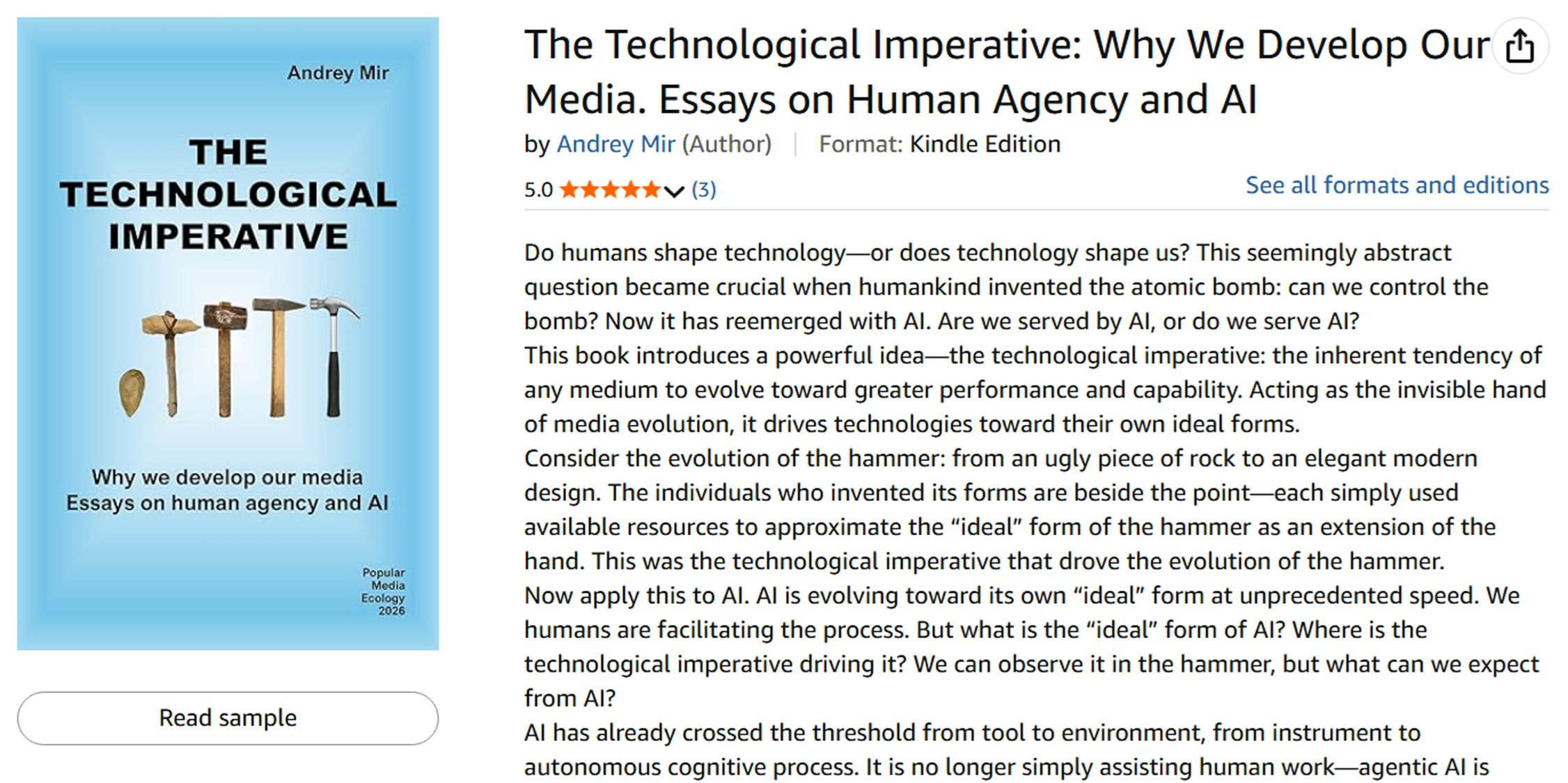
2026—just published. 134 pages.
Do humans shape technology, or does technology shape us? This book develops the concept of the technological imperative: the inherent tendency of any medium to evolve toward greater performance and capability. Acting as the invisible hand of media evolution, it drives technologies toward their ideal forms.
Consider the evolution of the hammer: from an ugly piece of rock to an elegant modern design. Now apply this to AI. AI is evolving toward its own “ideal” form at unprecedented speed. But what is the “ideal” form of AI? Where is the technological imperative driving it?
This isn’t another AI book. It places AI and other new media within the broader patterns of media evolution, a process driven by the technological imperative, a force that may ultimately outgrow humans.
Summer reading sale:
2. The Digital Reversal. Thread-Saga of Media Evolution
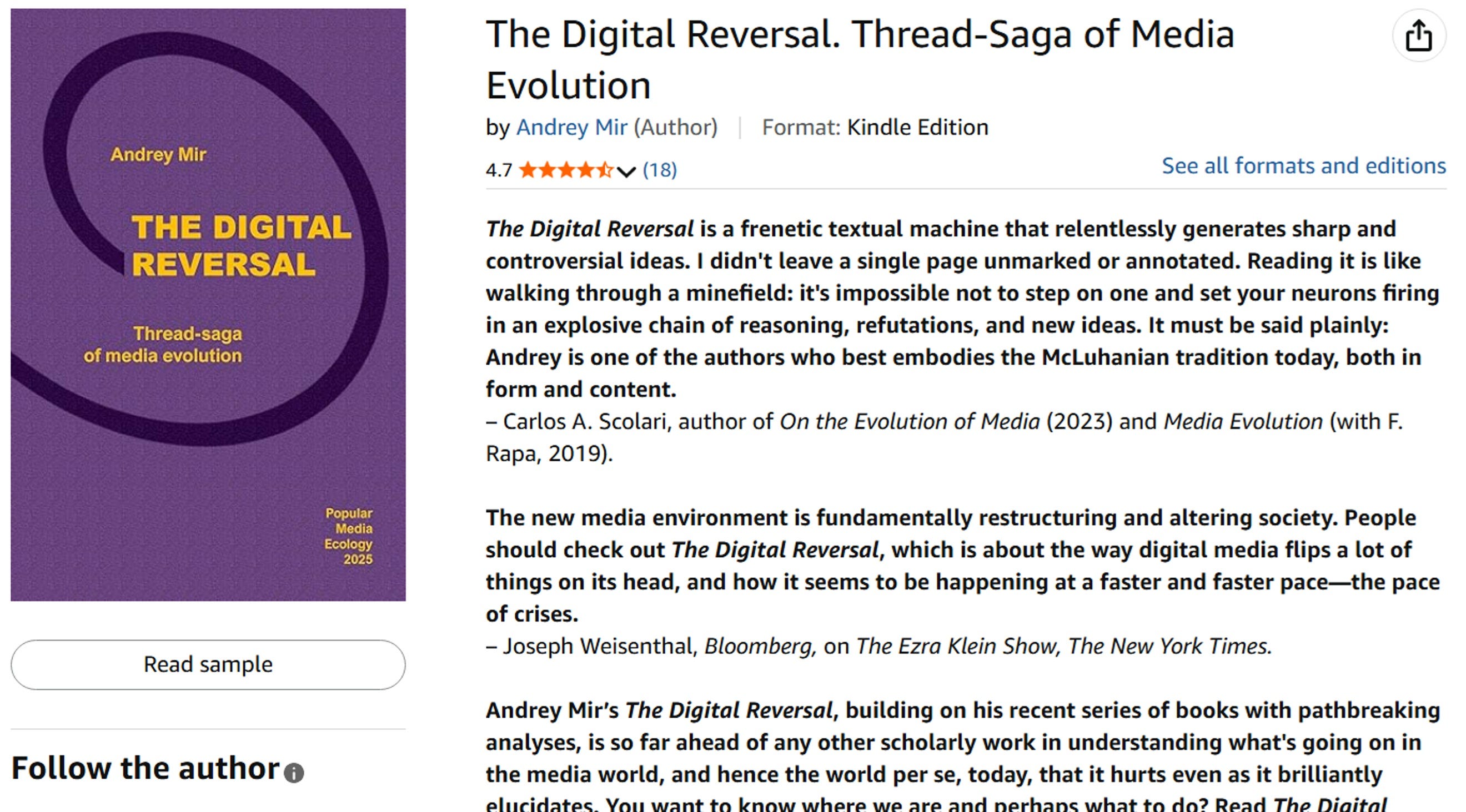
Published: 2025. 250 pages.
According to McLuhan’s Laws of Media, each medium reverses its effects when it reaches its limits, its full potential. Like cars: they help us move faster, but when their use reaches extreme levels, mobility reverses into traffic jams.
With electricity, humankind reached the speed limit in communication; now, with digital media, we have reached the speed limit of social interaction. Never before has our interaction with each other and the environment been so fast—instant.
No wonder everything is now reaching its extreme forms and reversing, merging into one global, cataclysmic Digital Reversal. The Digital Reversal is a fast-paced “thread-saga,” written in tweets, that explores and explains how digital media accelerate and reverse everything.
Recommendations, references, and reviews
The Digital Reversal was recommended by Joseph Weisenthal of Bloomberg on The Ezra Klein Show in The New York Times. (And here are the book recommendations from that episode.)
“Everything you know and everything you are is becoming its opposite.” Review of The Digital Reversal by William Kuhns. New Explorations.
“The Great Digital Reversal.” Review of The Digital Reversal by Eugenio Palopoli. Revista Seúl.
“Understanding the Law of Reversal (I): Humans as extensions of media.” Review of Andrey Mir’s The Digital Reversal in the context of McLuhan’s Laws of Media, by Carlos A. Scolari.
Andrey Mir’s Digital Reversals. Review by Sam Kahn. Castalia.
Summer reading sale:
3. The Viral Inquisitor and Other Essays on Postjournalism and Media Ecology
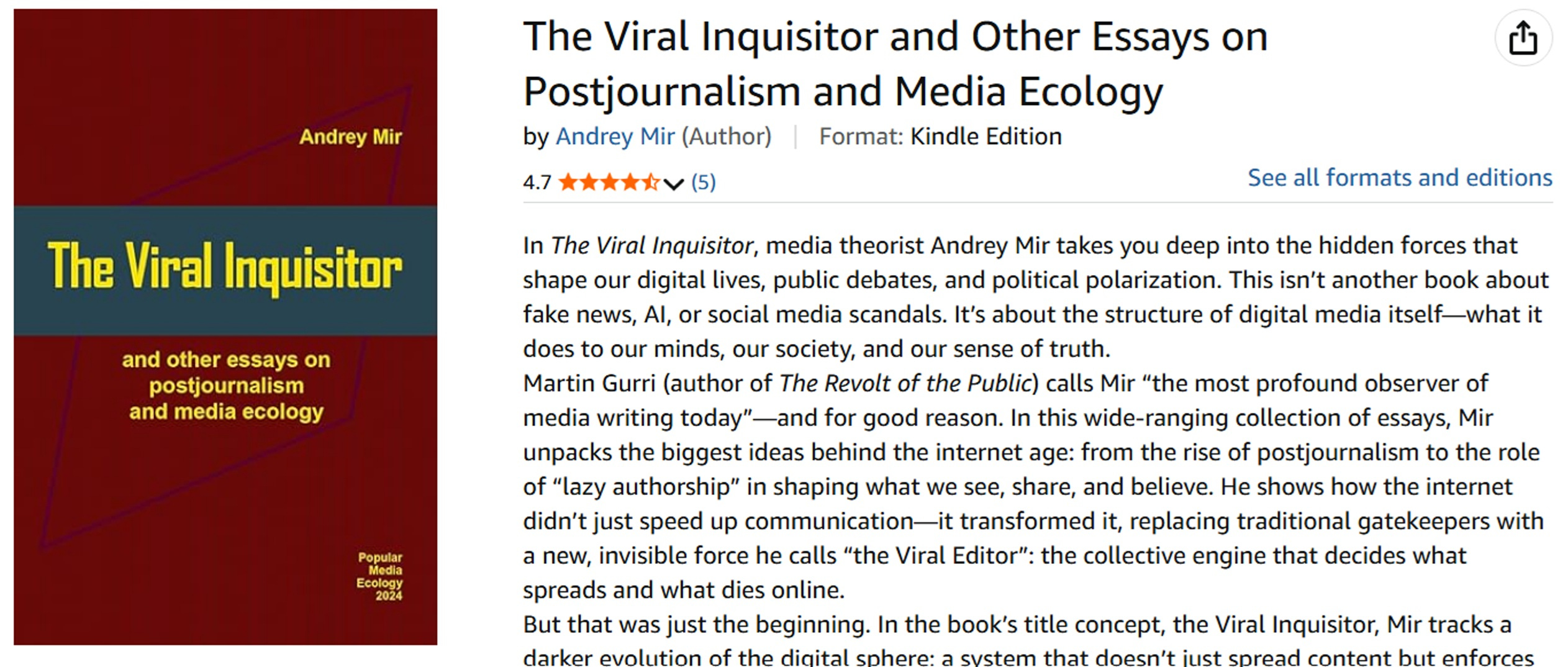
Published: 2024. 189 pages.
This collection of essays unpacks the biggest ideas behind the internet age: from the rise of postjournalism to the role of “lazy authorship” in shaping what we see, share, and believe. The internet didn’t just speed up communication—it transformed it, replacing traditional gatekeepers with a new, invisible force, the “Viral Editor”: the collective engine that decides what spreads and what dies online.
But that was just the beginning. As algorithms overtook digital platforms to amplify user engagement, the Viral Editor mutated into the Viral Inquisitor. In this new phase, algorithms and engagement loops don’t just report what’s viral—they demand allegiance, creating a dispersed digital tribunal where affirmation and outrage serve as proof of belonging. Collective editing has flipped into collective policing, and self-informing has flipped into mutual cancelling.
Drawing from media ecology, McLuhan’s insights, and real-world events, The Viral Inquisitor explains how viral validation replaced traditional authority, how journalism abandoned objectivity for affirmation, and why digital culture rewards identity over merit. The book explores how “digital orality”—our hybrid form of online speech—reshapes everything from ethics to education, and why the collapse of media boundaries has left us in a state of constant reaction.
Summer reading sale:
4. Digital Future in the Rearview Mirror: Jaspers’ Axial Age and Logan’s Alphabet Effect
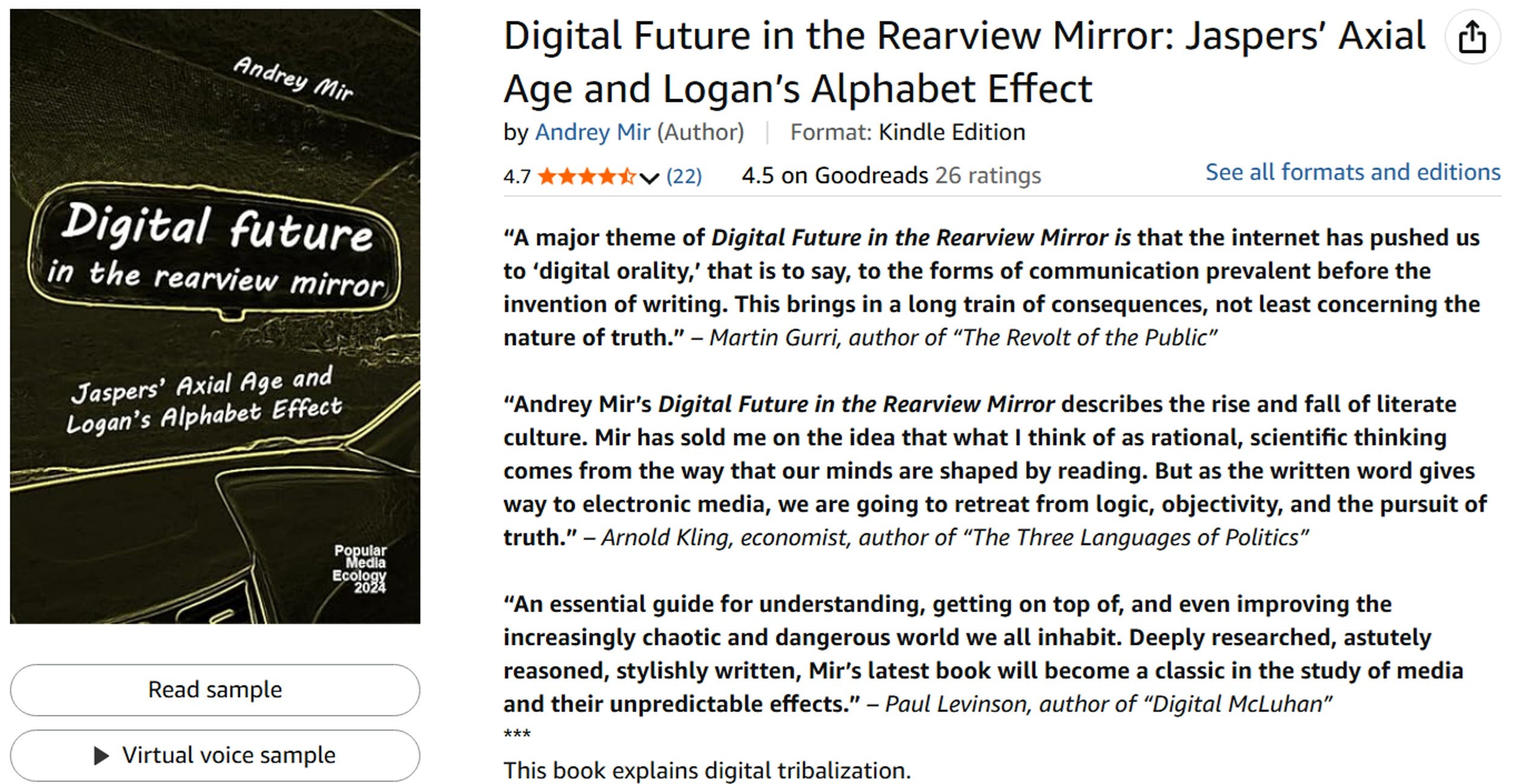
Published: 2024. 330 pages.
Digital Future in the Rearview Mirror explores digital change as the historical reversal of literacy into digital orality.
Digital orality rewinds the historical Axial Age. According to Karl Jaspers (1949), the Axial Age (the 8th–3rd centuries BCE) was a period of human “awakening.” This process aligned with the emergence of writing and the alphabet effect.
2.5 millennia ago, the transition from orality to literacy marked the shift from myth to logos, from magic to faith, from polytheism to monotheism, from customs to laws, from moral relativism to moral absolutes, from practical and negotiated truths to objective and absolute truth, from environmental and collective immersion to abstract thinking and individual detachment, from the “circle of life” to personal destiny, from the agitation of tribal belonging to the individual tragedy of (not-)becoming.
Now, by reversing literacy and retrieving orality, digital media are replaying these processes backward. In this book, the effects of orality and literacy are cataloged to observe how they shape digital society.
Recommendations, references, and reviews
The Death of Gutenberg. Is the rise of digital media causing the fall of literacy? Review of Digital Future in the Rearview Mirror by Geoff Shullenberger. City Journal.
The Fifth Wave: Andrey Mir takes on world history. Review of Digital Future in the Rearview Mirror by Martin Gurri. Discourse.
Summer reading sale:
5. Postjournalism and the death of newspapers. The media after Trump: manufacturing anger and polarization
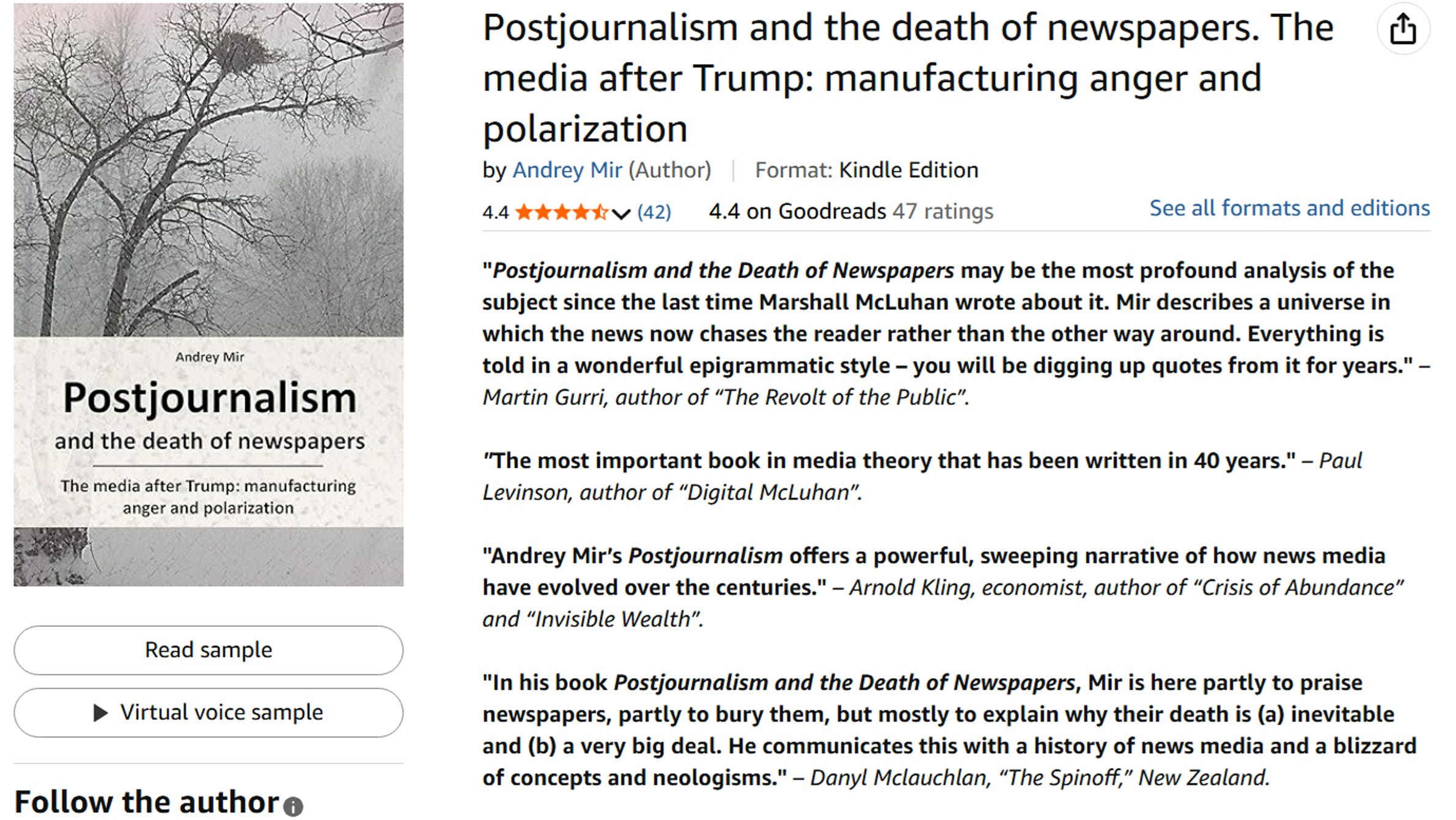
Published: 2020; revised in 2025. 360 pages.
This is my best-selling book so far, with thousands of copies sold. It introduced the concept of postjournalism—the term that many people in media and politics now use, often without realizing it came from this book.
The main cause of the mutation of journalism into postjournalism was not political; it was media ecological and economic. Journalism was funded predominantly by advertising, but the internet took ads away. The news media were forced to switch from plentiful ad revenue to desperately seeking subscriptions.
The ad-driven media manufactured consent. The reader-driven media manufacture anger. The former served consumerism. The latter serve polarization. The book explores polarization as a media effect.
Recommendations, references, and reviews
Postjournalism and the Death of Newspapers was recommended by Martin Gurri on The Ezra Klein Show in The New York Times (the book recommendations are here).
How the news business’s economics altered the news itself. By George F. Will. The Washington Post.
How to understand the rage economy. Review of Postjournalism by Murtaza Hussain. The Intercept.
Slouching Toward Post-Journalism. By Martin Gurri. City Journal.
How economics drives news media. Review of Postjournalism by Arnold Kling. EconLib.
Things fall apart: why journalism might not survive what’s coming next. By Danyl Mclauchlan. The Spinoff , New Zealand.
Summer reading sale:
6. Human as media. The emancipation of authorship
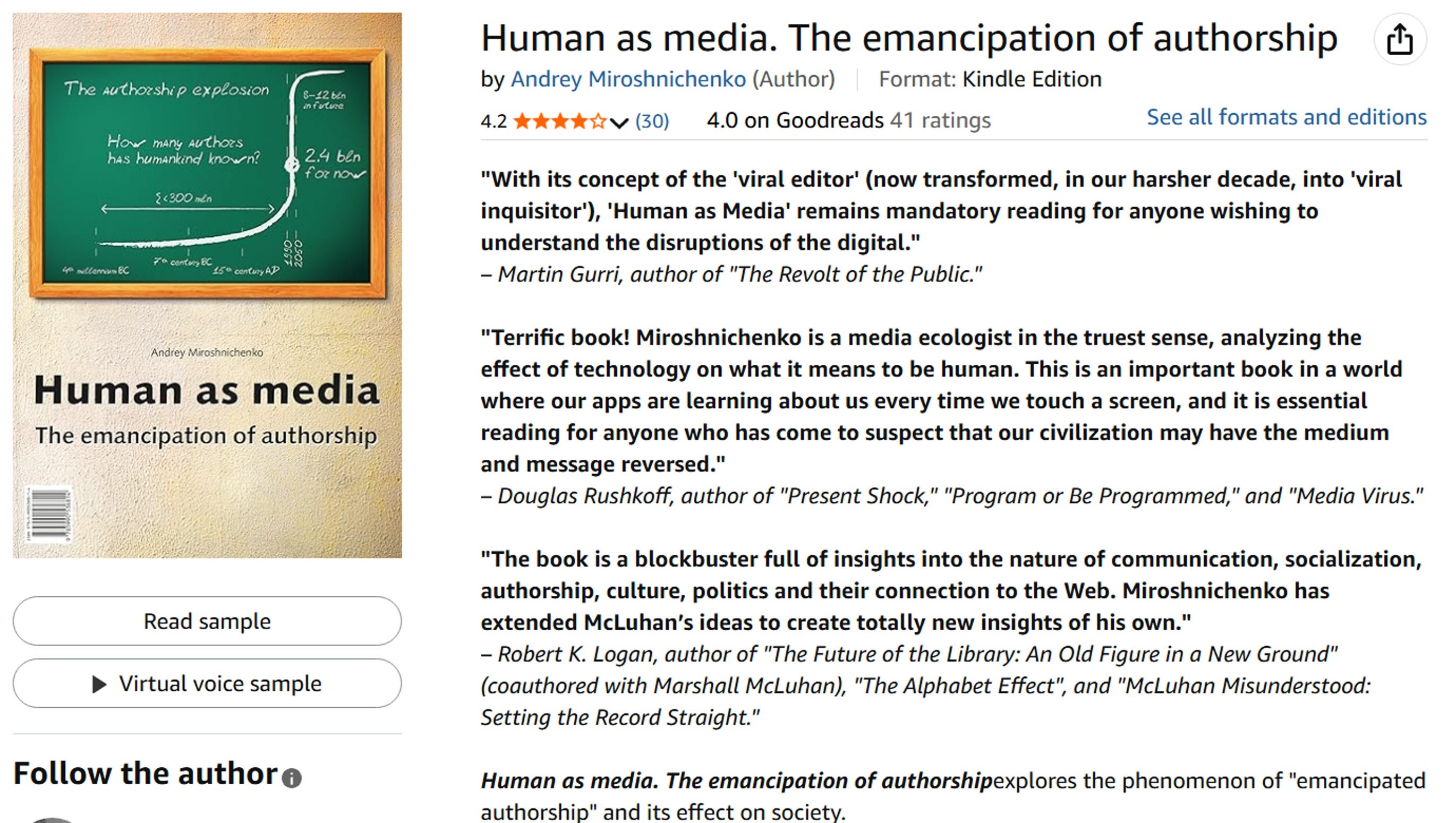
Published: 2014. 100 pages.
Human as Media introduced one of the fundamental effects of the internet: the emancipation of authorship. Over 6,000 years of writing, there have been about 300 million authors—people capable of communicating their opinions beyond their physical reach. By 2013, thanks to the internet, the number of authors had reached two billion, historically almost instantly.
Emancipated authorship created a new environment of alternative, crowdsourced agenda-setting and triggered a chain of subsequent media effects, from skyrocketing activism to polarization, from the “crisis of authority” (Martin Gurri) to postjournalism.
(This book also connected me with Martin Gurri, whose first edition of The Revolt of the Public was published in the same year (2014). We happened to analyze the same cultural phenomena: Martin from the political angle and I from the media ecology standpoint.)
Recommendations, references, and reviews
Mir-roring McLuhan in the digital era. By William Kuhns. New Explorations.
Summer reading sale:
See other books by Andrey Mir:
NEW! The Technological Imperative: Why We Develop Our Media. Essays on Human Agency and AI (2026)
The Viral Inquisitor and other essays on postjournalism and media ecology (2024)
Digital Future in the Rearview Mirror: Jaspers’ Axial Age and Logan’s Alphabet Effect (2024)
