
Why McLuhan Matters IV. Digital Overload, Numbness, and Amputation (and AI!)
If overwhelming extension leads to amputation, what does AI extend—and amputate?

Digital media became the pond of multiple reflections that numbed—amputated—Narcissus’s sense of reality. An excerpt from an essay in the new Canadian journal “2067”; read the full essay here.
Marshall McLuhan argued that every service of a medium comes with a disservice. One major disservice of all new media is sensory and cognitive overload, which shocks our perception whenever a new medium extends our organs and senses beyond what we were used to handling.
Now imagine the shock when the central nervous system is extended to the entire planet. Imagine the shock when our whole persona is extended to all of humankind through social media. It is fortunate that we were at least partly prepared for this by television. If a person from pre-electrical times suddenly had to talk with countless distant others on social media, that person would likely mistake it for a supernatural event and react with shock and panic. Who are they? Where are they? How do they even know me? Have I died and started talking to ghosts?

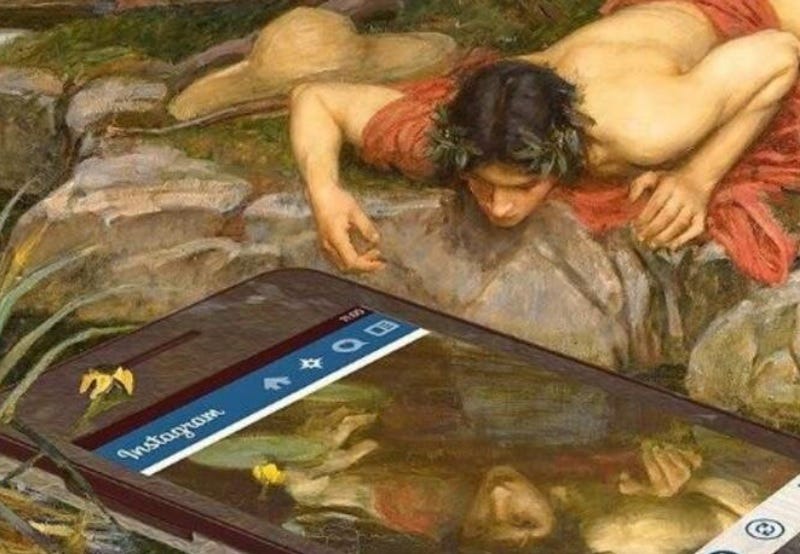
Digital media extend our selves so powerfully that they create our doubles in shared virtual space. To illustrate this split between humans and their technological extensions, McLuhan used the myth of Narcissus. In the myth, Narcissus is cursed to fall in love with his own reflection, which he does not recognize as himself. McLuhan argued that humans are hypnotized by their reflections in technologies, and that this hypnosis, or “narcosis,” numbs their perception of everything else.
It was quite a metaphor then, hard to grasp. But look at our relationship with smartphones. Do we not stare at them just as Narcissus stared at his reflection in the pond? Is it not true that when we stare at screens, we cannot see anything around us and may not even recognize our own physical selves? Guess how McLuhan titled the chapter about Narcissus’ narcosis in Understanding Media (1964): “The Gadget Lover.”
McLuhan closely examined the mechanism of this technological numbness and came up with even deeper and more unsettling conclusions. By extending perception, any new medium supplies: 1) more stimuli and 2) more intense stimuli, leading to sensory and cognitive overload. He wrote: “In the physical stress of superstimulation of various kinds, the central nervous system acts to protect itself by a strategy of amputation or isolation of the offending organ, sense, or function.”[9]
He also used the notion of “self-amputation”: the nervous system “amputates” the organ or faculty that the medium has pushed beyond its natural limits. A simple example is memory: gadgets have vastly extended our capacity to store and process data outside the mind, but the overload of external information numbs our reliance on organic memory. “Use it or lose it”: our natural skills of memorization decline.

A more complex example is how social media affect our social life and relationships. For every one of us, social media have increased the number of “friends” enormously, yet this inflation of digital friendship erodes our ability to form and maintain real friendship. Moreover, when you can add friends with just a click, the “soft skills” needed to befriend strangers and build real-world relationships can become atrophied and, eventually, “self‑amputated.”
It won’t be an exaggeration to observe that this interplay of extension and amputation is turning into an existential threat for humankind in the age of AI. If AI extends human cognition, what does it numb and amputate? Our minds? Our personalities? Our humanity?
This is an excerpt from an essay in a new Canadian journal, “2067,” on applied McLuhan in the AI era, covering:
II. The Global Extension of the Central Nervous System and AI
IV. Digital Overload, Numbness, and Amputation (and AI!)
V. Surviving the Digital Maelstrom


See other books by Andrey Mir:
NEW! The Technological Imperative: Why We Develop Our Media. Essays on Human Agency and AI (2026)
The Viral Inquisitor and other essays on postjournalism and media ecology (2024)
Digital Future in the Rearview Mirror: Jaspers’ Axial Age and Logan’s Alphabet Effect (2024)

love this!