
Upcoming book Counter-Digital Media Literacy is about how not to use media
Support the book on Kickstarter!

A fundraising campaign has been launched for my next book, Counter-Digital Media Literacy, on Kickstarter. Support the book—join the cause!

The idea of the book
Counter-Digital Media Literacy is a survival guide for the digital age. We all know how to use digital media; what we know far less is how not to use them.
Counter-digital media literacy is the skill of turning off, slowing down, postponing response, choosing deep reading over scrolling, resisting digital nudges, and building habits of sustained attention and critical thinking. It’s an immune system for the mind in a digital age.
The book will be written in tweets: each paragraph under 280 characters (like this pitch). I wrote my previous book, The Digital Reversal, in tweets, making it the first “tweetise” in history, and it worked well. The format disciplines the author and makes the book more readable.
This book is not for scholars. They may find it useful too, but its main audience is the general public. It speaks to young professionals who have acquired strong digital habits, sometimes even digital addictions, and who struggle to sustain effort and concentration at work.
It’s for parents struggling to manage their children’s digital appetites and suspecting (rightly so!) that digital devices may harm kids’ development. It’s for teachers and professors who can no longer assign essays because, with ChatGPT, essay writing has flipped into cheating.
It can guide health professionals alarmed by rising anxiety, distraction, and burnout tied to digital habits; officials and politicians challenged by sudden shifts in social behavior; community leaders and activists seeking to rebuild dialogue and meaningful civic engagement.
By backing this project, you’ll help bring to life a book that empowers people to resist algorithms and restore focus, memory, and critical thinking in a world of distraction.
Why “counter-digital”
The idea of media literacy emerged in the late TV era. However progressive, that concept followed the old tradition of teaching how to read—but now how to “read” the messages encrypted in TV and advertising. Later, it taught how to use computers, apps, and blogs.
But digital media have evolved. They are “user-friendly,” designed to lure. The best minds of Silicon Valley make sure you learn all the skills on the fly. No need to teach how to use a smartphone or TikTok—intuitive prompts (“try and see”) do the job. With AI, you just ask.
With digital media taking over our entire life, true media literacy should be not about “how to,” but about “how not to.” You will use digital media far more efficiently once you learn how not to use them. That’s why we need counter-digital media literacy.
What’s inside the book
Estimated length of the book: 180–220 pages (6×9 inch format). After introducing the idea of counter-digital media literacy, the book offers two main sections: counter-digital media awareness and counter-digital media tips.
The media-awareness section shows how media reshape us and society through click effects, screen use, dopamine urges, status contests, and polarization. Seeing the hidden forces behind everyday experience is the first step to regaining control.
The media-guidance section offers tips to handle digital urges: from seeking alternative excitements to training fake tolerance, from practicing internet hygiene to managing the levels of engagement, from fostering meaningful absence to regaining the cognitive skills of literacy.
In conclusion, I’ll discuss counter-digital media engineering. Building personal resistance is hard but doable; all it takes is strong willpower and adequate knowledge. But can it be “engineered” in others—in kids, in family, in society at large? I aim to provide an answer.
Why back this author
After 20 years in journalism, I saw what was coming and turned to media ecology to explore why the internet changes everything. For the last 15 years, I’ve been studying media effects, with a PhD in communication and bylines in popular and academic outlets.
I have written five books about the impacts of digital media. My experience in media production and book writing has allowed me to succeed in self-publishing. My books have sold in the thousands on Amazon, and my reach as an author is growing.
Trained in journalism, I focus on delivering new and provocative concepts. You might have heard some of them, like “postjournalism” or “digital orality.” My latest book, which introduces the concept of the global Digital Reversal, is generating some buzz right now.
Here is what some reviewers say about my writing:
Has anyone else writing today about the Internet and the new media it’s spawned, come off sounding as much like McLuhan on steroids?
– William Kuhns: Mir-roring McLuhan in the digital eraThe upshot of Mir’s analysis is that, over the past two decades, civilization has undergone a shift comparable with that experienced over the much longer period during which literacy displaced orality.
– Geoff Shullenberger, managing editor of Compact, about Digital Future in the Rearview MirrorPostjournalism and the Death of Newspapers may be the most profound analysis of the subject since the last time Marshall McLuhan wrote about it. Mir describes a universe in which the news now chases the reader rather than the other way around. Everything is told in a wonderful epigrammatic style—you will be digging up quotes from it for years.
– Martin Gurri, author of The Revolt of the PublicAndrey Mir’s Digital Future in the Rearview Mirror describes the rise and fall of literate culture. Mir has sold me on the idea that what I think of as rational, scientific thinking comes from the way that our minds are shaped by reading. But as the written word gives way to electronic media, we are going to retreat from logic, objectivity, and the pursuit of truth.
– Arnold Kling, economist, author of The Three Languages of PoliticsAndrey Mir’s The Digital Reversal, building on his recent series of books with pathbreaking analyses, is so far ahead of any other scholarly work in understanding what’s going on in the media world, and hence the world per se, today, that it hurts, even as it brilliantly elucidates.
– Paul Levinson, author of Digital McLuhan
Here are my books:
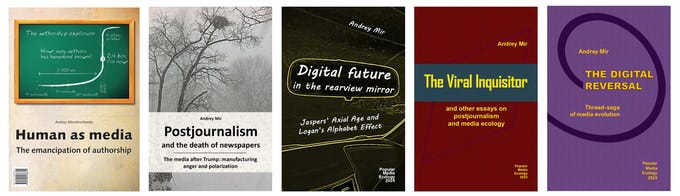
Digital Future in the Rearview Mirror: Jaspers’ Axial Age and Logan’s Alphabet. (2024).
The Viral Inquisitor and other essays on postjournalism and media ecology. (2024).
The Digital Reversal. Thread-Saga of Media Evolution. (2025).
My Substack blog: Media Determinism. Join me on X/Twitter.
Join the cause
If you’re still reading this, you likely share concerns about the tsunami of digital disturbances. You recognize digital effects and resist their power. This also means you would support counter-digital media literacy not just for yourself but for others, for society as a whole.
That’s why I count on your support. This book will develop tools to withstand digital pressure and rehumanize digital interaction. By supporting it, you support the cause: your pledge, whatever the amount, is a mandate to pursue the solution not just for yourself but for many.
At the same time, backers will receive their benefits, as per reward tiers. Most importantly, you’ll get insights and practical tips on how to improve focus, protect yourself and your kids from digital overload, and restore offline–online balance in your daily life.
You’ll also be the first to access draft chapters and updates from the writing process. Writers usually show the product, not the process, but since Kickstarter promises a “creative journey,” I’ll be sharing news and ideas along the way.
The amount set as a goal gives a kickstart: once the goal is met, it will launch my work and commitment. Ultimately, the amount raised will show the demand—the more we raise, the clearer the urgency. The book will take 8–10 months. Most ideas are already developed.
Pledges show up in Canadian dollars (CA$). Don’t worry—if you’re not in Canada, at checkout your card will be charged the lower USD amount. Maple-leaf bonus! To give you a sense of what it is in USD, an approximate amount is shown for each reward tier.
Digital media rewire the brain and reshape society. The fallout is everywhere: attention collapse, AI in classrooms, mental health crises, tribal animosity on social media. We need counter-digital media literacy now. Join the cause!

See also books by Andrey Mir:
The Viral Inquisitor and other essays on postjournalism and media ecology (2024)
Digital Future in the Rearview Mirror: Jaspers’ Axial Age and Logan’s Alphabet Effect (2024)
