After the decade of the 2010s, when the revolting public, empowered by social media, undermined institutions’ power around the globe, the authorities are regaining their power and tightening control over the public. Read more in: The Digital Reversal. Thread-saga of Media Evolution.
Between 2009 and 2014, the blogosphere and social media gave people ample opportunity to shape their own agendas. These alternative agendas became so powerful that they led to a “crisis of authority,” in the words of Martin Gurri, who described this as the “revolt of the public.”[i]
The Viral Editor stirred the public into political indignation.[ii] Institutions weakened, and the power of the public rose, fueling the anti-establishment wave around the world—from the Twitter revolutions of 2009–2011 to Brexit and Trump’s rise to power in 2016.
Institutions simply did not know how to deal with the disruptive power of the internet. As Peter Thiel put it in 2015, it was a “world in which bits were unregulated and atoms were regulated.”[iii]
But 10 years later, do these conditions still exist? Are bits as unregulated as they were in the early 2010s? Hardly so.
On the contrary, institutions often struggle to regulate atoms, but they have learned to regulate bits. A vivid example: U.K. and German authorities flounder in finding solutions to their immigration issues but have started arresting people for inappropriate posts about it.
Put simply, the internet’s power has reversed—it now threatens the public, not institutions. Globally, regardless of regime, institutions have learned not just to neutralize the disruptive power of the internet but also to harness its capacity for control and subjugation.
***
In August 2024, French authorities arrested Telegram co-founder and CEO Pavel Durov on allegations of enabling illegal activities on the platform. Commenting in “Discourse,” I noted, “The revolt of the public is over; the institutional restoration has commenced.”[iv]
But then Donald Trump won the 2024 election. Referring to my thesis about the restoration of institutions, Martin Gurri wrote: “We are living through a moment of revolt, not reaction… The public was still in command of the strategic heights above the information landscape.”
A large part of the public does express anti-establishment sentiments in the U.S. and worldwide. Yet—however counterintuitive after Trump’s return—the internet now empowers institutions rather than disrupting them. They are regaining control over the public, rebellious or not.
For years, Martin Gurri and I concurred; he even called us “intellectual doppelgängers.” Yet we took different angles. Martin’s focus was political—how the internet disrupted authority. Mine was media-ecological—how social media turned online activity into political activism.
Media ecology has changed drastically since the Twitter revolutions of the early 2010s. However dear Martin is to me, dearer still is media ecology. And media ecology says that the revolt of the public is over, and the restoration of institutional power is well underway.
There are four main arguments to prove that the revolt is over and the restoration has begun—or four environmental factors that brought that era to an end.
***
Factor 1: The global demographic transition to digital, which caused the revolt of the public in the first place, is now complete.
The demographic transition to digital occurred in two distinct waves. First, social media were adopted by the young, educated, urban, and progressive in the late 2000s and early 2010s. This led to Twitter revolutions everywhere, from the Arab Spring to Occupy Wall Street.
Soon, however, social media proliferated further and empowered older, less urban, less educated, and more conservative demographics, leading to the conservative rebound and the global right turn in the late 2010s, exemplified by Brexit, Trump, Bolsonaro, and so on.
With this, the demographic base available for politicization on social media was exhausted. There will be no significant demographic arrivals to fuel the digital transition that once ignited the clash between the digitized public and old institutions.
Of course, new generations of youngsters and new media platforms for them can still cause political turbulence, but this will be generational—Turgenev’s “Fathers and Sons” issues, not a global demographic media transition. That is now complete.
***
Factor 2: Old institutions absorbed rebellious elements from the public, transforming them into institutional loyalists and champions.
During the Digital Rush, old institutions went digital and targeted early digital users, mostly progressive. As a result, a significant portion of educated and rebellious strata—even activists—were co-opted by the elites, creating a chimeric hybrid of establishment and activism.
This couldn’t last—no society has the resources to sustain disruption for too long. As a second, more conservative wave emerged on social media, the “progressive disruption” met a “conservative backlash,” triggering new political turmoil by disrupting the previously disrupted.
***
Factor 3: A class of professional abusers of the internet emerged, inciting growing public frustration and a demand for harsher control over information.
The internet that spurred the public’s revolt in the late 2000s was unspoiled by fakes and manipulation. Early social media users were educated and mostly considerate. But as the user base grew, the quality of online conversation inevitably declined.
By the late 2010s, bots, trolls, and data harvesting had turned the internet from a beacon of democracy into a poisoned well. Not only was the problem real, but it fueled frustration and demands for tighter control. Institutions received carte blanche… from the public.
***
Factor 4: Algorithms emerged, leading to centralized, controllable digital platforms.
The revolt of the public thrived not just on the public’s awakening but also on the elites’ inability to counter decentralized protests. However powerful, old institutions couldn’t catch the organizers—there were none. A bear can crush some bees but never the swarm.
Then the amorphous blogosphere coagulated into centralized social media platforms, which are corporate entities. Algorithms made them incredibly profitable—and vulnerable to regulatory risks. Institutions are well-versed in handling profit-seeking corporations.
After 2016, facing the risks of regulatory retaliation and profit loss, digital corporations readily complied with the elites’ demands. Platforms introduced self-censorship, which became the censorship of their users. To extend the bear-bee metaphor, the bear has hired beekeepers.
Digital platforms cannot host revolutions; they cannot tolerate any unsanctioned activity for long—ask Telegram’s Durov, who was arrested in France essentially for noncompliance. The revolt of the public has largely lost its online hosting.
***
These four factors are evident globally. In the 2010s, the internet enabled a progressive revolution followed by a conservative counter-revolution; both were successive parts of the revolt of the public. That phase is over because the digital media ecology has changed.
Institutions have adapted and rebuilt themselves to address digital challenges and capitalize on digital opportunities. Digital platforms have become the new gatekeepers—far more powerful than any past tools of elite discourse control, whether old media, academia, or Hollywood.
Who controls the platforms controls the public. This new landscape is forming everywhere in the world. Only the “land of the free” seemingly re-energized the revolt of the public with Trump’s re-election in 2024. Or did it?
The Donald Trump of 2016 was a political outsider. He ruled more by public appearance, while the bureaucracy continued doing what it had been doing before, preserving its alliance with progressives formed during the Digital Rush.
But 2024 was different. Trump came with a claim to “drain the swamp”—revamp the bureaucracy and cut institutional ties to progressives. He actively engaged with institutions. His cadres controlled the party. His appointees assumed command of the “Deep State” to steer its course.
The classic public’s revolt could not do that. It lacked political tasks and could not develop policies. Its only “policy” was anti-establishment nihilism. This is why the revolt of the public was regime-agnostic: it rebelled against Mubarak, Obama, or Putin indiscriminately.
In 2024, it was no longer a revolt of the public but a struggle between right and left. Digital media now enabled not the public’s revolt but the rotation of ideology—a business of elites, not of the public. Whatever the ideology, institutions regained control over the masses.
The public was involved only to provide the proverbial “mandate” and carry some echoing legacy of the revolting 2010s. It wasn’t a failure of the public—it might still be revolting—but digital media are now ushering in the restoration of institutional control over society.
The restoration of institutions does not refute the revolt of the public but indicates its reversal. The revolt of the public was one of the defining processes of the Axial Decade. When it exhausted its demographic and technological potential, it flipped to new societal forms.
Martin Gurri saw it coming. In the 2018 re-edition of The Revolt of the Public, he envisioned “a technology-driven churning of new people and classes.” Digital media made the public attack institutions, but it’s only logical that the fruits were appropriated by elites.
Fitting the logic of reversals: local revolts of the public will keep happening—when restored or revamped institutions pressurize enough protest energy (MAGA in 2024), or when new generational energy accumulates enough charge (Mamdani in NY in 2025).
***
The reversal of the public’s revolt into institutional restoration goes hand in hand with several related reversals. Most notably, cancel culture reverses from horizontal to vertical prosecution, and from corporate to government enforcement.
Cancel culture came from the honor system, suppressed by literacy but retrieved by digital orality as peer pressure and reprobation. Unlike orality, digital talk leaves records—so cancel culture is less violent than the honor system, yet more “factual,” persistent, and intrusive.
With institutional restoration, cancel culture tends to reverse into something resembling McCarthyism. If cancel culture was enforced by digital peer pressure and corporate HR, the purge of unsanctioned digital speech will likely evolve into policing by official authorities.
From different democratic countries, we’ll hear more about thought policing by governments, lawmakers, and law enforcement. Institutions are regaining control over thought and speech, which they greatly missed during the protest movements of the early digital era.
***
Paradoxically, all this development has made platform capitalism more receptive to the essentially socialist idea of a big state. The reason is that digital platforms tend to encompass all human activities—from socializing and dating to banking and shopping.
Platforms’ omnipresence in human life naturally calls for the totality of regulation over human life. This is why platform capitalism is inherently more “socialist” and totalitarian than industrial capitalism, which largely ignored private lives and even human lives in general.
Digital platforms allow their algorithms—and their rulers—to be curious about and intrusive in private lives. Access to personal interests and activities is essential for platform business, but it also invites political control—just as pervasive as the platforms’ intrusiveness.
In the 2010s, Russian dissident Alexey Navalny used crowdsourcing and crowdfunding for his daring political projects. By the decade’s end, the authorities had learned to use the same social networking and online banking in reverse—to track and suppress Navalny’s supporters.
A similar strategy, as if copied from the Kremlin’s playbook, was used in Canada by the liberal Trudeau government to crack down on the Freedom Convoy, a massive networked protest. The government criminalized dissent and used legal tools to digitally track and target protesters.
The crowdfunding of political dissent was prosecuted in reverse: donors who supported the political protests found themselves accused of sponsoring “criminal” activities and faced personal restrictions from banks. More than 200 bank accounts holding nearly $8 million were frozen.
Digital platforms invite such “reverse engineering” at scale. Dispersed user activity—once a hallmark and pride of the digital grassroots movement in the early 2010s—has turned into dispersed surveillance and retaliation by the government.
Decentralization, having hit its political limits, reversed into centralization. Digital platforms—whether social media or online payment systems—flipped from facilitators of anti-establishment protests to tools of surveillance and punishment on behalf of the establishment.
***
Critics on the left blasted platform capitalism for its algorithmic power to monitor and dictate consumer behavior. The only thing worse than surveillance capitalism is surveillance socialism (reversal!), where users are controlled not just by corporations but also by the state.
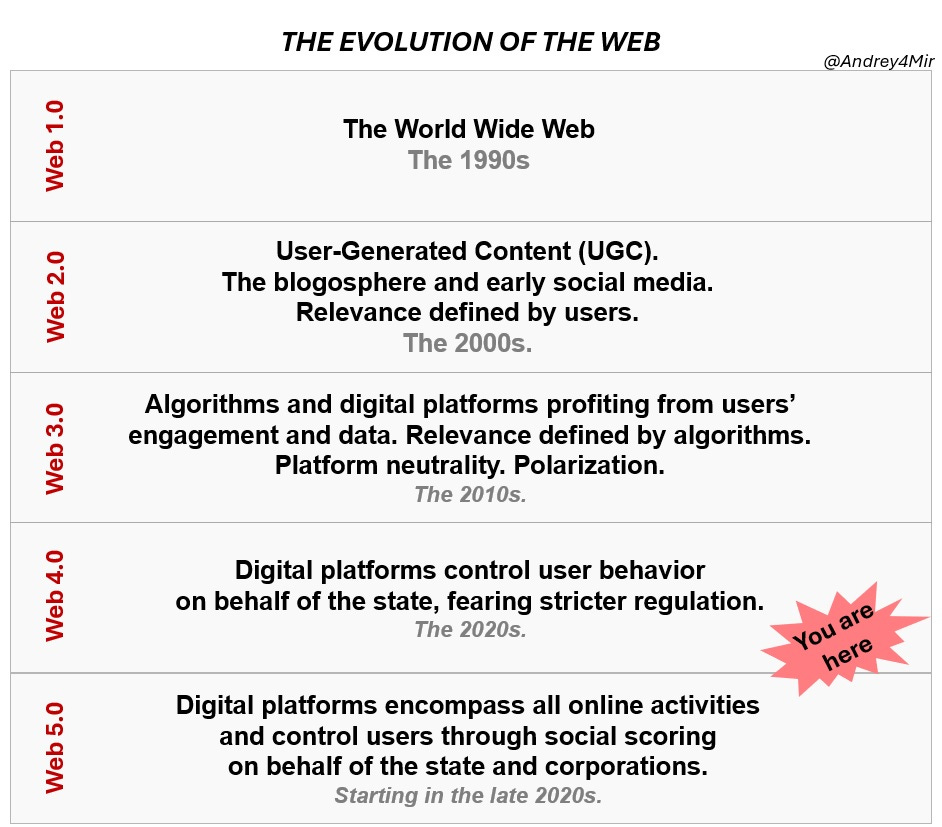
In a short period, the internet reversed freedom into control. It started as Web 1.0—the global library with free access. Web 2.0, with user-generated content, brought the emancipation of authorship and the revolts of the public. Web 3.0 gave us algorithms and digital platforms.
Web 4.0 is marked by the platforms’ political compliance and the restoration of corporate control. What comes next? Web 5.0: platforms exercising full control over people on behalf of the state and corporations through mechanisms of social scoring.
Facebook already tracks our transgressions and “adjusts” our access accordingly. As banking, transport, government services, and other activities go digital, the platforms providing them will increasingly introduce various forms of social scoring.
Social scoring is inherent in credit scores. Insurance uses scores for risk calculation—but they also work as behavior modifiers. Platforms employ scoring to reward loyalty, but customer scores also have a punitive role—on Uber, a lower score means a longer wait for a ride.
The platforms’ ability to control and modify user behavior invites political control. Web 5.0 makes platforms operate not only as businesses but also as state proxies, employing their power over users on behalf of governments in exchange for a license to operate.
Censorship, algorithmic control, and the criminalization of more online behavior will only grow as digital platforms evolve and converge with the state. Both political elites and corporations seek more control; platformization will provide greater affordances for it.
The ultimate reversal of former internet freedoms will produce either anarcho-totalitarianism or anarcho-tyranny. Both are outcomes of the convergence of Western democracies with platform control, pushed to their extreme forms.
Anarcho-totalitarianism: total control where the state and corporations can reach, a lack of regulation where they can’t. Anarcho-tyranny: total control over those who abide by the law, impunity for those beyond its reach.
Pick your favorite. (Not that one’s choice will matter.)
[iii] Baer, Drake. (2015, April 8). “Peter Thiel says tech innovation is outpacing everything else for one simple reason.” Business Insider.
[iv] Mir, Andrey. (2024, August 29). “Is Durov a New Assange? Or Is Musk the Next Durov? The Durov Affair reveals that society is shifting from ‘a revolt of the public’ to a digital ‘big state’.” Discourse.