
The imminence of Internet censorship
The Internet has transformed from a tool of liberation to a mechanism of social control.

Twenty years ago, the internet was a medium liberating people from state control. Now, the internet is increasingly seen as a threat triggering calls to restore state control over online behavior. The latest twist in this trend is the growing demand to criminally prosecute both users and platforms for unacceptable speech or behavior. How did we get here? (Excerpts from the article Internet freedom is fading in the new era of social control in Big Think.)
Some view this phenomenon as a side effect of political struggle. In reality, though, it reflects the development of the medium itself: The internet progressed from undermining old mechanisms of gatekeeping to creating new forms of social control, now executed through digital platforms.
The evolution of digital media makes stricter regulation of online behavior not only feasible but inevitable.
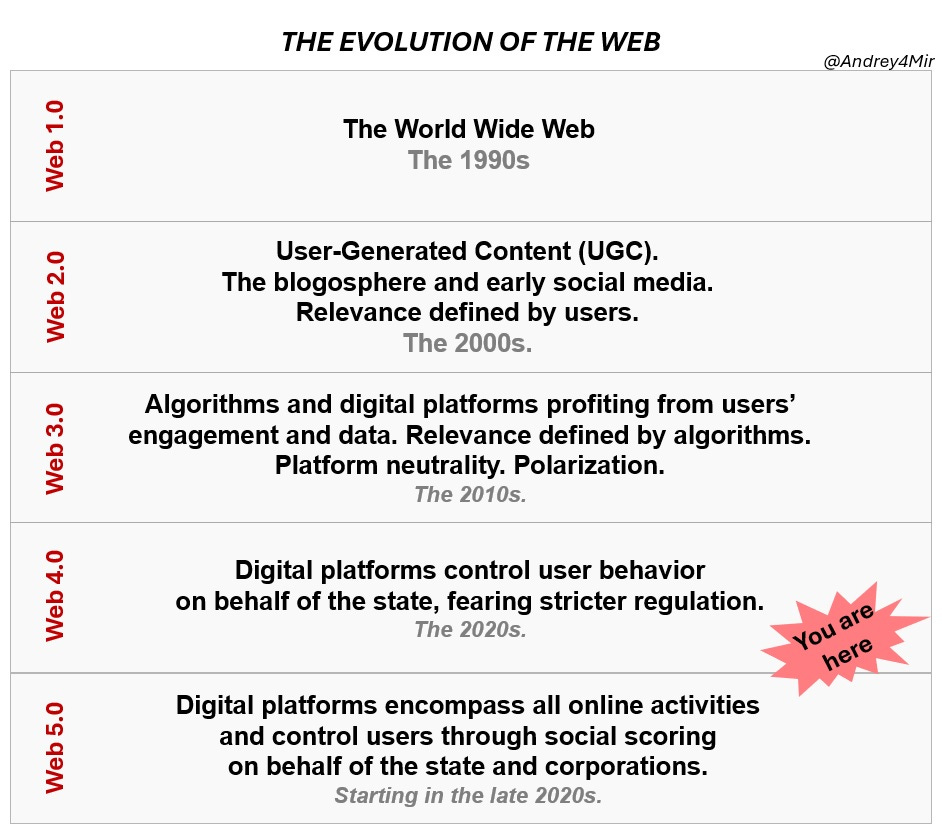
Web 1.0: The global library with free access
The earliest version of the web, Web 1.0, granted people far greater individual access to information. This alone challenged the old order in which elites controlled the mechanisms of “manufacturing consent” through news media, education, and entertainment.
Uncontrolled flows of information undermined the elites’ monopoly over knowledge. But information alone was not the key. It was not the content but the very mode of access — the medium — that began to undermine authority. A close analogy: After the printing press made the Bible affordable to the masses, it wasn’t the verses of the Bible that triggered the Protestant Reformation, but rather the ability of a layman to read the Bible independently of a priest’s choice, find inconsistencies, and question the Church’s authority. The affordability of access to the Bible made it clear, for the first time, that the Church’s perspective is just that: a view.
In the 1990s, the freedom to browse and inquire disrupted the homogeneity of the dominant news agenda. For the first time, people gained control over what appeared on their screens. The message of this medium was the individual ability to browse and inquire at will — and people started doing just that. Traditional gatekeeping, which relied on a centralized and uniform agenda, began to lose ground.
Web 2.0: The emancipation of authorship and the revolts of the public
The 2000s ushered in Web 2.0, defined by the rise of user-generated content (UGC). The blogosphere and early social media emancipated authorship by granting people greater access to not only information but also self-expression. The early digital adopters — mostly young, urban, educated, and progressive — began informing each other, quickly realizing how significantly their views and values differed from the mainstream agenda. This led to what Martin Gurri called the “crisis of authority” in his 2014 book The Revolt of the Public. The Twitter revolutions — the “revolts of the public” — sparked around the world, from the Arab Spring to Occupy Wall Street.

Old institutions were clueless about how to react. They could not catch up with the changes because they simply could not catch anyone responsible for them, as there was no one. The dispersed, networked activity simply did not provide a specific target for traditional institutional countermeasures. In the battle between the bear and the swarm of bees, the swarm was winning, despite the seemingly prevailing power of the bear, who could take down some bees or even many of them, but never the entire swarm.<...>
Web 3.0: The rise of algorithms and digital platforms
Instead of the blogosphere run by humans, social media evolved into an ecosystem run by algorithms. These algorithms began defining the relevance of content and human connections. They enabled high precision in the personal customization of news feeds and created business opportunities, including selling users’ personal data to advertisers. This advertising service proved far more efficient and profitable than traditional media could ever provide.
A side effect of this adjustment was the economic decline of traditional media and the emergence of postjournalism. But the main outcome of the algorithms’ introduction was the coagulation of the amorphous and swarm-like environment into digital platforms: centralized corporations. The online public square turned into an online marketplace. Web 2.0 mutated into Web 3.0 — an internet with algorithms of relevance and digital platforms profiting off users.

Algorithms were also tasked with accelerating user engagement. They boosted the visibility of content that would likely trigger more reactions. People were increasingly exposed to more agitating content and, in turn, conditioned to respond with more agitating reactions. This not only accelerated engagement but also further fueled polarization and online outrage, contributing to the growing public anxiety about the internet.
Before that, old institutions struggled to handle Web 2.0 due to its dispersed, swarm-like nature. The best they could do was bribe digital progressives with grants, academic positions, and corporate HR jobs. However, Web 3.0 introduced digital platforms as corporate entities bearing the risks of losses and regulation. Old institutions are well-versed in dealing with corporations. As a result, the revolt of the public had lost its momentum, allowing old institutions to begin restoring their power under the new conditions — without traditional news media, but with digital platforms instead. The snake has shed its old skin and started growing a new one.
Web 4.0: The platforms’ political compliance and the restoration of corporate control
With the 2016 election of Trump in the U.S., the power of internet platforms to shape political outcomes became undeniable. Digital platforms could no longer preserve their political neutrality, especially after the January 6 attack on the U.S. Capitol in 2021. Fearing regulatory retaliation, the largest social networks banned Trump and thousands of his supporters. The elite control over discourse production, lost after the decline of traditional media, was regained through digital platforms. To deal with the swarms, the bear commissioned the beekeepers.
This development has given us Web 4.0 — an internet where platforms regulate users’ behavior to appease governments and avoid punitive measures. On Web 4.0, digital platforms not only provide services but also act as intermediaries between users and state authorities, restricting online speech and behavior at the state’s request in exchange for the license to continue doing business with users. They openly employ moral and political judgments regarding users’ behavior to protect public morality and democracy, as if appointed to do so. <...>

Of course, there have been resistance attempts, aiming to preserve what the internet was 20 years ago: a venue for opinion exchange, free of any control. Two notable examples include Telegram, with its encryption and the cult of privacy, and X/Twitter, still embodying the anti-establishment ethos of early 2010s social media. Both heavily rely on the personal commitment of their owners and therefore cannot be considered systemic factors. <...>
Ironically, however, after Trump’s win, Musk’s X/Twitter can easily convert into a platform controlling users on behalf of the dominant political force — precisely what it was becoming before Musk took over. Platforms are inherently designed to shape and therefore control users’ behavior. Besides, the need to define “lawful speech” remains and can and will be used for political prosecution.
Web 5.0: Digital platforms as proxies for state control through social scoring
What comes next? Web 5.0: the platforms exercising full control over people on behalf of the state and corporations through the mechanisms of social scoring. We may not notice it yet, but algorithms are already tracking our transgressions and adjusting our access to digital services accordingly. <...>

The idea of Web 5.0 paints a future where platforms operate not only as businesses but also as proxies for the state, employing their power over users on behalf of governments in exchange for the license to keep doing business. The combination of censorship, algorithmic control, and the criminalization of online behavior will only grow more sophisticated as digital platforms continue to evolve and converge with the state. Both political elites and corporations seek greater control; the growing digital platformization of users/citizens will provide more opportunities to gain it.
Facing such explanations and predictions, people usually ask, “How do we fix it?” That’s the wrong question. One cannot “fix” media evolution. The right question is: “How are we going to live with it?” There are two main strategies: 1) resistance and 2) cooperation with the inevitable. The former entails self-sacrifice, while the latter necessitates specific media literacy aimed at environmental survival.
Read the full article: Internet freedom is fading in the new era of social control in Big Think
See also books by Andrey Mir:
The Viral Inquisitor and other essays on postjournalism and media ecology (2024).
Digital Future in the Rearview Mirror: Jaspers’ Axial Age and Logan’s Alphabet Effect (2024)

Internet censorship has been in place for years. We use effectively one company's app to view information, and that same company's service to determine whether it exists in the first place.
Why mobile first? Because daily location data is a 6X multiplier across the value of ALL sold data - ads are actually a small part. Why is it then no local and all browser second? Because it's a reliable way to place and track ads. Why is there lacking GPT, much less ANY, innovation for the last 20 years? Why is there still no way to search your bookmarks? Because the search/click/back/click loop is extremely profitable, and they haven't figured out how to monetize a GPT loop yet. Time to revisit web rings of the old days.
So we are in the midst of a cultural and political revolution akin to those experienced in the wake of the invention of the printing press and the rise of mass literacy in the 16th century. Instead of Benedict Anderson’s ‘Imagined Communities’, which culturally legitimised colonialism and politically structured our nation states, we face a reiteration of a rise in Renaissance style city states as tech bros engage in factional wars of control over cultural and physical landscapes.
The Musk family are culturally no match for the Borgias although they may yet surpass them in casual cruelty and social brutalism