
The features of orality: collective involvement—you’ll never walk alone
An oral individual carries an acoustic bubble of self-exhibition like a smell, so that everyone around can get involved or be repelled.

This chapter follows “The features of orality: Environmental immersion—experiencing the world live” in Digital Future in the Rearview Mirror: Jaspers’ Axial Age and Logan’s Alphabet Effect.

In 1938, a small fire broke out in the stands of the Paris National Velodrome during a sports event. The panicking crowd rushed to the only exit. The situation was on the verge of becoming deadly. Luckily, there were two psychologists in the crowd who began to loudly chant: “Ne-pousse-pas! Ne-pousse-pas!” (“Do not push! Do not push!”). The rhythm was picked up by those around them, spread like a wave, and synchronized the crowd’s chaotic movement. The panic transformed into a coordinated action. The energy of coordinated efforts helped people safely leave the arena.[1]
The call not to push sounded reasonable; however, the crowd was not so much reasoned with as it resonated with the rhythmic chanting. The content of the chant suggested a strategy, but the rhythmic chanting turned it into collective will and made everybody comply. The rhythmic chanting was the medium of the message that induced cooperative behavior and likely saved lives.
Rhythm serves as the metronome of collectivity ingrained in humans as collective animals, physiologically. Synchronization through rhythm is physiologically reinforced by the feeling of being part of a larger organism, by the sensation of multiplied strength in unity. Using rhythm, one can organize any number of people, even without knowing their language; if you create the right rhythm, they will join in.[2]
We humans evolved not only through interactions with the environment but also, first and foremost, through interactions with each other. Others were the most crucial element of our environment, either beneficial or threatening. This is why environmental immersion also implies collective involvement: an individual cannot not be engaged with others. In an oral society, collective involvement is as total as environmental immersion itself.

Synchronization is a precondition of a collective’s cooperation, and rhythm is its most ancient and efficient medium. But the members of the collective also had to emotionally tune into cohabitation. For this, the series of oral acts people displayed to each other had to be gestural, emotional, loud, salient, excessive in all aspects, and engaging in every possible way, something McLuhan called “empathic involvement.”[3] For tribal cohesion to occur, everyone needs to be prominently present and signal their readiness for connection and inclusion. Orality made people loudly and saliently exposed to each other for the sake of coordination and synchronization. Being an extravert is an organic condition of orality.
By filling shared spaces with the acoustic bubble of their self-exhibition, an oral individual asserts their level of integration into the collective, which also becomes a claim to status in the hierarchy. Those who are better “seen” and “sensed” by the collective can demand greater social benefits. Individuals who are self-absorbed will likely lose in the competition for status and social benefits. That is why an oral individual carries the cloud of their acoustic space with them like a smell, so that everyone around can get involved or be repelled. Loud and overtly affective speech may be considered ill-mannered in a literate culture, but in orality it is a survival strategy.
Empathic involvement can be seen as harmony: the community harmonizes its life through the total mutual exposure of its members. This harmonization comes at the cost of the total absence of privacy. In orality, one cannot keep one’s life to oneself. It is always shared, exposed to others, and intertwined with the lives of others. You’ll never walk alone. Individuals are involved in the exchange of obtrusive phatic signals (social grooming and requests for affirmation). Intimacy, in whatever sense of the concept, is likely impossible in an oral culture; intimacy is a side effect of literacy. The oral community would be a nightmare for an introvert. For a literate and self-absorbed person, just as for an electrician, insulation is better than grounding. It’s quite possible that introverts are a by-product of literacy, too.
Some features of orality persist in our everyday interpersonal communication, though they are hard to recognize. For example, the phatic function of speech serves to establish and maintain social relations. When we meet a neighbor in the elevator, we chat about what a rainy day it is outside. The conversation conveys no useful information for either participant; both have just been outside and have identical information about the weather. The meaning of the exchange is not to share information but to reinforce our mutual status as neighbors and thus maintain tribal unity. Linguists assume that phatic interactions may comprise up to 30% of everyday conversations. The only purpose of these interactions is social grooming and establishing mutual status in the social hierarchy, and through them, ensuring collective coherence.

Small talk is inherently intrusive—we must show interest in someone’s daily life. Contemporary urban culture imposes significant restrictions on such intrusiveness: you cannot ask a neighbor about their relationship with their spouse after hearing some noise from their apartment. You cannot ask a coworker why he or she looks so pale today. Weather small talk is the safest. In an oral community, in a small village, there are no such restrictions. Everything will be asked and expected to be answered, driven by the survival strategy of “empathic involvement.”
Under the conditions of orality, small talk was not actually small. It was of Homeric proportions and included vocal performance and pantomime. But there was also something atypical for the contemporary phatic exchanges of literate minds. The exchange of information about the weather, recent hunts, family scandals, and other personal affairs held real meaning in primary orality. These exchanges were the news media of the oral era. News has a peculiar quality—it becomes important as long as you follow it. Continuous news consumption fosters the habit of following the news: in an oral society, gossiping was an imperative that kept the tribe together, just as the Habermasian public sphere helped to maintain modern society.
And there was more to it. The rapport created by phatic exchange served to tune up the collective mechanism of memorization. This effect of the phatic function is best explained in contrast to literacy. We can easily memorize or communicate information in writing, no rapport with our pen and paper, computer, or smartphone is required. We still need to configure writing tools in a certain way, but this is more a matter of technical customization. We do not need to get them to act in unison with us by imparting emotional and mental tones. Now imagine that the only medium for communication and memorization is not paper or a smartphone but another person. The only way to succeed in communication and memorization is to trigger that person’s response, achieve rapport, and incite their contribution to collective coherence. Most communicative effort has to be spent on tuning them in. The excessively affective speech of orality included efforts to achieve collective rapport and cohesion for coordination and memorization.

Writing, and then printing, allowed for collective coordination on a scale unimaginable in orality. Electronic media did as well. However, while writing and print coordinated people by co-opting them individually into shared ideas, radio and television coordinated people through shared emotions in a semblance of the tribal acoustic space—through “empathic involvement.”
Social media deepened this reversal toward the emotional engagement of everybody with the collective. In McLuhan’s words, spoken in 1967, 50 years before social media,
Too many people know too much about each other. Our new environment compels commitment and participation. We have become irrevocably involved with, and responsible for, each other.[4]
The exposure of everyone to everyone on social media also serves as a request for others to resonate and acknowledge each user’s existence and rightness. This ongoing mutual exposure and constant communication requests make social media even more akin to the village than the global village of the TV era, when people were emotionally engaged with collective issues but at least did not expose themselves. Social media enabled this: imagine every TV viewer displaying their reaction to what they see on the TV screen and expecting appreciation of those reactions from others.
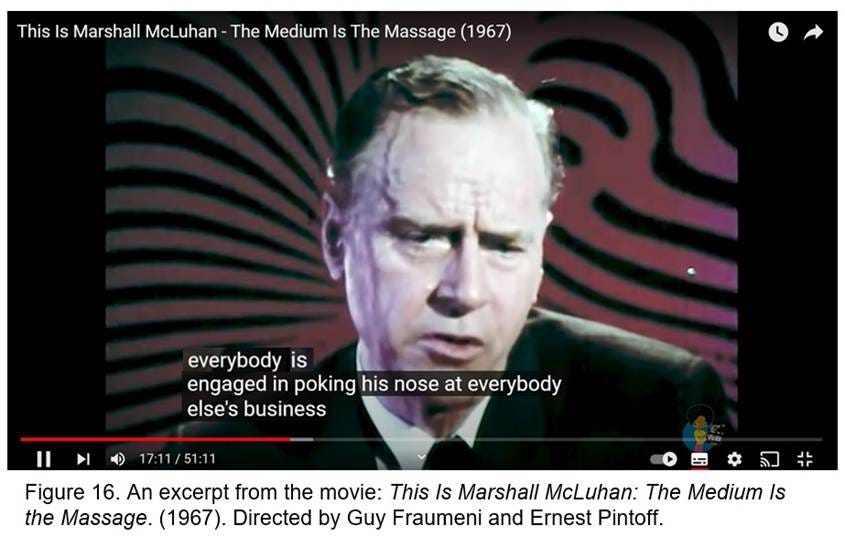
In the movie This Is Marshall McLuhan: The Medium Is the Massage, made in 1967, McLuhan sounds as if he is describing the social media of the 2020s:
The Global Village is at once as wide as the planet and as small as a little town where everybody is maliciously engaged and poking his nose in everybody else’s business. The Global Village is a world in which you don’t necessarily have harmony – you have extreme concerns with everybody else’s business and are much involved in everybody else’s life... It doesn’t necessarily mean harmony, peace and quiet, but it does mean huge involvement in everybody else’s affairs.[5]
According to McLuhan, such relations emerge when “the spaces and times are pulled out from between people” by electronic media and people are exposed—“get close”—to each other. We can clearly see here the pattern of reversal from literacy to orality by electronic media and now digital media. They achieve this by removing the literacy-induced detachment of individuals from the environment and from each other. As a result, “everybody becomes totally involved in everybody.” [6]
This piece continues the topic of “The features of orality: Environmental immersion—experiencing the world live” in Digital Future in the Rearview Mirror: Jaspers’ Axial Age and Logan’s Alphabet Effect.


See other books by Andrey Mir:
NEW! The Technological Imperative: Why We Develop Our Media. Essays on Human Agency and AI (2026)
The Viral Inquisitor and other essays on postjournalism and media ecology (2024)
Digital Future in the Rearview Mirror: Jaspers’ Axial Age and Logan’s Alphabet Effect (2024)

[1] The story is recounted by Akop Nazaretyan in his 2001 book Psychology of Spontaneous Mass Behavior. Nazaretyan was the author of the principle of Techno-Humanitarian Balance; see: Nazaretyan, Akop (2017). “Mega-history and the twenty-first century Singularity puzzle.” Social Evolution & History, Volume 16, Number 1, March 2017. Interestingly, as an expert in crowd control and the political psychology of the masses, Nazaretyan worked for the Central Committee of the Soviet Communist Party in the 1970s and trained revolutionary cadres for anti-capitalist resistance in the Third World. When visiting guerrillas in Latin America, “Comandante Akopo”, aside from his ideological work, also gathered a great deal of ethnographic material for his later universal evolutionary theory, which somewhat resembles Teilhard de Chardin’s theory of mega-evolution. See Akop Nazaretyan’s profile on the Social Studies website.
[2] In Understanding Media, Marshall McLuhan referred to radio as “the tribal drum,” implying its ability to audially, immersively synchronize nations into tribes of imperial scale. See: McLuhan, Marshall (1994 [1964]). Understanding Media, p. 297. He underscored radio’s crucial role in Hitler’s regime (ibid., p. 300). By forming tribal unity on an unprecedented scale, radio indeed created all three major empires of the 20th century: the Communist, the Nazi, and the consumerist ones.
[3] McLuhan, Marshall. (1962). The Guttenberg Galaxy, p. 39.
[4] McLuhan, Marshall, and Fiore, Quentin. (1967). The Medium Is the Massage: An Inventory of Effects, p. 24.
[5] An excerpt from the movie: This Is Marshall McLuhan: The Medium Is the Massage. (1967). Directed by Guy Fraumeni and Ernest Pintoff. 17:00.
[6] McLuhan, as quoted in: Chrystall, Andrew. (2015). “After the Global Village.” First published in The Canadian Journal of Media Studies, 2011, 9 (1).