
Postjournalism and polarization
How the media polarized us

The shift from plentiful ad revenue to the desperate pursuit of digital subscriptions has turned journalism into postjournalism. Read more: The Viral Inquisitor and Other Essays on Postjournalism and Media Ecology
Throughout the twentieth century, journalism relied for its funding predominantly on advertising. In the early 2010s, as ad money fled to Internet platforms, publications sought to earn revenue through subscriptions instead of advertising. In the process, they became dependent on digital audiences – especially their most vocal representatives. The shift from advertising to digital subscriptions invalidated old standards of journalism and led to the emergence of postjournalism.

The golden age of the news media
Everything we once knew about journalism depended on the model of the ad-funded news media. Advertising accounted for most of the news industry’s revenue during the twentieth century.
This business model provided a selective advantage to certain kinds of media. Since the revenue from copy sales was not sufficient to maintain news production, news outlets needed to attract advertising. As a result, the media that relied mostly on the reader’s penny, such as the working-class press, which was quite influential in the late 19th to early 20th century, were marginalized and eventually driven out of the market. The mass media that were oriented around the “buying audience” – the affluent middle class – received money from growing advertising and thrived.
In political economy, this selective effect is called “allocative control.” The ad money did not tell the media what to do; it just chose the media that encouraged its audience to buy goods. Along the way, advertising money created the mechanism of discourse formation that Herman and Chomsky called the Propaganda Model (1988).[i] Seeking more advertising, the media maintained a context favorable for consumerism and political stability. Using Walter Lippmann’s term, Herman and Chomsky claimed that the media “manufactured consent.”
This business model was extremely successful. By the end of the twentieth century, the news media had reached the apex of their 500-year history. Even regional newspapers such as the Baltimore Sun possessed several well-staffed foreign bureaus. Never were the media as rich and influential as in their golden age, just 25 years ago. Plenty of journalists still on the job remember those glorious days.
Under the ad-based model, media capital represented a significant social force. It protected its interests, its market value, and therefore its independence. The abundance of money enabled newsrooms to develop an autonomy secured by the division between news production and ad-sales departments – a “glass wall” between ads and news. Preselected by ad money, news organizations geared toward affluent audiences became influential to the point that their independence determined their market value.
Ad money carried the risks of advertisers’ pressure in news production, which would have undermined newsroom autonomy, a source of reputation and therefore capitalization. So, professional standards were elaborated to protect journalism from advertisers and establish the credibility of news coverage. Credibility was seen as a professional virtue but also as a commodity. “The theory underlying the modern news industry has been the belief that credibility builds a broad and loyal audience, and that economic success follows in turn,” declared the American Press Association in its 1997 “Principles of Journalism” statement.

Thus, paradoxically, the allocative control of ad money determined not only the allegiance of mainstream media to corporate elites (hence, “corporate media”) but also sustained high-quality journalism. Newsroom autonomy was protected by the standards of objectivity, nonpartisan and unbiased reporting, attention to the arguments of all parties involved, investigative rigor, the separation of fact from opinion, and other guarantees enshrined in the ethical and professional codes of news organizations.
The same set of professional standards that was meant to secure credibility and independence from ad money turned journalism into a public service. “The central purpose of journalism is to provide citizens with accurate and reliable information they need to function in a free society,” claimed the American Press Association’s statement. “Commitment to citizens also means journalism should present a representative picture of all constituent groups in society. Ignoring certain citizens has the effect of disenfranchising them.”
The only entity to which journalism was called to be biased against, even meticulously so, was power. This was a part of the credibility code, too. Endowed with these principles, initially rooted in ad funding, journalism evolved in the twentieth century as the “watchdog of democracy,” positioning itself above partisan party struggle.
Another effect of advertising predefined the attitude towards the audience. If the audience was supposed to be affluent, mature, and able, so too were journalists expected to avoid judgment and patronising when reporting. The naked but thoroughly investigated facts and the positions of both sides were supposed to be presented to the public to judge. Hypocrisy and a sort of professional arrogance, of course, had always had a place in the profession. Journalists are generally prone to see themselves as priests and shepherds. Nevertheless, leaving the privilege of judgement to the readers was deemed to be one of the fundamental virtues of journalism at a time when it was funded predominantly by advertisers.
Advertising as a leading source of revenue predefined also the social-demographic targeting in the media. For better advertising reach, news coverage was supposed to broaden audience, not narrow it. The audience was regarded through the prisms of consumer profiling and cooptation, not political affiliation and separation. Potentially divisive political issues were downplayed.
All of this cooled the political activity of the public. Observing the state of the media in the 1990s, Robert McChesney called his book Rich Media, Poor Democracy, describing the low degree of participation in elections as “democracy without citizens.” If the medium is the message, then the message of the ad-funded news media was “buy!” – not “vote!” or “protest!”
The political passivity of the masses might have seemed to be bad for democracy, but polarization in society was at a low point, while the influence and prosperity of the media were at an all-time high. Capitalism generously paid the media for promoting consumerism and manufacturing consent. Political tranquility was a side effect – detrimental or benevolent, depending on one’s perspective
The collapse of advertising
The Internet broke this idyll. It turned out that the ad-based model relied not on the content attracting an affluent audience but on the monopoly over ad delivery that the Internet simply destroyed. It took a hundred years for the ad-based media business to achieve power and prosperity; it collapsed in just ten.
The collapse started with the classifieds. At their peak in 2000, classified ads brought in $19.6 billion,[ii] about one-third of newspapers’ revenue.[iii] Craigslist, eBay and others killed this market by offering people a better service for free. Classifieds revenue plummeted to $2.2 billion in 2018.[iv] Thus, $17 billion was wiped out from newspapers just because consumers had migrated to better platforms with the same (actually, better) functions.
Corporate advertising was the next to go. Suddenly, firms found that they could reach their desired audience directly and precisely, with full control over content, context, and targeting.
Finally, Google and Facebook delivered the fatal blow. Old media used to offer advertisers a costly and inefficient carpet-bombing advertising. Unlike the news media, Google and Facebook know the personal preferences of each user and provide the personally customized delivery of ads to billions. In 2013, Google alone made $51 billion in ad revenue. That year, American newspapers’ ad revenue was $23 billion, and the global newspaper industry collected $89 billion in ad revenue. The Google-Facebook duopoly surpassed 60 percent of the share in the U.S. digital ad market in 2018.[v] It became increasingly clear that old media had no chance of competing with digital platforms. Digital platforms offered a completely different scale, cost, accuracy, and efficiency of advertising.
Ad revenue in the US press hit rock bottom in 2013. It plummeted below the level of 1950, when the industry started measuring the print ad market. [vi] The addition of digital ads was insignificant and did not save the day.
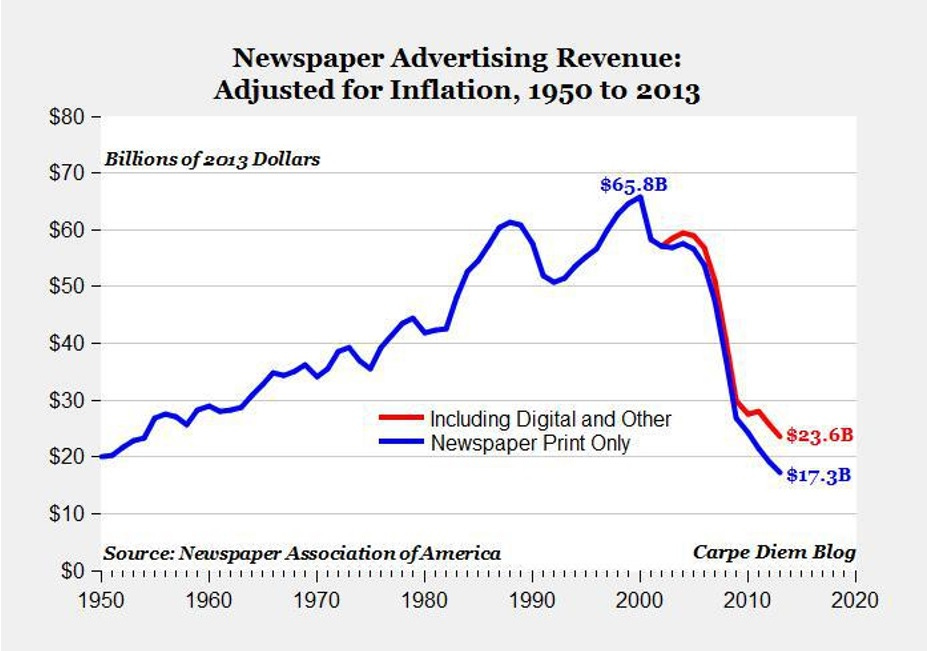
Calculations by Mark Perry, The American Enterprise Institute.
In 2016, the Newspaper Association of America stopped reporting newspapers’ annual ad revenue: this source of revenue had basically ceased to exist. Residual advertising in print media, both offline and online, lost its industrial scale. Today, advertising contracts in some news media often resemble charity from ideologically aligned businesses.
Not only did ad revenue collapse to historically low levels, but it also plummeted below the level of reader revenue. This happened simultaneously around the world. In 2014, ad revenue in the global newspaper industry ($86.5 billion) trailed reader revenue ($92.4 billion) for the first time in the history of industrial measurement. Even the strongest American newspapers could not hold advertisers: the New York Times began getting more revenue from readers than from ads in 2012.
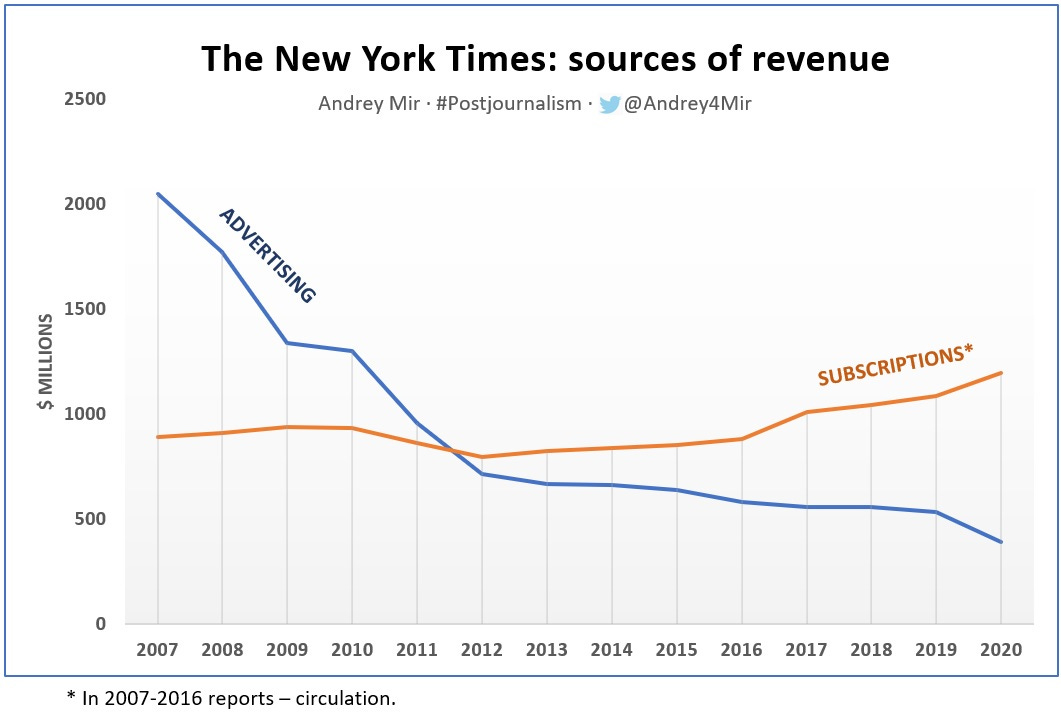
Ad and reader revenues in the New York Times. Source of data: The New York Times Company.[vii]
Observing the catastrophic occurrences in the industry, Robert McChesney wrote in the foreword to the 2015 reissue of his 1999 Rich Media, Poor Democracy: “The marriage of capitalism and journalism is over.” The era of classical journalism was indeed over. The media were no longer “rich”. But did democracy stop being “poor”? Divorced by capitalism, who did journalism start seeking in marriage instead?
Some publications invested their hopes in ancillary businesses – from organizing conferences to selling wine – but these markets were already saturated. Literally everyone else, each business, sells “something else” and, thanks to the Internet, themselves become media.[viii] Some publications courted philanthropic billionaires or public funding, but the handful of high-profile survival stories could not arrest the dynamic of decline.
After desperate and entertaining attempts to secure atypical funding, the news media returned to their natural and only remaining source of revenue: selling content. But the issue was that selling print subscriptions and copies at stands was no longer a viable option. News consumption had already moved to the Internet and social media. Losing ad business and having no support from print subscriptions, news orgs turned to their last hope – digital subscriptions. They started wooing the digital audience.
…Digital who?
But who was the digital audience at the time, in the early 2010s?
Social media accelerate socialization by enabling an instant response from others to any user’s activity. Seeking a response, users strive to find, produce, and share interesting facts, evidence, opinions, and expertise – whatever can trigger the response of others. This creates a dispersed mechanism of mutual informing that I call the Viral Editor.[ix] This mechanism indeed does the job of the editor, as it selects, refines, and delivers socially relevant content by collective efforts in the process of viral distribution (hence “viral”).
The Viral Editor of social media created an alternative environment of news supply. Led by the pioneers of digital activism, the urban educated progressive youth started shaping an alternative agenda for themself. Before long, they revealed how significantly their agenda differed from the agenda of the old establishment in the mainstream media. These two types of agenda-setting always contradict each other. Sooner or later, the contradiction grows into the question of agenda control. And this is a political question. Politicization on social media was inevitable. [x] It happened always and everywhere simply due to the morphological differences in agenda-setting between legacy media and social media.
This morphological discrepancy in agenda-setting can be metaphorically described as a clash between the Pyramid and the Cloud.[xi] The Pyramid represents the established institutions of authority that are financially maintained by corporations and ideologically maintained by the mainstream media. The Cloud, in turn, represents the multidirectional, versatile, oscillating forces born in the live interactions of peers and is structured and embodied by the Viral Editor.
The power of the Pyramid is based on top-down hierarchical distributions of material resources. The power of the Cloud is based on the coagulating contributions of information resources. These are incompatible forms of social organization. When the Cloud gains sufficient potential for self-recognition, meaning its own agenda, it simply cannot tolerate the Pyramid.
The greater the differences between the agendas shaped by social media and by the mainstream media, the more intense the clash between the Cloud and the Pyramid becomes. Between 2009 and 2014, the alternative agendas induced on social media became so powerful that they produced a “crisis of authority,” in the words of Martin Gurri, who described this as the “revolt of the public.”[xii] The Viral Editor agitated the digitized, urban, educated, and progressive youth to the point of political indignation. Protests, and even revolutions, broke out across the globe, including the Arab Spring (2009–11), Occupy Wall Street (2011), the “social justice” protests in Israel (2011), the Indignados protest in Spain (2011), the student protests in Greece (2010–11), the anti-Putin protests in Moscow (2011–12), the Taksim Square Protest in Turkey (2013), and many others.

Each of these events had its own set of causes, of course, but all had several features in common. First was the specific demographics of the protesters – the digitized urban educated progressive youth. Second, the protests generally opposed the establishment, regardless of ideology, from Hosni Mubarak’s and Vladimir Putin’s regimes to the U.S. economic and political system during Barack Obama’s presidency. Social media elevated the role of progressive discourse producers, including all kinds of artists, trendsetters, young academics, and activists. The main social feature of the new medium – the intensity of self-expression in the pursuit of response – tended to saturate private talks with public concerns and thus empowered activism as a mind-set, not just an activity.
The very design of social media has made activism highly socially contagious. Yes, people contaminated each other with certain ideas. But most importantly, they infected each other with a mode of action – with the necessity of self-expression, which was environmentally driven to judge public matters and escalate toward extremes due to the increasing noise and decreasing receptiveness. This was the true message of this new medium. In the 2010s, activism gained momentum in digital media and proliferated far beyond its traditional circles.
Seeking to please the digital audience
Such were the conditions in which legacy media began looking for business opportunities in a new digital environment. To sell digital subscriptions, they needed to find ways to attract this digital audience (as there was simply no other digital audience at the time).
This is not to say that journalists were complete strangers to the digital public. On the contrary: journalists usually come from the ranks of urban, educated, and progressive elites. Many of them were themselves social-media pioneers. Journalists, therefore, were naturally predisposed to align with the dominant ethos of early social media – in part, because they “have always been more liberal than their fellow countrymen,” as Batya Ungar-Sargon pointed out in her 2021 book Bad News. “But in the past,” she maintained, “this liberalism was checked by their publishers, who were often the owners of large corporations, or Republicans, or both. They wanted their newspapers and their news stations to appeal to the vast American middle, which meant that journalists were not at liberty to indulge their own political preferences in their reporting.” [xiii]
Indeed, the ad-based business model had kept the natural liberal predisposition of journalists in check. The balance between the liberalism of the newsrooms and the business necessity to appeal to the “vast middle” for better advertising maintained both the market value and cultural power of journalism. Despite the inherent liberalism of many journalists, the need to address the largest affluent group of consumers – the middle class – led journalism to elaborate on and strictly follow the professional standards of objectivity and unbiased investigative rigor. The highest examples of that work – such as the Watergate investigation, the Pentagon Papers, and the Boston Globe’s “Spotlight” investigation of sexual abuse in the Catholic Church – bolstered the professional reputation of the news media.
Yet the essential ingredient of that recipe – the advertising-dictated necessity to appeal to the median American – had disappeared by the early 2010s. The inherent liberal predisposition of newsrooms was suddenly unchecked by any financial imperative. Now the news media needed to appeal to the digital progressives. Furthermore, social media provided an unprecedentedly efficient tool for news gathering. This was an extra stimulus for journalists’ immersion into social media discourses dominated by the progressives at the time.
In his famous 2011 theses, “Ten tweets to transform newspapers,” publisher John Paton (who issued the call “Digital First!” for the industry) stated: “…Trust the crowd & especially your youngest employees: they will lead the needed experiments.”[xiv] And so the media naturally did: they submitted to the digital crowd and younger demographics; the digital crowd happened to be the younger demographic, eager for societal changes.
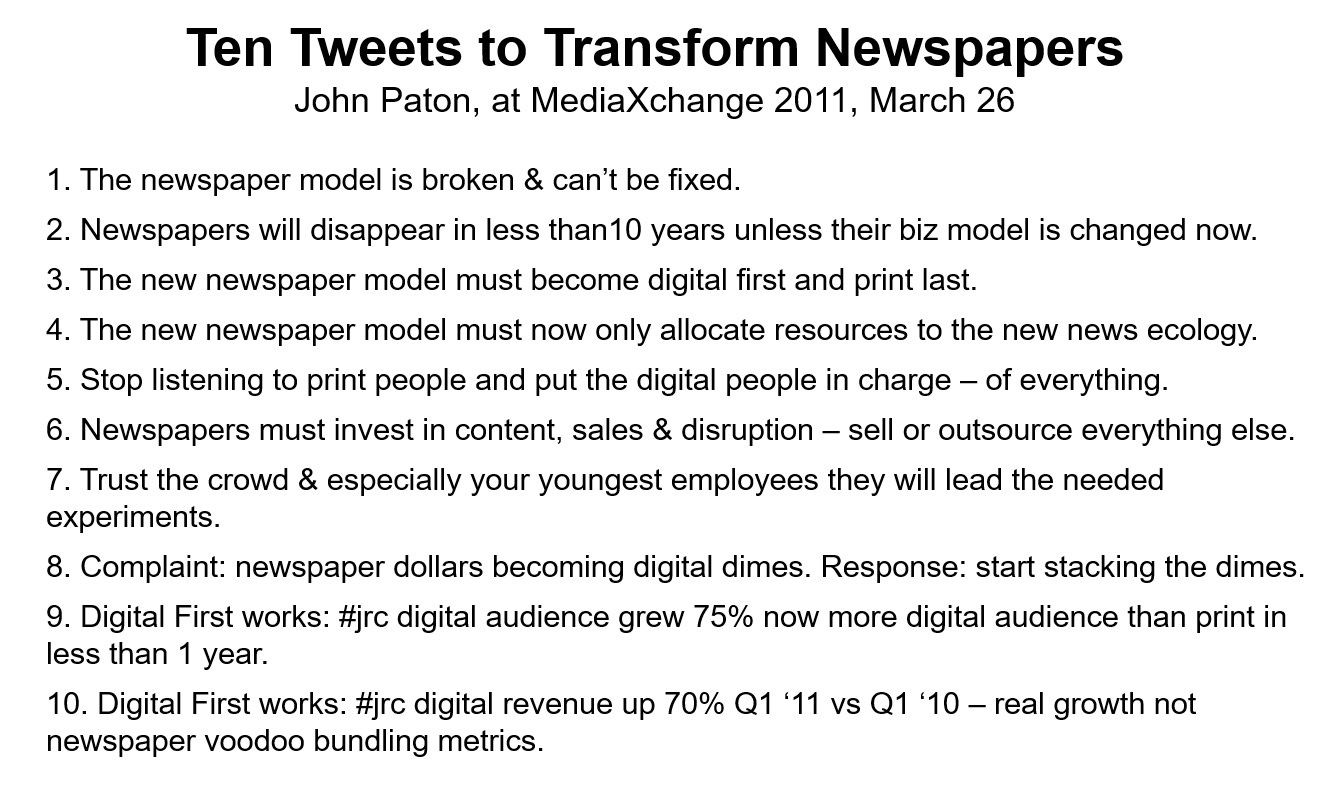
“Ten Tweets to Transform Newspapers” – Digital First! manifesto by John Paton, 2011. Digital First! seemed to bring incredible growth in the beginning, as this was growth from a very low base. Bottom line: Digital First! affected policies but did not save the business.
The cultural proximity between journalists and the progressive users of early social networks, the news-gathering power of social media, and the need for media organizations to secure digital subscriptions led to an ideological convergence between the majority of large media organizations and digital progressives. As a result, the principles of news coverage changed dramatically. Coverage became determined not by the necessity to reach out to the “vast middle” but by focusing on pressing social issues highlighted by the progressive Twitterati. Quantitative studies cited by Ungar-Sargon indicate that the use of terminology associated with woke politics, such as “racism,” “people of color,” “slavery,” “white supremacy,” and “oppression,” has skyrocketed in the American mainstream media precisely since the early 2010s.[xv] This radical shift affected the entire news ecosystem. TV and radio needed to “go digital”, too. They started developing their own digital addictions and dependence on social media crowds.
Frequency of prejudice-denoting words in written news media
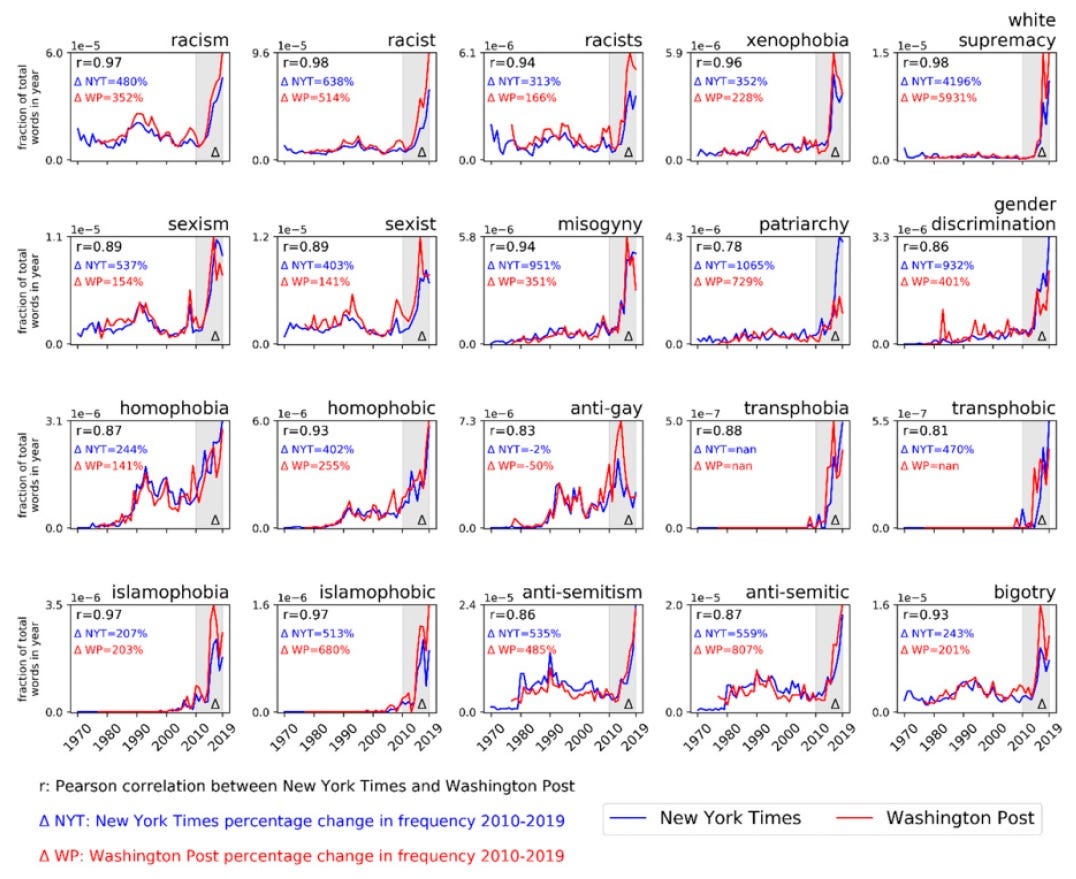
The frequency of prejudice-denoting terms in the New York Times and the Washington Post news and opinion articles, by Rozado et al.[xvi] In total, the study analyzed word use in 27 million news and opinion articles written between 1970 and 2019 and published in 47 of the most popular news media outlets in the United States and detected similar patterns. The study registered the statistical change in language and the synchronization between the media but did not make any connection to the political economy of the media. The surge, however, clearly correlated with the Digital Rush – the switch of the news media from plentiful ad revenue to desperately seeking digital subscriptions in the early 2010s, when the digital audience had very specific social-demographic characteristics: mostly white, urban, educated, and progressive youths.
This happened historically instantly between 2010 and 2016. In terms of social effect, the loss of advertising and focus on the digital audience resulted in a shift of the media from representing a broader populace to representing its digitized and most progressive part.
This ideological transformation, however, did not bring the media any much-awaited financial gains until Trump came.
The Twitter revolution continued: from Occupy Wall Street to MAGA
Thus, the metamorphoses of the media did not happen during Trump’s presidency. On the contrary, Trump’s ascension was, in no small part, the result of these metamorphoses.
The key to understanding this lies, again, in the demographics of social media use. Comparative data on social-media proliferation suggest a hypothesis that the online activity of a certain demographic group can lead to the political activation of this group if the group exceeds an “awareness threshold,” to use Martin Gurri’s terminology.[xvii] This “awareness threshold” can be defined, very roughly, as when 60% of the group uses social media.
In the demographics of “urban”, “age 18–49” and “college educated”, this “awareness threshold” was passed around 2009-2011. They were digitally “activated” and politicized. At the time, digital progressives still identified with a new, decentralized political subculture that opposed the establishment. Soon enough, however, the attention of the mainstream media propelled the digital progressives into a discourse-formation role not just for the urban, educated digital youth but for the entire society. The marriage with the mainstream media granted the digital progressives an entry ticket to the establishment. In a matter of several years, digital progressivism resettled from the Cloud to the Pyramid, from a posture of rebellion against centralized power structures to one of alliance with them.

Meanwhile, social media continued to grow and proliferate. By 2016, the next demographic wave of social media users – older, less urban, less educated, and therefore more conservative – reached the “awareness threshold,” with 60% of the group using social media.
Now the digital conservatives became a part of the Cloud – the new Cloud. In the same vein as their younger predecessors 5-6 years before, the digital conservatives acquired access to agenda-setting. Soon enough, they discovered that the agenda, imposed by the newly formed alliance of the mainstream media with the digital progressives, completely ignored their views and values. The news media embraced an unheard-of stance: they marginalized the majority.
Similar to their younger predecessors, the digital conservatives “evolved” from idle talks to political outcries. Excluded from the mainstream agenda, they grew resentful. Their indignation coagulated into a socially significant force seeking release. It is the same mechanism that underlay the Arab Spring and all early Twitter revolutions. In terms of media ecology, Trump’s ascension completed the Occupy Wall Street movement, but on a different demographic base.
The rest is well known. Donald Trump, with his TV instincts for popularity and having no political agenda whatsoever, sensed the demand. He quickly tweaked popularity into populism, gained incredible media attention for free, made himself a channel for conservative indignation, and enabled the release of the already built-up resentment pressure of the conservative Cloud, disregarded by the mainstream media due to their romance with the digital progressives.
Mutation into postjournalism completed
From 2010–2011, when the leading media began introducing paywalls, until 2016, digital subscriptions remained insignificant from a business perspective, especially amid the hopes that were placed in it. However much the news media wooed the digital progressives, it was not until the conservative demographics arrived on social media that the news media started scoring in digital subscriptions.
The reason was that the ideological alliance of the media with the digital progressives could not bring commercial returns. The digital progressives were indeed progressive – they did not consume news from old media. News and ads were delivered to digital audiences through other platforms. The mainstream media had no commodity to offer their newly chosen reference group, nor could they profit from selling this audience to advertisers.
Trump helped fix the lack of business relations. He became that missing commodity immediately after his shocking victory in November 2016. The mainstream media recognized the signal, upgraded Trump from amusement to existential threat, and started selling the Trump scare.
Importantly, the relationships were not transactional. The news media did not sell news about Trump – this news was always already known to any digital user from social media news feed. Even though the news media supplied the news there, users received it for free, leaving little opportunity for the traditional business model of selling news. Instead of no longer viable transactional news sale, the news media quickly learned to solicit subscriptions as support for a noble cause – the protection of democracy from “dying in darkness,” as the Washington Post put it.
A new business model emerged – soliciting subscription as donation to a cause.[xviii] Donations required triggers, so the media supplied those triggers. The crucial part of the new business model was not just Trump himself but the significant number of his supporters. The most terrifying thing was that fully half of the electorate supported such a “monster” (in the view of the other half). The news media joined the political battle.
The media were by no means interested in mitigating this divide. On the contrary, they needed to maintain frustration and instigate polarization to keep reader-donors scared, outraged, and engaged. Basically, the news media turned to confirming how outrageous the outrageous news were. Their focus shifted toward such news almost entirely. Checking the disturbing value of disturbing news meant that the mainstream media switched from news supply to news validation. This was a clear sign of the mutation of journalism. It started turning into postjournalism.
It all was about Trump, of course, but both ends of the political spectrum were involved. Right-wing outlets also tried to sell scare instead of news – the scare of losing ground and country. The new business model made the media the agents of polarization. They organically joined to the mechanisms of polarization that had formed in the larger media environment – on the Internet and social media.
The validation of disturbing news within certain value systems had finally become a viable business model. Some mainstream media grew their digital subscriptions severalfold during Trump’s tenure. This surge in subscriptions was labeled the Trump Bump.
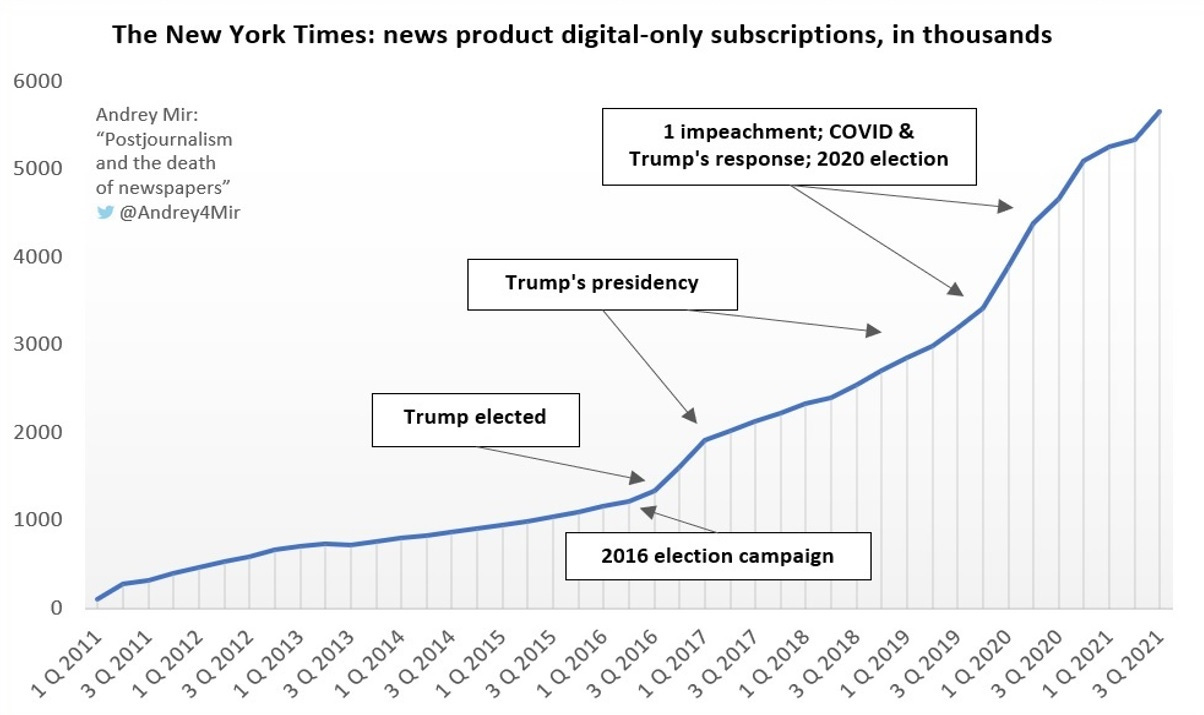
The New York Times: news product digital-only subscriptions (in thousands). Source: The New York Times Company’s press releases[xix].
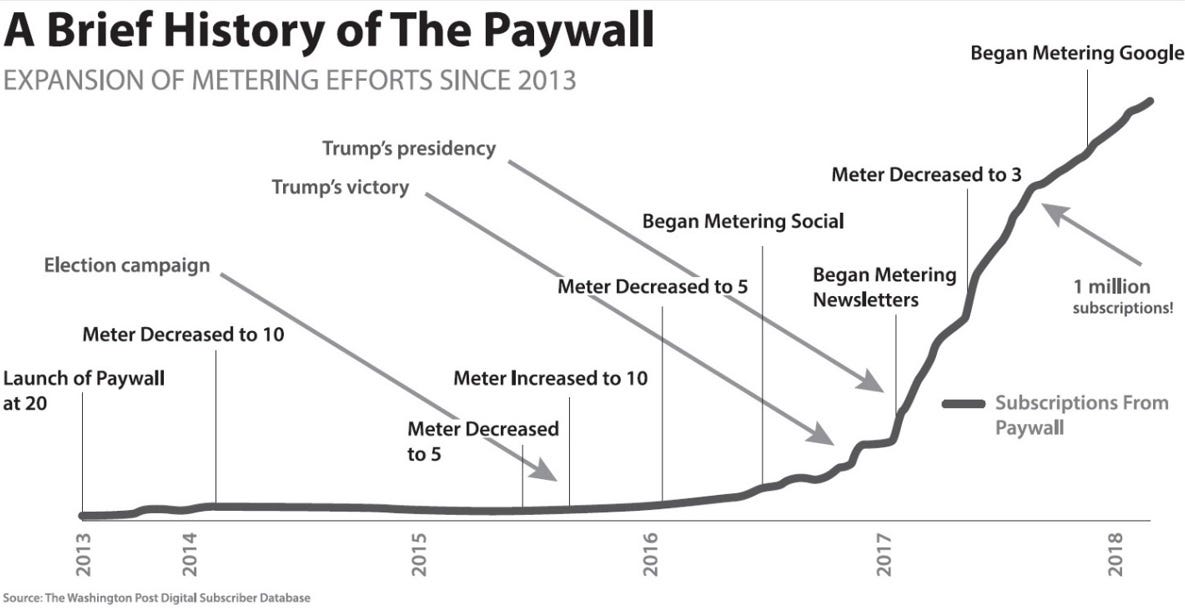
Correlations between the growth of the Washington Post’s digital subscriptions and marketing strategy – or Trump-related events. Source: World News Publishing Focus, WAN-IFRA[xx]; Trump-related events are added.
However, this business model brought significant results only to the largest media outlets. The reason is that news validation creates a swarming effect. People want to have disturbing news validated by the most authoritative news notary, whose validation expertise is accepted by as many people as possible. For the validation of news about Trump, audiences were willing to pay only to flagship media outlets like the New York Times or the Washington Post.
Journalism wanted its picture to fit the world. Postjournalism wants the world to fit its picture. This is essentially a definition of propaganda. Postjournalism has turned the media into crowdfunded corporate ministries of truth that joined the political struggle out of desperate business need for survival. If the ad-driven media manufactured consent, the reader-driven media manufacture anger. The former served consumerism; the latter serve polarization.
It is common to conclude an analysis with a solution. There is no “solution” for a media shift of such magnitude. “How do we fix polarization?” is the wrong question. The right question is, “How are we going to live with it?”
Read more: The Viral Inquisitor and Other Essays on Postjournalism and Media Ecology.

See also books by Andrey Mir:
The Viral Inquisitor and other essays on postjournalism and media ecology (2024)
Digital Future in the Rearview Mirror: Jaspers’ Axial Age and Logan’s Alphabet Effect (2024)

[i] Herman, Edward S., and Chomsky, Noam. (1988). Manufacturing Consent: The Political Economy of the Mass Media.
[ii] Reinan, John. (2014, March 3). “How Craigslist killed the newspapers’ golden goose.” Minnesota Post.
[iii] Pew Research Center. (2021, June 29). Newspapers Fact Sheet.
[iv] U.S. Census Bureau, Breakdown of Revenue by Advertising Type: Newspapers Advertising Space - Classified Advertising for Newspaper Publishers. FRED, Federal Reserve Bank of St. Louis.
[v] Dang, Sheila. (2019, June 5). “9 months ago Google, Facebook have tight grip on growing U.S. online ad market: report.” Reuters.
[vi] Weissmann, Jordan. (2014, April 28). “The decline of newspapers hits a stunning milestone.” Slate.
[vii] The New York Times Company’s press releases.
[viii] Mir, Andrey. (2014, November 16). Content marketing: How companies are turning into media. Case study. Human as media Blog.
[ix] Mir, Andrey. (2013, November 13). The manifesto of the Viral Editor. Human as media blog.
[x] I explored the inevitable development of social media use from socialization to activism and politicisation in Human as media. The emancipation of authorship. (2014).
[xi] Mir, Andrey. (2019, December 25). The Pyramid against the Cloud: Institutions’ perplexity regarding the Net. Human as media Blog.
[xii] Gurri, Martin. (2018 [2014]). The Revolt of the Public and the crisis of Authority in the New Millennium.
[xiii] Ungar-Sargon, Batya. (2021). Bad News: How Woke Media Is Undermining Democracy. Encounter Books. P. 7.
[xiv] Paton, John. 2011, March 26. Ten tweets to transform newspapers. IndieWire.
[xv] Ibid. P. 4.
[xvi] Rozado, David, Al-Gharbi, Musa, and Halberstadt, Jamin. (2023). Prevalence of prejudice-denoting words in news media discourse: A chronological analysis. Social Science Computer Review, Vol. 41(1), pp. 99–122.
[xvii] Gurri, Martin, (2018 [2014]). The Revolt of The Public and the Crisis of Authority in the New Millennium. P. 53.
[xviii] I examine this business model in Postjournalism and the Death of Newspapers. The Media after Trump: Manufacturing Anger and Polarization. (2020).
[xix] The New York Times Company’s press releases.
[xx] Veseling, Brian. (2018, July 30). Washington Post puts emphasis on creating paths to subscription. World News Publishing Focus, WAN-IFRA.
[xxi] Benton, Joshua. (2019, July 31). “The L.A. Times’ disappointing digital numbers show the game’s not just about drawing in subscribers – it’s about keeping them.” NiemanLab.