
Media evolution – the evolution of what?
Thoughts on the margins of Paul Levinson’s “Human Replay” (2017 [1978])

Paul Levinson was a doctoral student of Neil Postman in the 1970s. He organized the Tetrad Conference for Marshall McLuhan in 1978. He worked later with Eric McLuhan. A funny fact: Levinson is probably the only person in the world who possesses a personal voicemail from Marshall McLuhan. In August 1978, McLuhan called him to give feedback on his dissertation and left a message on his home phone (available on Levinson’s podcast). Levinson belongs with that first cohort of younger colleagues of Postman and McLuhan (with Lance Strate, Susan B. Barnes, Thomas F. Gencarelli, and Casey Man Kong Lum) that formed the Media Ecological Association in 1998 and has led the entire movement since then.
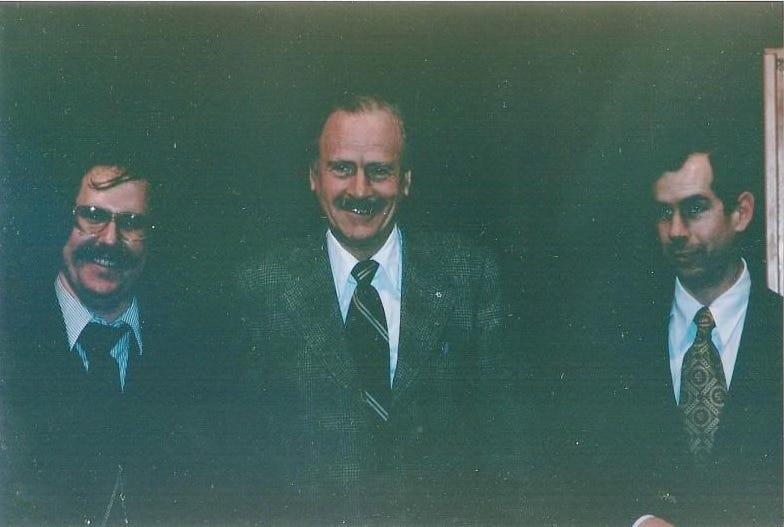
From Left to Right: Paul Levinson, Marshall McLuhan & Eric McLuhan.
Photo by Mary Lou Bale, taken at the Tetrad Conference organized by Paul Levinson at Fairleigh Dickinson University, Teaneck, NJ, March 10, 1978. McLuhan Galaxy Blog.
Levinson defended a dissertation on the “anthropotropic” theory of media evolution in 1978. The dissertation was published, with some adjustments (for example, different placement of footnotes), in 2017 under its original title Human Replay: A Theory of the Evolution of Media. The book is unique evidence of the early media ecological explorations and advances an original theory of media evolution, which has gained particular value due to the latest development of new media.

In the 1970s, the lifespan of a significant medium, such as TV, radio, or phone, was far longer than a human generation’s lifespan. However, the periods of certain media’s use started shrinking. It was clear when color TV, for example, was replacing monochrome TV. The world was stepping into an era in which the lifespan of a media generation was becoming shorter than a human generation. Today, new media are displacing each other at an increased pace. The “sequentiality” of media is visible, even tangible, to regular users. The idea that media might develop and offset each other within a certain general logic is becoming obvious. But this was not the case in the 1970s. Levinson was certainly a pioneer, if not the originator, of the very notion of media evolution.
Levinson’s innovative and prescient take on media ecology was cemented by the model he called “anthropotropic”. The anthropotropic model of media evolution holds that media evolve to better accommodate human needs in interactions with the environment. Mediating the environment, technologies must be compatible with human operational abilities. They must “replicate” the natural or “pre-technological” mode of sensorial and mental operations, hence the term “anthropotropic” – “moving towards human”. At the same time, media need to extend natural human capacities “to overcome the biological constrictions… the limitations of space and time that are a part of pre-technological environments” (p. 23 - 24). Aligning with natural human capacities, media simultaneously extend them across space and time. Therefore, those media survive and succeed that replicate the pre-technological world better while extending humans across space and time.
Levinson singles out three stages of media evolution.
Stage A. “In the beginning, all communication is non-technological or face-to-face. All elements which characterize real-world perception, such as color and motion, are present. Biological limitations on the ability to communicate across space and time are also present” (Levinson, 2017 [1978], p. 24).
Stage B. “Technologies are devised to overcome the biological constrictions on space and time communication. But to overcome these limitations, early technologies must jettison many desirable components of the real-world environment, such as color and motion perception” (Ibid., p. 24). At this stage of evolution, media drastically enhance some isolated human capacities, simultaneously distorting the natural human perception of reality or, to use McLuhan’s term, the equilibrium between senses. “Stage B technologies evolve towards maximum extension across time and space in complete disregard of their ability to replicate reality,” highlights Levinson (Ibid., p. 172).
Stage C. “As technologies are made more sophisticated, they attempt to regain the elements of face-to-face communication lost by earlier technologies, as well as maintain (and in some cases improve) the extension across space and time. Advanced technology thus combines the extension of Stage B with the reality of Stage A” (Ibid., p. 24).
Comparing early technologies to the forbidden fruit of knowledge, after tasting which humans were evicted from the Garden of Eden, Levinson states that, at Stage C, technologies turn into “a remarkable fruit that permits us re-entry” (Ibid., p. 24).

Levinson applies this three-stage anthropotropic model to examine “the entire evolution of media, from hieroglyphics to holography” (Ibid., p. 30). The angle he looks at media from is both ecological and evolutionary. He explores an ecological niche of a medium in terms of what sensory or mental “pre-technological” capacities a medium replicates; he also investigates what defines the survival or vanishing of a medium in that specific niche.
It is especially interesting to see the ecological analysis of certain media from the late 1970s because the time that has passed has added a media archeological flavour into the observation. Particularly noteworthy are futurological exercises from the past that are not so distant but nevertheless belong to another media era. They allow the assessment of media expectations – an interesting way to evaluate evolution by comparing what was expected with what actually happened.
For example, Levinson pays close attention to holography as a medium combining “one-dimensional” media that allowed the “replaying” of static or moving pictures, colors, multi-directional sounds, movements, etc. Holography, as seen from the 1970s, replicates the holistic and simulated 3D perception of reality from Stage A, the “pre-technological” stage. And while holography as a medium has not become dominant and its niche is very isolated, the function of the 3D replication of reality predefines modern media development. This media function (the ecological niche) is represented by different media devices, such as virtual-reality headsets, immersive movie theaters, and further to cognitive interfaces. Although holography as a medium has not been successful, the 3D replay of reality as a media function has been. Life-like immersion and engagement have become dominant principles of media engineering, be it in social media or sensory devices.
Similarly to techno-determinism being the vexed question for media ecology, teleology is the vexed question for any evolutionary theory. Does evolution lead somewhere? Does it have a “purpose”?
The three-stage anthropotropic model suggests if not the “purpose” then the “movement” or “direction” of media evolution. Media evolution takes humans from their natural conditions restrained by biology, empowers them with technologies, and moves towards recapturing or duplicating the “pre-technological balance of senses” now extended across time and space. Therefore, when assessing media and their capacity for usefulness/survival, one needs to look at how well a certain medium replicates isolated or combined “pre-technological” human capacities, hence the title “Human Replay”. If media are selected based on how well they replicate human sensory and mental capacities, media evolution has to lead to the emergence of the Ultimate Medium somewhere at the end of Stage C for humans to re-enter the Garden of Eden. The Ultimate Medium, tuned for total “hhuman replay” but with no biological restraints of space and time, will signify, of course, the moment of the Singularity.
The evolution of media is not just a protocol but rather a moving force of this process. New media replace old ones with increasing frequency. That which seemed to be an almost horizontal and just slightly elevating line of social and technological progress centuries ago has turned into a sharply ascending pattern in recent decades and will likely grow into the vertical, which is the pattern of the Singularity. There is obviously some logic behind this, but this logic does not come down to the linear succession of technologies. Media evolution is bigger and, most importantly, more complex than just media archeology or media history. As evolution is one of the basic concepts of ecology, media evolution has to become one of the central concepts within media ecology.
The need for understanding media evolution is becoming a pressing issue precisely because of the acceleration of historical time. We see that new media are emerging at a growing speed. Understanding the principles of their emergence is not about the past anymore; it’s about the future that is speeding toward us now faster than ever before. Just as media ecology implies media evolution, media evolution implies media futurology. What does the future hold for us? If there is a certain general logic in media replacing each other, where does this logic lead us?
Since it is becoming clearer that media are the agent of change and hence the shaper of the future, the demand for evolutionary media ecology will only grow. The works of Innis, McLuhan, and Postman were inherently evolutionary, but Levinson’s 1978 theory was perhaps the first that focused on the concept of media evolution per se. Twenty years later, a new wave of evolutionary media studies arrived, which included Lev Manovich’s The language of new media (2001); Robert Logan’s evolutionary theories of alphabet, language, and information (2004; 2014); Lisa Gitelman's Always Already New: Media, History, and the Data of Culture (2006): Carlos Scolari’s theory of media evolution (2013; 2020); and some others.
These initial waves of evolutionary-leaning explorations of media were all about “emergence, dominance, and survival/extinction” of “the media as species” (Scolari, 2013, p. 1418-1419). It accomplished an important job, as those theories of media evolution overcame the linearity and genealogy of media history as well as the fragmentation and randomness of media archaeology. As Scolari described his approach, media evolution became “no longer thought of as a linear series of branching technologies but rather as a network of intermedia relationships moving through the time axis” (Ibid, p. 1436).

But the logic of media evolution as the evolution of media species, charted into the future long enough, must lead to a paradox. If media replicate the human mode of interactions with reality (Levinson’s “human replay”), then they must evolve into the Ultimate Medium, the main feature of which will be… the total elimination of mediation. To give a tangible illustration: the rod as a medium succeeds when the fisher senses the fish, not the rod. Now imagine this effect of “immediacy” for the Ultimate Medium replicating all human sensory and mental capacities. It must not mediate; it must induce reality and immerse the user into it. It will stop being a medium and become an environment.
How can it be proved that media evolution will end in this way? It is simple: why would media stop short of it if they have been evolving towards “human replay” as Levinson clearly showed? The final, Ultimate Medium must be so perfectly good at “human replay” across space and time that it will enable the merger of the user and the environment. In the end, the user, the medium, and the environment must become one.
This thought experiment overturns the main question of media evolution. The paradox of the Ultimate Medium forces a reconsideration of the concept of media evolution as centered around the media as species. Species cannot evolve towards their annihilation. So, true media evolution is not the evolution of media (of “mediums”). Then the question is, the evolution of what exactly media evolution is?
The prompts for an answer can be found in Levinson’s Human Replay. Referring to Buckminster Fuller, he mentions “an ineffable ‘phantom captain’ or self, the human mentality or soul that launches and pilots the mechanized ship in life and abandons it in death” (p. 56). Since the sensorium and nervous system are “extensions of the self”, they need to be navigated by some authority that has consciousness and will. Call it the mind, or the self, or the soul – it has to have conscious and cognising agency that not only transcends biology (as referenced in the subtitle of Ray Kurzweil’s (2005) book The Singularity is Near: When Humans Transcend Biology) but also transcends human individuality. The conscious will is the substance, not an instance.
Media evolution can be seen as a part of Teilhard de Chardin’s mega-evolution. Humankind is just a current and temporary carrier of this conscious will that intrinsically is a divine property. From this point of view, humankind is the larva of the next god. Humankind bears the conscious will that becomes a god when media evolution reaches the stage of the Ultimate Medium, or Artificial Intelligence, or the Singularity, or the Omega point (according to Teilhard de Chardin’s terminology).
The signs of the oncoming divine transformation of humans by media are already visible. McLuhan started talking about this as early as the 1960s while discussing the impact of electronic media, TV in particular. He described “the angelic discarnate man of the electric age who is always in the presence of all the other men in the world”. He said that “<Electric media> give you a sort of dimension of an angel, an almost supernatural being, a disembodied spirit.” (See: Father Patrick Peyton. Interview with Marshall McLuhan on Television Show, “Family Theatre”, 14 November 1971.)
Thus, media evolution leads to “transcending biology” by the ‘phantom captain’ that currently inhabits the body and, through the body, its media and its planet. This view complies with the spirit of Levinson’s anthropotropic theory but does not fit its formal spelling. Yes, media extend the body into the environments, but they also extend mental capacities, the mind. Besides, the body itself serves as a medium, or even as multimedia, for the mind through its sensorium (the Pavlovian primary signal system) and through the capacity of speech (the Pavlovian secondary signal system). The anthropotropic “bias” of media can be revised as the nootropic one as media evolve to better accommodate the mind, with the body being just another medium. The root “noo” here has the same meaning as in the concept of the noosphere, the part of the planet’s surface, approximately 10 kilometres under and 200 kilometres above the surface, that is colonized and transformed by human consciousness and mental activity.
The idea of nootropic media evolution, in fact, decenters the concept of media evolution away from humans. The final cause of media evolution is not accommodating humans but to enable the transition of the willing mind, or the cognising will, from the biological form to a non-biological and likely non-material form. This, again, connects media evolution to the Omega point within mega-evolution. The non-individual and non-anthropocentric character of the nootropic bias of media is understood better within Teilhard de Chardin’s concept, who also was one of the originators of the notion of the noosphere and applied it to describe the move of humankind towards god-like conditions through extending the coalescing human mind across all of reachable space, both physical and mental.

If media evolution is driven by resettling the conscious will from humans to the environment itself, why then do media extend humans’ bodily, sensory, and mental faculties? Why is it so easy to fall into the idea that media replicate human pre-technological actions and serve humans?
Media ecology might have an answer. As McLuhan saw it, “Man becomes, as it were, the sex organs of the machine world, as the bee of the plant world” (McLuhan, 1994 [1964], p. 46). Referring to McLuhan, Ellul, and others, Levinson also highlights media’s “peculiar property of transferring power from origin to extension, putting the car or road in the driver's seat, as it were, and leaving the hapless driver at the mercy of his former ‘servants’” (Levinson, 2017 [1978], p. 63). The relations of humans and their media are rather symbiotic. By extending human senses, organs, and capacities, media empower humans in the environments. In return, media acquire human attention and care; these are humans who develop media. When using media as tools, the users themselves become the tool of media evolution. Levinson brilliantly put it in this way: “Since even the most sophisticated technologies, as yet, are incapable of reproducing themselves, it is obvious that the technological transmitting agent or ‘gene’ is, once again, the human organism” (Levinson, 2017 [1978], p. 83).
Thus, humans perform the role of “technological genes” in media evolution. The extensions by media do not serve humans. Media offer humans the nectar of convenience in colonizing space and time in order to attract humans and force them to perform pollination tasks for media. Media evolution collaborates with human evolution; they have the same “goal” withing Teilhard’s divine mega-evolution. When this goal is achieved, both media and humankind will cease to be what they are and merge with the environment in the paroxysm of giving birth to a new being, to whom we can refer as artificial intelligence or a new god.
So, media evolution is not (only) the evolution of media as species. It is also human-media co-evolution. At a bigger scale, human-media co-evolution is a part of the evolution of something else for which humankind is just a temporary biological vehicle. Media help to transcend biology, meaning they emerged because of biology. Space, time, and death are the preconditions of media. As soon as biology is transcended, media will cease to exist. Media evolution will accomplish the task and end.
The three-stage structure of the evolutionary model advanced by Levinson can also be revised. At the first stage, media as mechanical tools and pre-literate communication technologies created the media environment “given” to humans in their sensory perception, to use Lenin’s idea of materiality. In his main philosophical treatise, Materialism and Empirio-criticism, Lenin wrote: “Matter is that which, acting upon our sense-organs, produces sensation; matter is the objective reality given to us in sensation” (Lenin, 1909, Ch. III; highlighted by me – A.M.). Thus, mechanical tools and primitive technologies replicated the natural mode of action (“human replay”) in the media environment of the Given.
Literacy and accompanying media further overcame the biological limitations of the body in space and time and doubled the world by creating the media environment of the Represented. If the reality of the Given is still material, the reality of the Represented is already ideal. It is an abstraction that reflects the world and allows its planned and rational transformation.
Electric and, finally, digital media induce a new reality that replicates physical reality but only to seduce people and abduct them from physical reality so that they will develop digital media further. Human trafficking is the “purpose” of digital reality. Thus, digital media create the media environment of the Induced, which dismisses the biological limitations of space, time, and, soon, death. This is the reward promised to humans by media evolution for their exodus from the physical world.
Through the sequential environments of the Given, the Represented, and the Induced (Miroshnichenko, 2016), media resettle the mind from the biological body into the media environment. Media make the mind itself the environment, and this is the “goal” or the final cause of media evolution. Since the resettling of the mind into the induced environment will dismiss the biological body and therefore death, the resettling into the induced (better, safer) environment is also the final cause of human evolution. This is why media evolution and human evolution align and provide symbiosis between humans and media.
In 1978, Paul Levinson revealed that media evolve to better replicate “the pre-technological world” for humans. With digital media in full swing, it is becoming clearer that media replicated “the pre-technological world” only to seduce humans from the Given, through the Represented, into the Induced. Levinson also wrote that media evolve toward “more realistic forms”. This is true, but only at the stage of seduction. When digital media swallow the user, they start evolving toward less realistic and more surrealistic forms.
When the induced reality completely replaces the reality of the Given, nothing will stop media from developing even further and bringing new, surrealistic experiences and feelings. This is the historical moment we are at now. The anthropomorphization of media has almost done its job and is about to stop here. “Ars” no longer needs “imitatur naturam”.
The oncoming rejection of “realistic forms” by media can already be seen, for example, in digital media’s dismissal not only of space but also gravitation. We can experience flying, but does it feel real or surreal? Is it “human replay” at all?

“Human replay” as a running principle of media evolution worked as long as media needed to seduce physical human beings. When they no longer have to, “human replay” turns into playing God. In the digital, we can accelerate, stop, repeat, slice, or reverse the continuity of events and time itself. Users can avoid physical harm when participating in video battles or while really killing people with military drone strikes; they can personally navigate a rocket like a kamikaze but with no risk of death. Even death itself can already be reversed in the digital – a player needs to only save the game or respawn.
There still remains much to debate with Dr. Levinson regarding the nice metaphor of “human replay”, but it is clear that digital media reshape the human sensorium itself. The sensorium needed for interactions within the physical environment was space-biased and time-ignorant. The digital sensorium is becoming space-ignorant and time-biased. The digital sensorium is completely impervious to physical harm and highly vulnerable to psychological harm. Finally, the digital sensorium does not know death but is painfully susceptible to its digital equivalents – ostracism, cancelation, expulsion, exclusion, banning, blocking, and so on.
Besides, new sensations grow within the digital sensorium. For example, as a digital user knows no gravitation, the player’s sense of space extends to that of birds. (Do media aim at “bird replay”?). Most importantly, digital dwellers become so close to an unrestricted number of others that they need to sense not physical but social surroundings and conditions, such as collectiveness, popularity, attention, virality, relevancy, degree of anonymity, the dangers of bans, the premonition of ostracism, the rage or joy of exposition, and so on. In the digital, not only do emotions become sensations, but also new sensations emerge.
With those new conditions and sensations, the concept of truth is rapidly changing. Truth is no longer verified by the risk of physical harm but is validated by the scale of dissemination because non-complicity with widely accepted opinion may cause social harm. With no real-world tethering, the more people that share content, the truer this content is (Mir, 2020, p. 110).
So, there will be no need to replicate the pre-technological world when humans resettle to the post-technological world. Paradoxically, however, the anthropotropic theory is critically important for understanding that, in the final phase of media evolution, media do not “replay” but resettle humans (or rather that for which humans are vessels). The anthropotropic concept of media evolution laid the foundation for exploring the symbiosis between human and media in the process of their co-evolution.
Paul Levinson’s theory of media evolution removed the development of the media environment from the history, archeology, and genealogy of technologies and gave it its own perspective. Is media evolution really anthropotropic, and, if yes, to what extent? This is the question of the future for humankind. Now it is time to re-read Levinson’s theory and build upon it to understand the further media development.
First published in ETC: A Review of General Semantics, 79:1-2 (2022).

See also books by Andrey Mir:
The Viral Inquisitor and other essays on postjournalism and media ecology (2024)
Digital Future in the Rearview Mirror: Jaspers’ Axial Age and Logan’s Alphabet Effect (2024)

Bibliography
Gitelman, Lisa. (2006). Always Already New: Media, History, and the Data of Culture. Cambridge, Massachusetts: MIT Press.
Kurzweil, Ray. (2005). The Singularity Is Near: When Humans Transcend Biology. Penguin Books.
Lenin, Vladimir Ilyich. (1909). Materialism and Empirio-Criticism.
Levinson, Paul. (2017 [1978]). Human Replay: A Theory of the Evolution of Media. Connected Editions.
Logan, Robert K. (2004). The Alphabet Effect. Hampton Press.
Logan, Robert K. (2014). What Is Information? Propagating Organization in the Biosphere, Symbolosphere, Technosphere and Econosphere. Toronto: DEMO publishing.
Manovich, Lev. (2001). The language of new media. Cambridge, MA: MIT Press.
McLuhan, Marshall. (2001 [1964]). Understanding media. The extensions of man. Routledge Classics.
Mir, Andrey. (2020). Postjournalism and the death of newspapers. The media after Trump: manufacturing anger and polarization.
Miroshnichenko, Andrey. (2016). “Extrapolating on McLuhan: How Media Environments of the Given, the Represented, and the Induced Shape and Reshape Our Sensorium”. Philosophies, 1, no. 3: 170-189.
Scolari, Carlos A. (2013). “Media Evolution: Emergence, Dominance, Survival, and Extinction in the Media Ecology.” International Journal of Communication, 7 (2013), p. 1418-1441.
Scolari, Carlos A., Rapa, Fernando. (2020). Media Evolution: Sobre el origen de las especies mediàticas. Buenos Aires: le marca editora. Spanish edition.
Teilhard de Chardin, Pierre. (1959). The Phenomenon of Man. Harper Perennial.
Simulation