
Journalism in search of a cute little monkey
Selling "something else," the new media turn into sellers of "something else," not news

Having lost their traditional business to the internet, the news media are forced to sell ‘something else’. But selling something else, not content or ads, makes them sellers of something else, not the news media. Read more in Postjournalism and the Death of Newspapers. The Media after Trump: Manufacturing Anger and Polarization.

Years ago, resort photographers had a thriving business, taking beach vacation photos with captions like “Greetings from Acapulco 1982.” Now everyone has a smartphone camera. The quality may be lower than what a professional photographer would offer, but it is actually good enough. Or you can check the picture and try again. Besides, it’s always there for you, and it’s free.
What should resort photographers do? Some have found a solution: a cute little monkey (a crocodile or parrot works just as well). You can pose for a picture with an adorable pet or take one on your own device for a fee. No tourist would bring a cute monkey to a resort, so this is a unique, monopolistic offer that can trigger an impulse to buy. It might not work as well as photography did 30 years ago, but it’s still something.
The fun part is that the photographer is selling not photography but a monkey. Forced by the technological emancipation of photo authorship, the resort photographer has shifted from the art of resort photography to the craft of village-fair entertainment and zookeeping.
This is what has happened to journalism, without being noticed and for the same reasons. Having lost to former customers its monopoly over “photography supply,” journalism is desperately searching for a cute monkey to sell instead.
***
The business model with two main revenue sources—ads and readers—can no longer support journalism as it once did, so the media are forced to sell something else. A side business tied to content production—a media-allied business—seems to be a promising solution. Having highly professional writers, many newsrooms launched content studios that produce material for clients to be published elsewhere.[1] For example, The New York Times Company established T Brand Studio, a sort of content bureau. As its statement claims: “Through T Brand Studio, our branded content studio, we offer our brand partners access to The New York Times’s proven recipe for storytelling and work with them to develop industry-leading strategy, creative, and distribution.” [2]
The small local news site Richland Source in Ohio turned photo reporting about homecomings into profitable, celebrity-style photo galleries. They do the same with proms and Christmas concerts. This provides a kind of professionally facilitated collective selfie for the local community. As students and families want to see themselves as socialites, these photo galleries are the most visited pages on the Richland Source website—drawing ten times more visitors than average. [3] Sponsor slots in those public photo albums are sold out in advance.

Event management is one of the most logical auxiliary businesses for the media, as forums and conferences produce content too, though in a different form. Afterwards, this content can be used or reprocessed by media outlets in classical journalistic form.
The Texas Tribune is the leading event producer among US (and likely global) media, earning one-fifth to one-fourth of its revenue from events. Much of this comes from The Texas Tribune Festival, “a three-day extravaganza of education, health care, transportation, energy, and other topics that click with the Tribune’s audience.” [4] This annual event draws thousands of attendees, hundreds of speakers, and profits from sponsorships and ticket sales.[5] The format was modeled on The New Yorker Festival, organized in 2000 for the magazine’s seventy-fifth anniversary, and it inspired similar events at other media outlets.[6] In 2018, Texas Tribune events drew 14,382 attendees. [7] In addition to the festival, the Tribune produces about 60 sponsored and free public events each year.

The educational business also attracts major media brands. In 2016, the School of The New York Times began offering educational programs for pre-college and professional audiences. “We translate the knowledge and practices of The New York Times into educational experiences for diverse learners,” the school proclaimed.[8]

The School of The New York Times charges tuition fees and offers scholarships—exactly as traditional universities do. It is a full-scale educational institution with a brand and self-advertising capacity that many prominent universities would envy.
***
The list of auxiliary businesses maintained by The New York Times is not limited to the content bureau and educational programs. The New York Times Store[9] sells memorabilia and souvenirs branded with The New York Times. Clients can also buy branded and customized calendars, cookbooks, or a reprinted issue from a certain past date, such as someone’s birthday many years ago. The store also offers a wide range of New York Times-branded clothes, toys, and other goods. In 2014, “the Times’ ‘other revenue,’ which includes the store and other brand extensions, brought in 5–10 percent of total revenue, up 3 percent primarily through store sales.”[10]
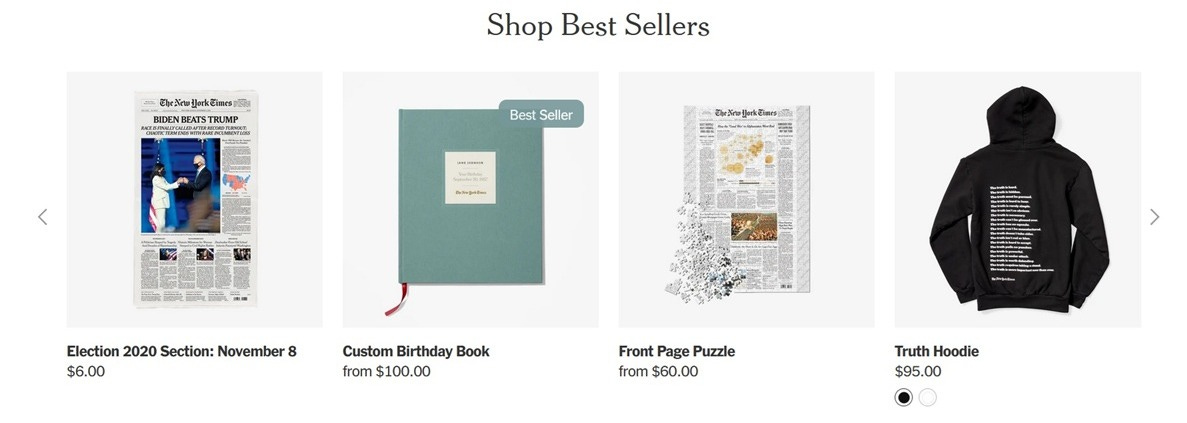
As TV shopping shows say, “But wait, there’s more!” — yes, you can also get vacation and “educational” tours with The New York Times Journeys,[11] which offers trips ranging from New York City tours to cruises around the world.
Others are dipping into tourism, too. In 2017, The Wall Street Journal launched the WSJ Business Travel Service, which became part of its WSJ+ subscriber benefits program, along with the WSJ Wine Club.[12]
Cross-promotion in the media market has some peculiarities. Goods and services were once used to attract subscribers. Now, subscriptions (or more often memberships) and certain goods or services complement each other and create a new business stream. New York magazine’s membership program, “with a bigger focus on food and drink events,” not only promotes paid memberships but also the paid events hosted by the magazine’s experts. It states that,
There will still be special discount codes and early access to sales at retailers, but more emphasis on exclusive food and drink events, ideally hosted by editors of its Grub Street vertical. Earlier this week, for example, New York by New York members got together to eat an entire pig with food critic Adam Platt and Grub Street editor Alan Sytsma at Gramercy Italian restaurant Maialino.[13]
Special events, sold to the general public and/or offered at a discount to subscribers, became a standard part of all membership programs after The Guardian introduced this approach in 2011 as a substitute for subscriptions. It targets subscribers, now member-donors, but also creates a new revenue stream by combining subscriptions with event production (or the production of other services).
Undoubtedly, this cross-promotional innovation may slightly revitalize the media business. But it has little to nothing to do with journalism and its social functions.
***
The idea of selling branded “merch,” like Disney or the Transformers franchise, also became popular with some media. After all, Playboy has long played almost in the same league as Disney: in 2016, the retail value of Bunny-licensed goods sold reached $1.5 billion.
But the biggest player among the media in this market is Meredith, parent company of Better Homes and Gardens, “which accounted for over $22 billion… second only to the $57 billion generated by Disney, according to License Global.”[14]
Many other publishers are active in brand licensing, including Hearst ($350 million), Rodale ($155 million), and Condé Nast ($150 million in brand-licensed goods sold).
Not only can the media produce branded souvenir merchandise or license their brand to someone else’s goods, they can also enter completely different markets with their own product lines. For example, Cosmopolitan launched its own jewelry line and “Cosmo-branded” cosmetic bags and accessories. ELLE launched its own line of fragrances.[15]
***
Other “cute little monkeys” the media seek to replace fading revenue are even funnier.
Hearst Magazines sold a self-rolling yoga mat accompanied by a voice-assistant yoga instructor. “The mat includes an Amazon Alexa command that turns your device into a yoga teacher and talks you through a flow of the day from Women’s Health,” announced Cosmopolitan.[16]
Men’s Health not only branded a bag of beef jerky but also made sure it “had the right protein levels without compromising on the taste.” [17] Not only is this an auxiliary business, but it also serves the noble function of watchdog journalism.

“We buy balloons and a helium tank,” said the head of the local newspaper Oktyabrsky Vestnik from Russia at a media conference in 2011. “We inflate balloons and sell them at local events. It doesn’t bring in huge revenues, but it’s fairly profitable.” Since a local newspaper is obliged to cover all local festivities and be present at them, why not sell something celebratory?
In 2017, BuzzFeed started selling an internet-connected “precision smart cooktop.” The experiment seems to have been so successful that BuzzFeed partnered with Epoca International, a houseware manufacturer, and Walmart in a joint venture under the brand BuzzFeed’s Tasty, a video-recipes division complemented by e-shopping. The venture aims to produce, promote, and sell spoons, spatulas, and other kitchenware.[18]
***
As the media are supposed to be capable of attracting an online audience, e-commerce seems like a logical and promising option for another auxiliary business. Many publications have tried it, with varying results. Even new hybrid half-media/half-e-commerce forms have appeared, such as PopSugar, initially a lifestyle online media outlet that acquired a fashion shopping search engine and turned into a lifestyle media/shopping entity.

The only problem with e-commerce is that, in order to sell something, you need to have that something—and there are many other players in the market who already have it. With this move, the media enter an area with virtually no chance of establishing the kind of monopoly to which they were once accustomed. They may have an advantage in gathering an audience, but not in goods production, logistics, or sales. This hybrid zone may be promising and may continue, but not for the media business; rather, it will be promising for other businesses-becoming-media—a form that all of them must now take.
However, the bigger risk relates not to uncertainty about business success but to the capacity of the media to hold true to their ideals when chasing digital dimes in the strange lands of online commerce or online marketing. As Digiday once put it,
Given the challenges of digital media, commerce is a tempting way for publishers to create new revenue streams by extending their brands. But slapping commerce links on articles can lead to the impression that the editorial side is for sale, damaging the publisher’s credibility.[19]
***
From small local newspapers selling helium balloons to world-class media behemoths such as The New York Times selling tote bags, many players in the media market are taking this slippery road, which leads to becoming either marketing agencies or media–commerce hybrids. The need to sell “something else” is turning the media into sellers of “something else.”
The question is how the quality of content and independent journalism can be preserved under such conditions. Journalism is turning into marketing. “Native advertising” has emerged—a format that marries external selling intents with editorial journalistic narrative, directly using journalistic tools, styles, and mindsets to market someone else’s goods under the guise of media storytelling. The erosion of journalism’s integrity through marketing has intensified.
The wall between advertising and news, a hallmark achievement of 20th-century journalism, is crumbling. The fall of this wall was once a dream of advertisers; now newsrooms offer it, and they are often even proud of their achievements in native advertising and other kinds of advertorials and infomercials—ads built into editorial content. Journalism invites marketing to come in and make itself comfortable. This is a Trojan horse built not by Odysseus but by Hector.

See also books by Andrey Mir:
The Viral Inquisitor and other essays on postjournalism and media ecology (2024)
Digital Future in the Rearview Mirror: Jaspers’ Axial Age and Logan’s Alphabet Effect (2024)

[1] Max Willens. (2018, October 4). Publishers are expanding their content studios to do more agency work. Digiday.
[2] The New York Company—T-Brand Studio.
[3] Hare, Kristen. (2017, November 1). “You can make money off homecoming pics and 9 other simple ideas to borrow from local news.” Poynter.
[4] Ellis, Justin. (2013, September 27). “What makes the Texas Tribune’s event business so successful?” NiemanLab.
[5] Nahser, Freia, (2018, September 27). “The Texas Tribune: audience strategy and business model.” Medium.
[7] Allen, Barbara. (2019). “The Trib effect.” Poynter.
[8] The School of The New York Times—About.
[10] Moses, Lucia. (2015, July 24). “Publishers set up retail operations to diversify revenue.” Digiday.
[11] The New York Times Journeys.
[12] Moses, Lucia. (2018, October 10). “How The New York Times uses T-shirt discounts and tours to drive subscriptions.” Digiday.
[13] Willens, Max. (2018, February 1). “One year in, New York magazine pivots membership program to exclusive events focus.” Digiday.
[14] Willens, Max. (2017, June 13). “Why Time, Conde Nast and other magazine publishers are charging into brand licensing.” Digiday.
[15] Innovation Media Consulting. (2019). “Licensing and brand extensions: profit or minefield?” Innovation in Media 2019-2020 World report.
[16] Narins, Elizabeth. (2018, November 23). “This genius exercise mat rolls itself up like a slap bracelet.” Cosmopolitan.
[17] Southern, Lucinda. (2017, December 11). “Beef jerky and sofas: Why Hearst is expanding product licensing.” Digiday.
[18] Kafka, Peter. (2018, March 1). “BuzzFeed has a new business model, so it’s selling its own line of kitchen tools at Walmart.” Vox.
[19] Moses, Lucia. (2015, July 24). “Publishers set up retail operations to diversify revenue.” Digiday.
This goes back to early television shows that were brought to you, in total, by brands.
“The fall of this wall was once a dream of advertisers; now newsrooms offer it” … this appears true but is not. Publications do offer advertisers new forms of content (ad products like native ads, that were invented by VC investors in social platforms fwiw, or affiliate links) that have closer proximity to editorial content. But there are separate teams that work on ad products. As an advertiser, I would get laughed at if I asked the NYT to assign a staff writer to work on my paid campaign. Further, this doesn’t get at the more fundamental problem journalism faces: its mission is not profit and it competes in an information environment that values profit over truth.