
Four pounds of a single issue of The Washington Post from 2013
How local advertising survived newspaper extinction, went digital, and returned to print

I keep this photo as a relic from a bygone era. Shot on March 17, 2013, it captures a Saturday Washington Post subscription bundle—a four-pound behemoth of newsprint and advertising that tells the story of the media industry’s decline.
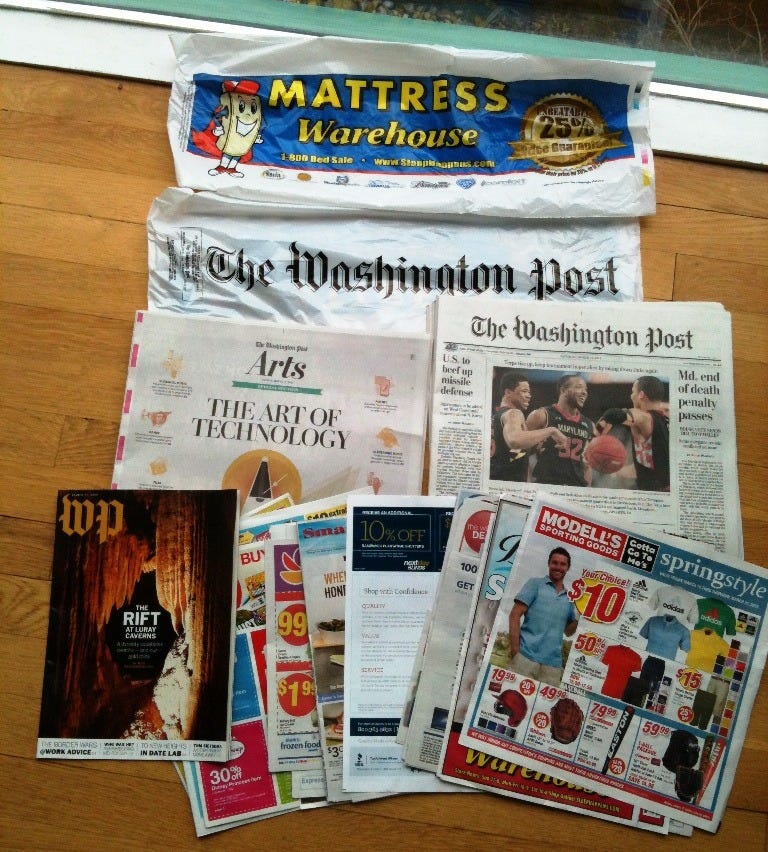
Inside the bundle:
The Washington Post itself—four sections: the main newsbook (national and international news, 16 pages), Metro (6), Style (6), Sports (8). Total: 36 pages.
Regular commercial supplements: Real Estate (12), Cars (10).
Saturday supplements: Arts (8), Travel (8), Sunday Style (10), Kids Post (4), Comics (8, complete with its own folded super cover!).
WP Magazine, the weekend glossy-lite (32 + 4 pages).
Fourteen (!) coupon booklets.
All packed into a branded The Washington Post bag.
And then slipped into an additional mattress-store promotional sleeve.
And that was the year when Jeff Bezos bought The Washington Post and expected to be its savior. The paper was already in crisis, and yet the power of the brand and market inertia still made its subscription weekend bundles densely packed with supplements.

Most of it, of course, went straight to the recycling bin. But coupons—even when almost always thrown away—actually worked for all parties involved: local businesses, local residents, and especially local newspapers.
The loss of coupons and classifieds delivered the first and most devastating blow to newspapers, inflicted by the internet.
In the 2000s, Craigslist siphoned off nearly the entire classifieds business by offering consumers a better platform, free or freemium. In 2000, at the tail end of the news industry’s golden age, US newspapers generated nearly $20 billion from classifieds alone—about one third of total industry revenue. By 2018, newspaper classifieds had fallen to $2.2 billion. Roughly $17 billion was wiped out of the print ecosystem and reassembled as a more efficient online service, which has lately declined as well.

Coupons followed a similar trajectory. Groupon built a more convenient marketplace for local deals. But Groupon required deep discounts from businesses and took its own cut, a model that ultimately proved inefficient for local businesses.
Yet the underlying demand never disappeared. Local coupons, promotions, and discounts remain a vital marketing tool for neighborhood businesses. The newspaper channel collapsed. Digital platforms underdelivered or over-extracted. So businesses improvised. They found a solution… in print. But without newspapers—and with mailbox delivery instead
My Toronto mailbox can fill with 3-5 local flyers on busy days: restaurants, dentists, appliance repair, real estate brokers, pizzerias. People complain about junk mail, but local businesses need precise local reach, and Canada Post needs the revenue. Direct mail offers targeting without algorithmic gatekeepers—crude, but effective.

This print-and-delivery “newspaperless” infrastructure gets even more interesting. Local politicians now produce their own micro-newspapers and micro-magazines, dropping them directly into mailboxes—not just during campaigns, but around holidays or major municipal events, simply to stay visible. These leaflets blend the functions of local press and party press, a hybrid propaganda format wrapped in neighborhood updates, echoing how the party press evolved two centuries ago.

So yes, Craigslist and Groupon gutted the classified and coupon cash cows in the news media, launching the newspaper death spiral 15–20 years ago. But the function of local business targeting survived. The demand for local classifieds and promos outlasted the digital platforms—and even circled back to print. Just without the newspapers.
See also books by Andrey Mir:
The Viral Inquisitor and other essays on postjournalism and media ecology (2024)
Digital Future in the Rearview Mirror: Jaspers’ Axial Age and Logan’s Alphabet Effect (2024)
